Your cat drools. Now what? If you are asking why is my cat drooling, the short answer is that a little clear drool while your cat purrs or kneads is normal. Other than that, there is not much reason for your cat to drool — and if there is, it is cause for concern. New, constant, smelly or blood-tinged drool is not normal. It usually means pain inside the mouth, nausea, a toxin or heatstroke.
This guide covers the whole picture: what normal cat drool looks like, why hidden dental disease is the odds-on answer in an adult cat, a four-tier triage table keyed off what the saliva itself looks and smells like, the 24-hour line that decides whether you call today, the ten minutes that matter after a poisoning, the one condition the “happy drool” reassurance fails, and what your vet will actually do.
Do Cats Even Drool Normally — And Why You Noticed It
Cats are not drooly animals. Dogs leave puddles; cats generally do not. That is exactly why a wet chin registers as alarming — and why your instinct to look it up is usually the right one.
What hypersalivation (ptyalism) actually means
The clinical terms are hypersalivation and ptyalism. Both describe excess saliva escaping the mouth, and there are only two ways to get there: your cat is producing more saliva than normal, or your cat cannot comfortably swallow the normal amount. That second route is the one owners miss, because it points straight at pain rather than at the glands.
The purr-and-knead drool: thin, clear and short-lived
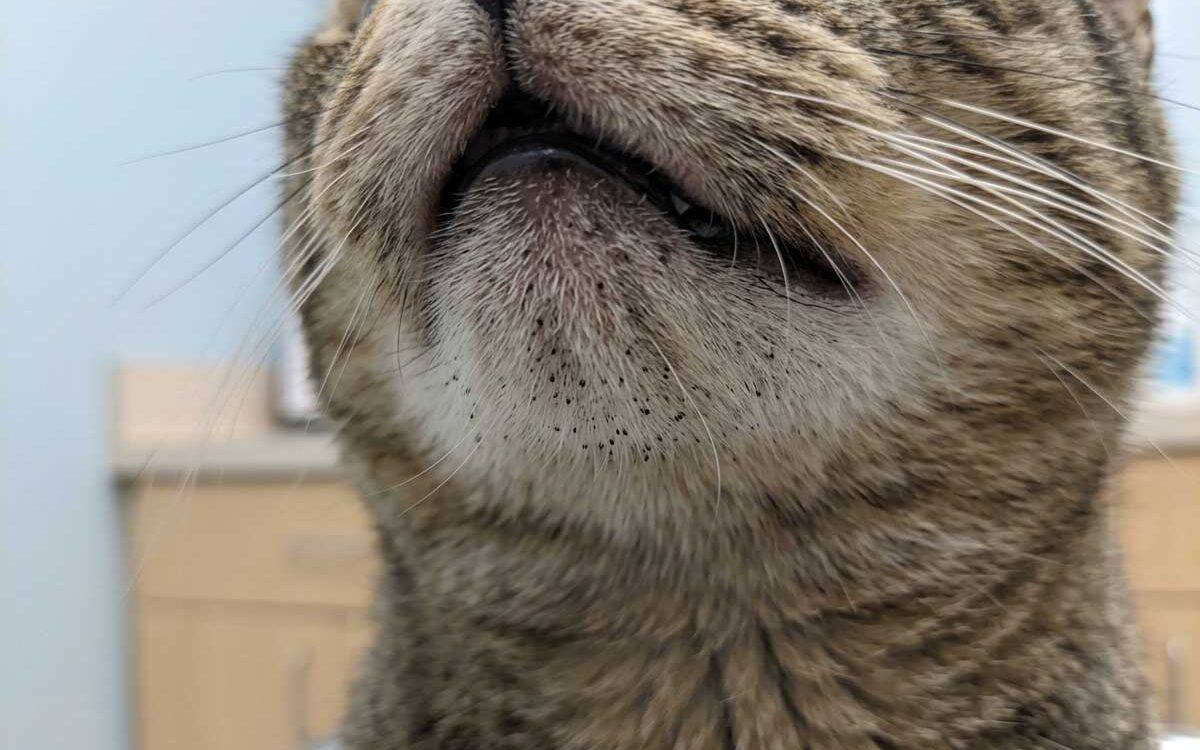
Purring, kneading, deep sleep and being petted are all thought to trigger an endorphin release that stimulates salivary flow. The result is drool that is thin, clear and slightly stringy. It is transient, and it stops when your cat gets up and walks away.
It is context-linked and self-limiting. Context-linked means the salivation happens with a particular stimulus and looks the same every time. Self-limiting means the volume is small and it does not run on. Between bouts, your cat is grooming, eating and behaving perfectly normally.
Why cat drool worries owners more than dog drool
Each cat has its own individual normal. Some have always left a small wet mark on a jumper during a lap session, and others never drool in twelve years. So the right question is not “do cats drool?” but “is this new for my cat?”
“It means your cat is relaxed and happy” is the reassurance most owners meet first. It is true for a minority of cases, and it is offered to everyone — which is how painful dental disease goes uninvestigated for months at a time.
The Real Reason Most Adult Cats Drool: Pain Inside the Mouth
If you are asking why is my cat drooling and your cat is a full-grown adult, the most common answer is mouth pain — specifically, painful dental disease you physically cannot see. Not a mood. Not a quirk. Disease, inside a mouth your cat will not let you examine properly, and that a quick lip-lift cannot rule out.
Gingivitis, periodontitis and tooth resorption: the odds in plain numbers
According to the Cornell Feline Health Center, the three most prevalent feline dental diseases are gingivitis, periodontitis and tooth resorption. Tooth resorption is the one whose numbers get quoted least often.
According to Cornell, tooth resorption — feline odontoclastic resorptive lesions — affects an estimated 20 to 60 percent of all cats, and close to three-quarters of cats aged five years and older. Tooth resorption is the most common cause of tooth loss in cats.
If your cat is five years of age or older, the base rate of a painful resorptive lesion sitting in that mouth is roughly three in four.
Why a visual look in the mouth misses it — and what radiographs find
You cannot confirm this at home, and your vet cannot confirm it with a torch either. Cornell is specific: tooth resorption is best confirmed by full-mouth intra-oral dental radiographs, and the only effective treatment is extracting the affected teeth. Lesions start beneath the gum line and at the root of the tooth, so a lifted lip would show nothing.
Other causes live in the same bucket and behave the same way — hidden, painful, drool-producing: oral ulcers, a tooth root abscess, a foreign object wedged under the tongue or between two teeth, and oral tumours including squamous cell carcinoma.
The tell-tale companions of dental drool
- Bad breath, the truly foul kind, not just fishy
- Food being dropped, or your cat chewing on only one side
- Your cat pawing at their face, or rubbing their mouth on your furniture
- Your cat approaching their bowl, and then backing away
- Your cat slowly losing weight, with a less well groomed coat
Why is my cat drooling but still eating and acting normal?
Cats are hardwired to hide pain in the mouth. It is why they keep eating, purring and greeting you at the door — and why the only outward sign may be a little drool. Survival for a small predator never rewarded showing weakness, and that instinct has not been bred out.
So when your cat drools and people say “he seems fine”, it does not mean the mouth is fine. Not at all. It means your cat is a cat. New drool plus bad breath in a cat that is five years or older means a dental appointment, not a new personality.
One group of these droolers deserves its own discussion: feline chronic gingivostomatitis. That gets its own section below.
Read the Saliva: A Four-Tier Triage Table for What to Do Now
Before a vet sees your cat, you have exactly three pieces of data: what the drool looks like, what it smells like, and what else your cat is doing. That is enough to sort yourself into one of four answers — do nothing, book an appointment, call today, or drive now.
| Tier | What the drool is like | What else you see | Likely cause | What to do |
|---|---|---|---|---|
| 1 | Clear, thin, stringy; small volume; only while purring, kneading, dozing or being petted, and it stops when your cat gets up | Nothing. Eating, grooming and behaviour all normal | Endorphin-linked relaxation drool | No action. Note it as your cat’s baseline |
| 2 | Clear but constant or repeated, not tied to any trigger | Bad breath, dropping food, pawing at the face, chewing on one side, gradual weight loss | Dental or oral pain — gingivitis, periodontitis, tooth resorption | Book a vet appointment within days and ask for an oral exam with dental radiographs |
| 3 | Foul-smelling, blood-tinged, brown-stained, or with a visible lesion, ulcer or lump in the mouth | Crying while eating, refusing food, drooling in sleep, obvious facial discomfort | Advanced oral disease, abscess, severe stomatitis or an oral tumour | Same-day exam. Call this morning, not next week |
| 4 | Foamy, frothy or profuse — appearing suddenly | Twitching, tremors, seizures, heavy panting, wobbliness, collapse, or known exposure to a plant, chemical or dog flea product | Toxin, permethrin exposure, heatstroke or a neurological event | Emergency. Go now, and phone on the way |
The 24-hour rule: drooling plus not eating is a same-day call
Most advice stops at “see a vet if the drooling is excessive,” which is almost impossible to act on, because owners cannot easily judge what counts as excessive. Here is a line you can actually hold a decision against:
- Drooling that has run continuously for more than 24 hours — same-day call.
- Any drooling in a cat that has not eaten for 24 hours — same-day call.
The second one is not arbitrary. Veterinary guidance on inappetence treats a cat that has stopped eating for 24 to 72 hours as a medical emergency rather than a wait-and-see, because hepatic lipidosis — fatty liver disease — can develop rapidly once a cat stops taking in food. A cat that has not eaten in more than 24 hours should be seen, and that is particularly true alongside signs of pain, lethargy or any of the other behaviours listed here.
That is the real cost of waiting a week. A treatable dental problem becomes a dental problem plus a liver problem, and the liver problem is the one that fills hospital cages.
Red flags that move your cat up a tier
Look for the following in addition to the table: halitosis, blood or foam in the saliva, pawing at the face, dropping food, weight loss, lethargy, not eating, vomiting, difficulty breathing, hiding, and crying while eating. Any one of these means you need to move your cat up at least one tier.
One exception: if you suspect a toxin or a flea product is involved, skip the table and go to the poisoning section below.
What Else Makes a Cat Drool: Stress, Nausea, Toxins, Heat and the Rare Causes
The mouth is the biggest bucket, not the only one. The rest have a story attached — a journey, a pill, a hot afternoon, a sneezing week. Dental drool tends to arrive with no story at all. It just started.
Can stress or anxiety make a cat drool?
Yes. Think of the situations that make a cat feel frightened or cornered: the carrier, the journey, the waiting room, fireworks, an unwanted encounter with a new animal in the house. Stress-related drooling comes with other signs of anxiety — panting, flattened ears, hiding, vocalising — and it usually stops or lessens once the stressful situation is removed. If a cat stops drooling the moment the carrier door opens at home, that is an answer.
Nausea and drooling before vomiting
Drooling is a classic pre-vomit sign and can be caused by motion sickness, hairballs, dietary upset, gastrointestinal disease or problems with the kidneys. Lip-smacking and repeated swallowing usually come first, then the drool, then the vomiting. The same is true in other pets — it is the same reflex sequence described in our guide to why a dog is throwing up — but in cats, repeated vomiting alongside drooling is worth blood work rather than a wait.
Foaming at the mouth after medication
Some tablets and liquids taste very bitter, and some dewormers cause dramatic foaming within a minute or two of being given. It is alarming to watch. It is usually benign and resolves on its own in 10 to 20 minutes — the taste, not a reaction. If it is not resolving on its own, or your cat is otherwise unwell with it, call the practice that dispensed the medication.
Cat flu, mouth ulcers and painful swallowing
Upper respiratory infection — cat flu — and feline calicivirus cause ulcers on the tongue, gums and palate. Swallowing hurts, so saliva simply runs out of the mouth. Other signs include sneezing, a reduced appetite and a runny eye and nose over the same few days (similar to us getting the flu).
Heatstroke, seizures and rabies: the urgent and the rare
Drooling with heavy panting after time in a hot car, conservatory, greenhouse or unventilated room is heatstroke, and it is a medical emergency. Call your vet and start cooling your cat while you travel.
Drooling with twitching, collapse, paddling limbs, disorientation or loss of awareness points at a seizure or another neurological cause. Drooling with repeated gulping, gagging or food coming straight back up points at a swallowing problem — a foreign body, an oesophageal issue or a growth in the throat. There are many possible causes of drooling in cats, from a lodged foreign object to seizures and cat flu, and the PDSA keeps a comprehensive list of them.
Rabies is noted by petMD as belonging on the list for completeness, but it is genuinely rare and essentially irrelevant for a vaccinated indoor cat. In an unvaccinated cat with potential wild animal contact, it is important to consider it alongside behaviour change and difficulty swallowing. With suspected rabies, behave as if it is an emergency and do not handle the mouth.
Suspected Poisoning: What to Do in the Ten Minutes Before You Reach the Vet
This is the gap. Owners are often told to “contact a vet” and nothing more, but there are two poisons where the first ten minutes decide the outcome. If you are typing “why is my cat drooling” ten minutes after a flea-treatment mistake, read this before anything else on the page.
Dog flea treatment on a cat: wash it off now
One of the more serious cat poisonings is caused by dog flea treatments. Permethrin, the insecticide in many dog flea products, is highly poisonous to cats. The PDSA states that there is a high risk of poisoning, mostly due to accidental application of a dog’s spot-on treatment to a cat, or a cat grooming a recently treated dog. The signs of poisoning include drooling, twitching and seizures. If untreated, permethrin poisoning is usually fatal to cats.
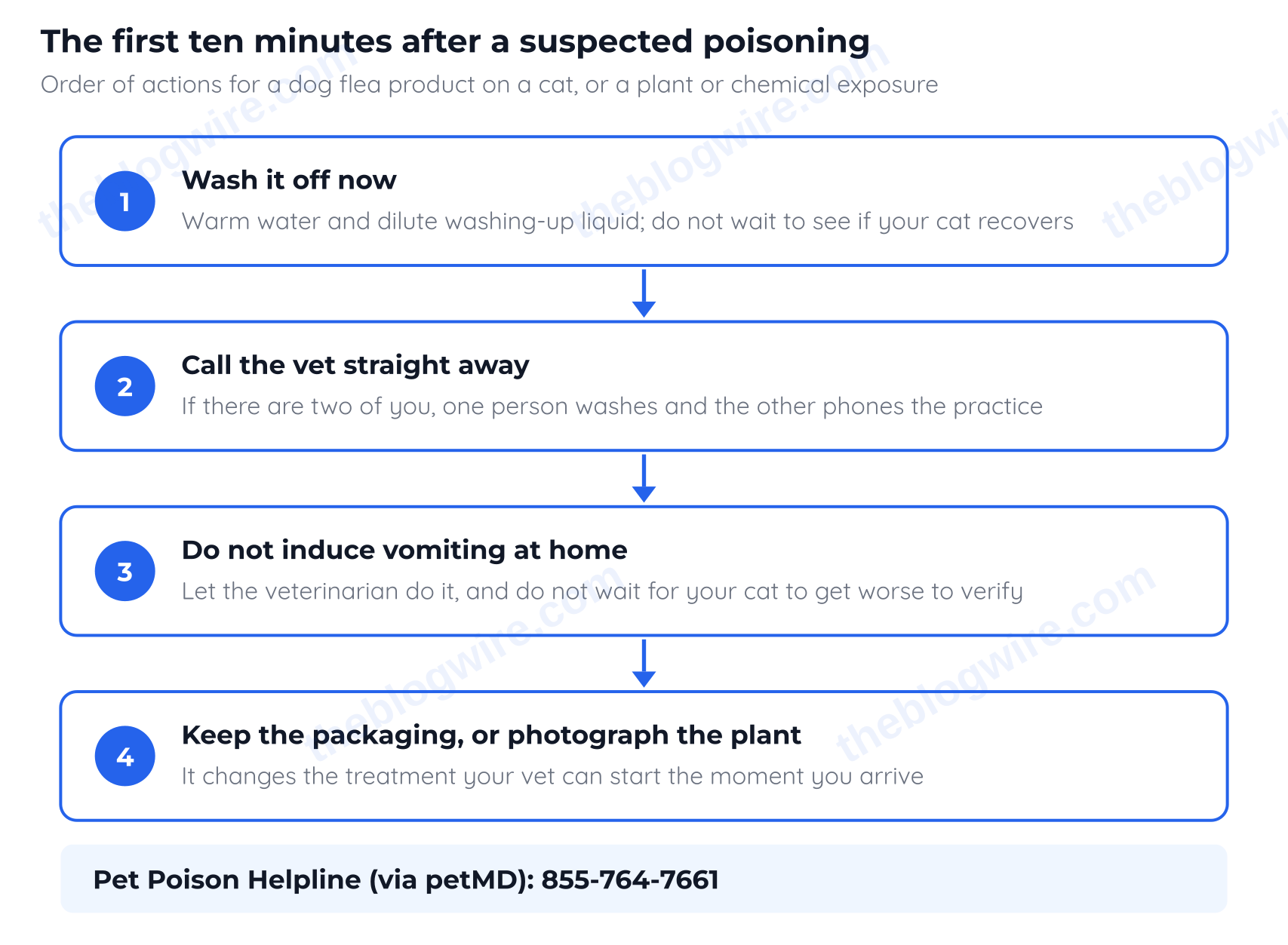
What the PDSA says to do is to wash the product off immediately with warm water and dilute washing-up liquid, and to call the vet straight away. If there are two of you, one person should wash and the other should call. Do not wait to see if the cat recovers.
Lilies and the other toxins worth a same-minute phone call
First, lilies. Lily exposure was the Pet Poison Helpline’s most common cat-related call of 2023, and both true lilies (Lilium species) and daylilies (Hemerocallis species) can cause kidney failure in cats. Pollen brushed onto a cat and then groomed off is enough. A single chewed leaf is enough.
Call it in immediately for human painkillers or any human prescription medication, antifreeze, rodent or slug bait, and household cleaners walked through on a wet floor and then licked off. petMD has the number for the Pet Poison Helpline on 855-764-7661 — use it rather than waiting it out.
What not to do while you wait
- Do not induce vomiting at home. Let the veterinarian do it.
- Do not wait for the cat to get worse to “verify” the exposure.
- Keep the packaging — bring it to the vet, or take a photo of the plant. It changes the treatment your vet can start on arrival.
Prevention here is unusually complete: keep lilies out of the house entirely, don’t store dog parasite products where your cat can get them and never use them on a cat, and put cleaning products away before your cat walks across a wet floor.
The Cats the “Happy Drool” Reassurance Fails: Feline Chronic Gingivostomatitis
This section is for a specific cat: drooling constantly rather than contextually, often a young or middle-aged adult, where a routine scale-and-polish is not the whole plan.
Feline chronic gingivostomatitis (FCGS) is an immune-mediated inflammation of the mouth. A clinical-management review published in PMC puts the estimated prevalence at 0.7 to 12 percent of cats, and states it is usually seen in young to middle-aged adults.
How FCGS drooling differs from ordinary dental drool
Drooling is listed in the review as one of the core clinical signs, along with halitosis (bad breath), bleeding from the mouth, eating difficulties, vocalising while feeding, weight loss, and reduced grooming. In clinical practice, the sign owners notice first is often that the cat has stopped grooming itself: the coat looks unkempt and matted along the back.
Full-mouth extraction: realistic success rates and the 1-in-3 who don’t respond
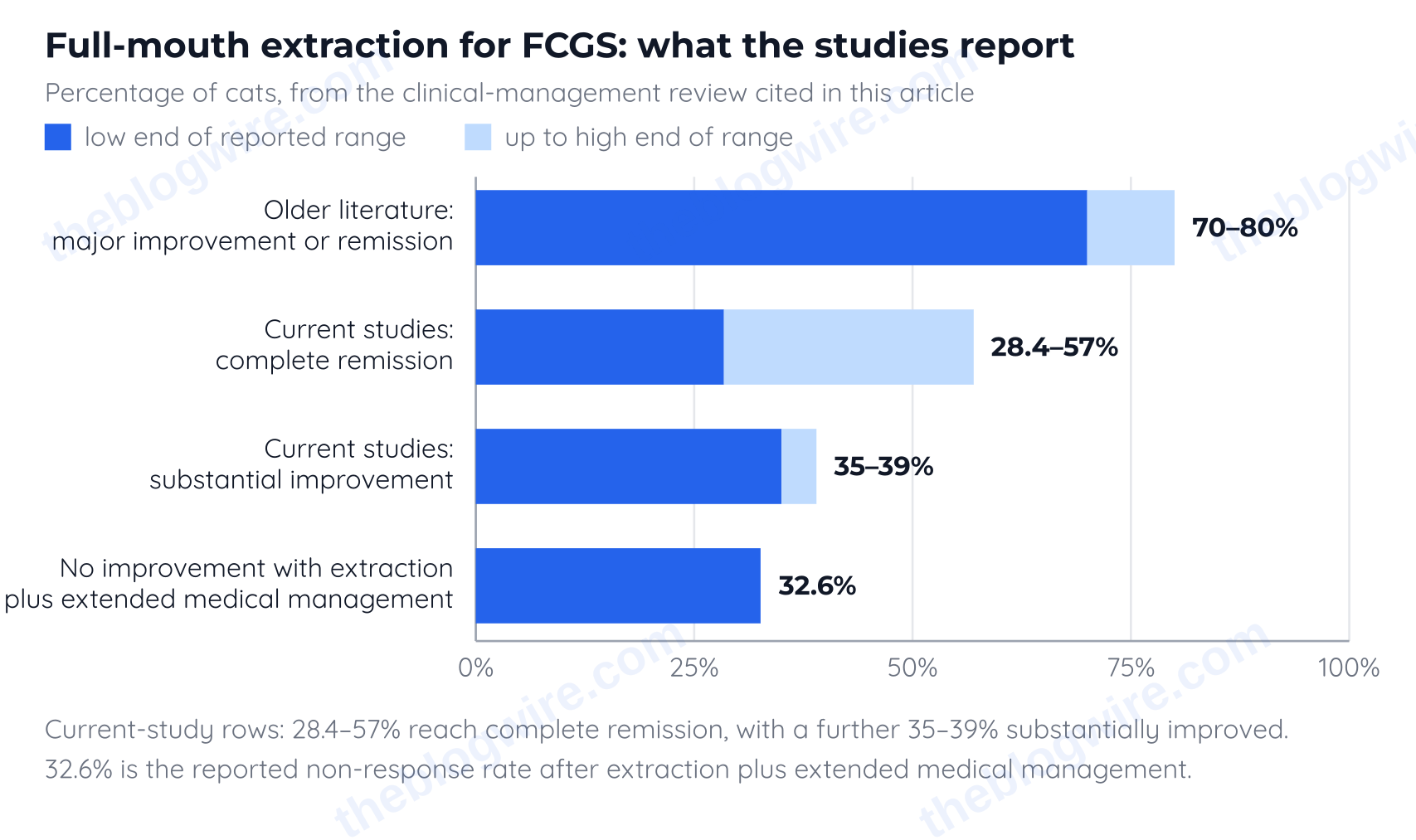
Treatment is comprehensive or full-mouth extraction. The same review notes that older literature put major improvement or complete remission at roughly 70 to 80 percent of cats, while also reporting that about 32.6 percent of cats do not improve with extraction plus extended medical management.
Honest numbers matter more than the optimistic ones. Current studies in that review put complete remission at 28.4 to 57 percent, with substantial improvement in a further 35 to 39 percent. One of the older single series noted 80 percent of cats significantly improved or clinically cured, and pages still quoting that older 80 percent figure alone overstate the certainty.
There is a second line. Mesenchymal stromal cell (stem cell) therapy is now documented in the clinical literature as inducing long-term remission in FCGS cats that have proved refractory to both extraction and drug therapy. The practical point is that an FCGS cat needs a vet who discusses the non-responder scenario before surgery, not after.
What Your Vet Will Do, and How to Stop the Drooling Coming Back
Knowing the order of events makes the appointment easier to sit through and the quote much less of a surprise.
Why the real exam usually needs sedation or anaesthesia
Expect a quick conscious look in the mouth first. As petMD mentions, a definitive oral evaluation in a painful cat usually requires sedation or general anaesthesia. This is not escalation; it is normal practice. A cat in pain will not hold still for the only exam that gives you the answer you need.
The step worth asking about by name is full-mouth intra-oral dental radiographs. This is what finds tooth resorption and root pathology that an awake exam cannot. Ask whether they are included in the quote before the day.
Alongside that, expect bloodwork for kidney and liver values and a hydration assessment, especially in an older cat or one that has gone off food. Likely interventions then follow the cause: scaling and extractions for oral disease, anti-nausea medication and diet work for gastrointestinal causes, decontamination and supportive care for toxins, active cooling and fluids for heatstroke, anticonvulsants or referral for seizures.
Why is my older cat suddenly drooling?
Because three separate risks all climb with age at once: cumulative dental disease, kidney disease, and oral tumours. A 10-year-old cat that has never drooled and has recently started doing so would be given a more immediate appointment than a 2-year-old that has the same symptom. Aging is not a reason to do nothing. It is a reason to do something.
Dental home care and the annual oral exam
- Brush your cat’s teeth daily or near daily, introduced gradually with a cat-specific paste. This is the biggest preventive measure you can take.
- Consider vet-approved dental diets and chews as a complement to daily dental care, not as a substitute for brushing.
- An oral exam at every annual check-up — twice yearly once your cat is over ten.
- Dentals done when they are recommended, rather than deferred to the next visit and the next.
- Household controls: never leaving a cat in a car, conservatory or sunroom; no lilies indoors; dog parasite products out of the house; and all medication closed away.
One last thing. Record what you saw — volume, colour, smell, how long it lasted, what your cat was doing at the time — ideally with a phone video. The detail will help your veterinarian more than any description you will manage to give from memory in a consult room.
The answer to why is my cat drooling usually splits in two. A small amount of clear drool while your cat purrs on your lap is likely nothing. Newly produced, constant, foul-smelling, bloody or foamy drool, however, is a message from a mouth your cat cannot show you — and in an adult cat, the most likely cause of this is hidden dental disease, rather than just relaxation. Check the triage table against what you are actually seeing. If the drooling has lasted longer than 24 hours, or your cat has not eaten in 24 hours, call your vet today and ask for an oral exam with full-mouth dental radiographs. If a flea product or a plant is involved, wash and call now.
Rule of thumb: drool with a trigger that comes and goes is a cat; drool with a smell, or drool that won’t stop, is a mouth — and a mouth needs a vet.