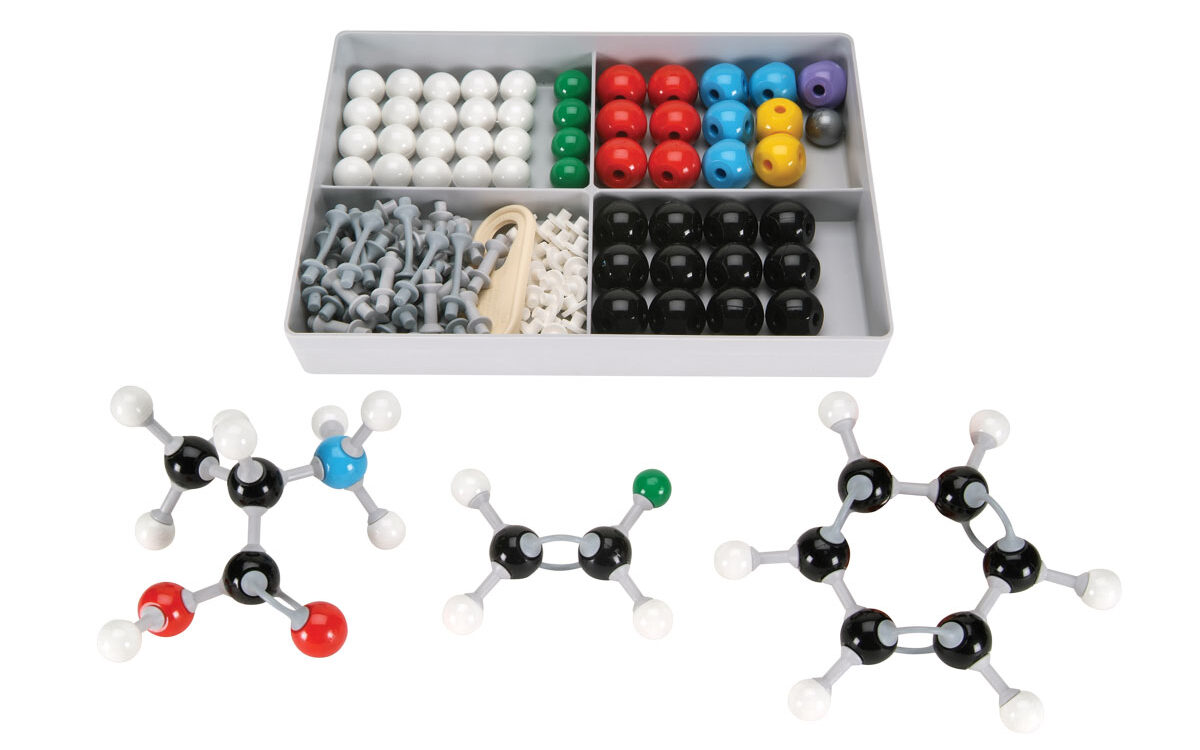
Linus Pauling found that an electronegativity difference of 1.7 is the dividing line between ionic vs covalent bonds. According to Wikipedia’s chemical polarity article, when the difference in electronegativity is 1.7, the bond is about 50% ionic. With differences less than 1.7, atoms share their valence electrons. With differences greater than 1.7, the more electronegative atom is considered to be taking the electrons outright. This makes an anion, and the less electronegative atom loses the electrons, becoming a cation.
Of all the differences between covalent and ionic bonding, this one is the most important and drives all the others. Ionic bonds occur when a metal loses its valence electrons and forms a cation, and a non-metal gains those valence electrons, and becomes an anion — the two oppositely charged ions are then stuck together by electrostatic attraction. A covalent bond shares electron pairs instead, because neither atom pulls hard enough to win them. Ionic bonding typically shows up between a metal and a nonmetal; a covalent bond may occur between two non-metals. Everything else on this page — lattices versus molecules, high melting points versus low, conducting in water versus not — follows from that difference.
What is the main difference between ionic and covalent bonds?
The short answer in one sentence
In an ionic bond, electrons are transferred from one atom to another. In a covalent bond, electrons are shared by the atoms. That sentence is the one to put on a worksheet.
In sodium chloride, sodium loses its single 3s electron to chlorine. This results in a +1 sodium ion and a -1 chloride ion, and the bond is simply the pull of attraction between those two charges. In hydrogen, methane and water, there is no transfer of electrons. In those compounds, the hydrogen and the other atom share pairs of electrons. Chemistry LibreTexts defines the two exactly this way: complete transfer on one side, shared pairs on the other, with sharing happening when the atoms’ electronegativities are similar enough that neither preferentially attracts the electrons.
Why atoms bond at all: the octet rule
Both bond types happen to satisfy the octet rule. Each atom is trying to reach a stable noble-gas electron configuration. Transfer and sharing are just two routes to the same destination, and which route an atom takes is decided by the electronegativity difference between the two partners, measured on the Pauling scale.
Worth answering here because it trips people up constantly: water is composed of covalent bonds. The bonds that bond hydrogen to the oxygen in water are polar covalent, not ionic. Water dissolves ionic compounds beautifully, but that is a consequence of its polarity, not evidence that it contains ions.
Ionic vs covalent bonds compared side by side
The comparison table
| Property | Ionic bond | Covalent bond |
|---|---|---|
| Bond mechanism | Valence electrons transferred; cation and anion attract electrostatically | One or more electron pairs shared between the atoms |
| Elements involved | Metal + nonmetal (or a polyatomic ion) | Nonmetal + nonmetal |
| Electronegativity difference | Large (commonly above 2.0 on the Pauling scale) | Zero to moderate (below about 1.6) |
| Structure | Extended 3D crystal lattice; no discrete molecules | Discrete molecules with definite geometry |
| Melting point | High | Low (for molecular covalent compounds) |
| Boiling point | High | Low |
| State at room temperature | Solid | Often liquid or gas — but this row is unreliable: sugar, iodine and diamond are all covalent solids |
| Hardness and shape | Hard and brittle; no definite molecular shape | Softer; definite molecular shape and bond angles |
| Electrical conductivity | Conducts when molten or dissolved in water | Generally does not conduct |
| Solubility | Dissolves in polar solvents such as water | Dissolves in nonpolar or organic solvents such as alcohol and acetone |
| Typical examples | NaCl, NaF, MgO, KBr, NH4Cl | H2, O2, HCl, H2O, CH4, CO2, sucrose |
The table shows state at room temperature as the weakest link. Most of the versions of this table show covalent compounds as liquids and gases and then a few lines down give example of sugar as a covalent compound and sugar is in your kitchen as a solid. If you need to classify a real sample, you may skip state at room temperature and test conductivity instead, melt it or dissolve it in water and see if the solution carries a current.
Naming and formula conventions that differ
There are different naming conventions as well which is often a quick tell on an exam. Binary ionic compounds are named cation first followed by the anion with an -ide suffix. Examples are: NaCl (sodium chloride), MgO (magnesium oxide), KBr (potassium bromide). Covalent molecular compounds use Greek prefixes to denote the number of atoms in the compound. Some examples are CO2 (carbon dioxide), CO (carbon monoxide), N2O4 (dinitrogen tetroxide). If a compound’s name needs a prefix, it is almost certainly a molecule.
How can you tell if a compound is ionic or covalent?
The four-step classification rule
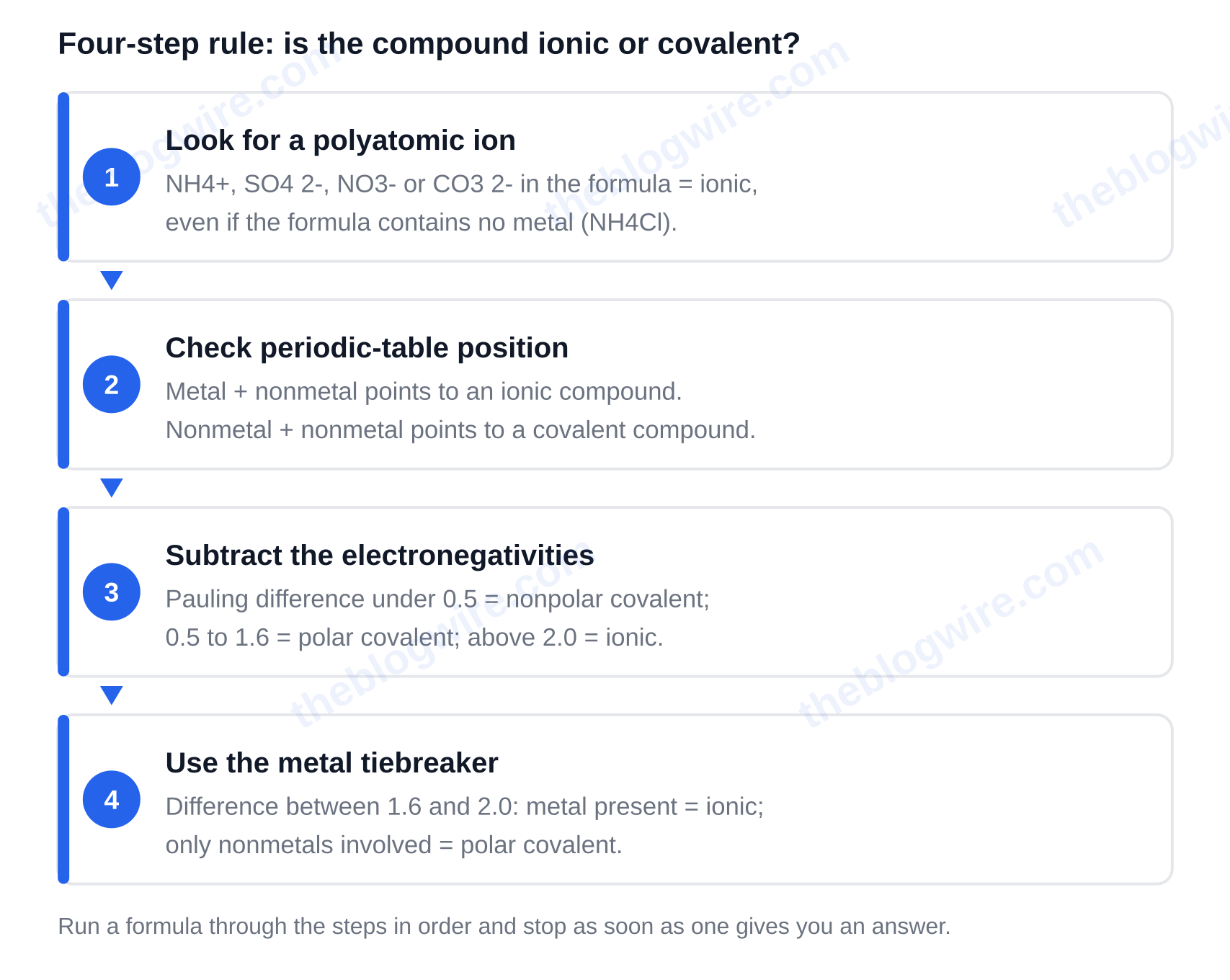
There is a four-step classification rule to classify a compound as ionic or covalent. Most explainers skip this part. This is the part you should focus on. Run a formula through all four of these steps in order and stop as soon as one gives you an answer.
- Look for a polyatomic ion. If you see NH4+, SO4 2-, NO3-, CO3 2- or similar, the compound is ionic, even if the formula contains no metal.
- Check periodic-table position. If a metal combines with a non-metal it points to an ionic compound. A non-metal combining with a non-metal points to a covalent compound.
- Subtract the electronegativities. Deduct the electronegativities and apply the cutoffs below to the bond in question.
- Use the metal tiebreaker for borderline cases. If the difference is between 1.6 and 2.0, and a metal is present, call it an ionic bond, and if only nonmetals are involved, say it is a polar covalent bond.
Electronegativity cutoffs (and why textbooks disagree)
There are some cutoff differences between various textbooks, and here are the working numbers from ChemTeam’s bond-type classification page. A Pauling difference less than 0.5 is classified as a nonpolar covalent bond, from 0.5 to 1.6 is classified as a polar covalent bond, and more than 2.0 is classified as an ionic bond. Some textbooks say the ceiling for a polar covalent bond is 1.7, and Pauling’s own benchmark was that 1.7 roughly corresponds to about 50% ionic character, with polar bonds spanning roughly 0.5 to 2.0.
So, as mentioned previously, there is no correct, official cutoff, and you should not consider this a mistake in your understanding. Use the cutoffs given in your textbook, and keep in mind that the gap between 1.6 and 2.0 is where the metal tiebreaker comes into play.
Worked examples: classifying NaCl, H2O, CH4 and NH4Cl
NaCl, NaF, MgO and KBr are ionic — metal plus nonmetal, large gap, no ambiguity. H2 and O2 are nonpolar covalent, since identical atoms give a difference of zero. HCl, H2O and CH4 are covalent, with HCl and the O-H bonds in water sitting in polar covalent territory. CO2 and sucrose are covalent. NH4Cl is ionic, and it contains no metal at all — step 1 catches it, step 2 would get it wrong.
Where the metal-plus-nonmetal rule breaks down
This rule commonly appears as a flat fact in almost every source covering this topic. In practice it breaks down in two directions, both of which show up on tests.
Metal + nonmetal that acts covalent: AlCl3, BeCl2 and Fajans’ rules
Both AlCl3 and BeCl2 are metal-plus-nonmetal compounds that contain large amounts of covalent character. The reason is polarization. Al3+ and Be2+ are small and highly charged, therefore they polarize the big, squashy electron cloud of a chloride ion badly enough that the electron density ends up shared rather than handed over. This explains Fajans’ rules. With increasing charge on the cation, the character is more covalent, it falls with increasing cation size, and it rises with increasing size of the anion. This gives the order NaCl < MgCl2 < AlCl3 < SiCl4.
Nonmetal-only compounds that are ionic: NH4Cl
Ammonium chloride shows us the other breakdown. There is no metal in NH4Cl, therefore it is a nonmetal only compound. It is also ionic because the bond that connects NH4+ to Cl- is purely electrostatic. All bonds inside the ammonium ion are covalent. It contains both types of bonds, so it is also why checking for polyatomic ions is the first step.
Why no bond is purely ionic
The true reason these boxes merge: a polar bond is, quantum mechanically, a mixture. A polar molecule AB is described as a linear combination of a covalent and an ionic wavefunction — psi = a*psi(A:B) + b*psi(A+B-) — with the squared coefficients deciding how much ionic and how much covalent character the bond actually has. “Complete transfer” is a limiting case, not a real case.
Because of this, Pauling could assign a percentage of ionic character in the first place, and why a compound sitting near any cutoff gets classified differently by different authors. Real bonds run along the continuum, from nonpolar covalent to polar covalent to ionic. The main point: check for polyatomic ions first, and assume covalent character when seeing small, high charge, cations.
Which bond is stronger, ionic or covalent?
Lattice energy vs bond dissociation energy
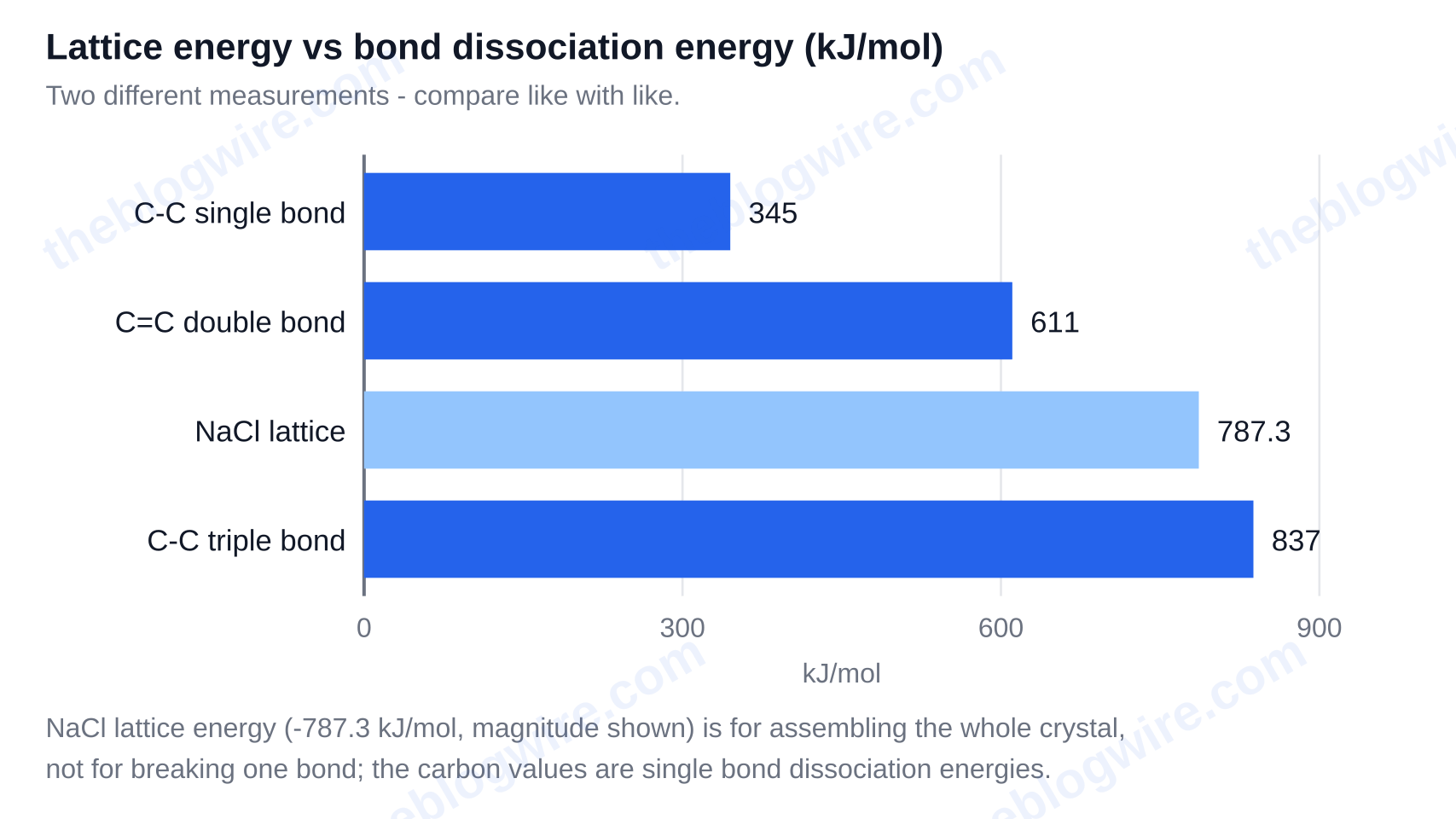
The usual case: ionic bonds are stronger, compares two different things. The number people reach for is lattice energy. Purdue’s chemical education site puts the lattice energy of NaCl at -787.3 kJ/mol, and this is the energy released when the entire NaCl crystal, made of alternating Na+ and Cl- ions, assembles from gas-phase ions. It is not the energy to break 1 bond.
Set it against single-bond dissociation energies and the mismatch is obvious: a C-C single bond runs about 345 kJ/mol, a C=C double bond about 611 kJ/mol, and a carbon-carbon triple bond about 837 kJ/mol — more than NaCl’s whole-lattice figure. The rule that actually works is boring and reliable: compare lattice energy to lattice energy, and bond dissociation energy to bond dissociation energy.
Why ionic compounds melt at higher temperatures
Ionic solids still win decisively on melting point, for a structural reason rather than a per-bond one. Because a lattice has no discrete molecules to separate, it must be broken up into its entire charged network to be melted. On the other hand, a covalent molecular solid only requires that the intermolecular forces be broken; the molecules themselves survive intact. As for conductivity, this is pretty straightforward; melt or dissolve an ionic compound and you free mobile ions that can conduct, while covalent molecules go into solution neutral and whole.
Where each bond type shows up in the real world
Why life runs on covalent bonds
Covalent bonding dominates organic chemistry and living systems. Nearly every carbon compound — methane, sugars, fats, proteins, the DNA backbone — is held together by shared electron pairs. Polarity then does the rest of the work: the dipole moment created by water’s polar O-H bonds makes it a powerful polar solvent, which is precisely why a covalent liquid is so good at dissolving ionic salts. On the ionic side, the everyday list is short and familiar: table salt, magnesium oxide in refractory bricks, the electrolytes in a battery or a sports drink, and molten-salt electrolysis in industry.
Metallic bonding: the third bond type
Add a third category so the comparison doesn’t feel like a clean binary. Metallic bonding occurs when cations are arranged in a lattice structure and surrounded by a shared sea of delocalized electrons. This is why metals conduct electricity in the solid state and bend instead of shattering. Ionic, covalent, and metallic bonding are three regions of the same bonding landscape, not three different worlds. And diamond and silicon dioxide are large covalent networks, the standing reminder that the rule “covalent means low melting point” applies to molecular covalent compounds only.
Use the classification rule, not the slogan
There is one main difference between ionic vs covalent bonds, which is transfer of electrons versus sharing of electrons. And the table follows from that. Lattices vs. molecules, high melting points vs. low, conduct electricity when dissolved vs. do not conduct electricity. The part worth remembering is these are two ends of a continuum. This is why borderline compounds like AlCl3 and NH4Cl need the four-step rule rather than the slogan.
The next step is taking ten formulas from your own problem set and running each through the rule — polyatomic ion, then periodic-table position, then electronegativity difference, then the metal tiebreaker — and check the cutoffs against the ones your textbook prints.
Remember the rule of thumb: metal or polyatomic ion means transfer, and nonmetals only means sharing. There’s plenty more to dig into on The Blog Wire.
Quick Answers
Why do ionic compounds conduct electricity when dissolved in water but covalent compounds usually do not?
Conduction requires charged particles that can move. Ionic compounds lose their crystal lattice structure when dissolved or melted, and free Na+ and Cl- type ions are released to migrate toward the opposing electrodes and carry current. In the case of sugar or methane, covalent compounds, they dissolve as whole neutral molecules. Nothing is migrating to conduct. The easiest benchtop test for an unknown sample is to dissolve or melt it and check for conduction. You don’t need to guess if the sample is a solid, liquid, or gas.
What electronegativity difference makes a bond ionic rather than polar covalent?
There is no exact, agreed number. Be aware of this before a test. ChemTeam’s working cutoffs are under 0.5 for nonpolar covalent bonds, 0.5 to 1.6 for polar covalent bonds, and above 2.0 for ionic bonds. Some textbooks consider the ceiling of the polar covalent region to be 1.7, and Pauling stated that a difference of 1.7 roughly reflects 50% ionic character. So, for a difference between 1.6 and 2.0, use the tiebreaker: if a metal is included, treat the bond as ionic, and if only nonmetals are included, treat it as polar covalent. Quote the cutoffs your own course uses.
Can a compound be ionic if it contains no metal?
Yes. NH4Cl (ammonium chloride) is an ionic compound that contains no metal at all. The bond between the ammonium ion (NH4+) and the chloride ion (Cl-) is an electrostatic (ionic) bond, and the four N-H bonds inside the ammonium ion are covalent bonds. Similar compounds, ammonium nitrate and ammonium sulfate, also follow this pattern. When classifying an unknown compound, the first thing that should be checked is whether there is a polyatomic ion, not the periodic table. The metal plus nonmetal rule misses these types of compounds entirely.
Why does sugar dissolve in water if it is a covalent compound?
Polarity determines solubility, not bond type. Sucrose is covalent, but it is covered in polar O-H groups. When polar groups are present, hydrogen bonds form with water molecules just as readily as water bonds with itself, and it is dissolved. The sugar separates into individual neutral molecules that are spread out in the solution. Unlike sugar, when salt dissolves, it separates into ions, and the solution conducts electricity, while sugar separates into molecules and the solution does not. Sugar is also a good reality check on comparison tables that list covalent compounds as liquids or gases. Sugar, iodine and diamond are all covalent solids at room temperature.