

To define covenant in the Bible: a covenant is a binding agreement of commitment and faithfulness between two parties, typically between God and his people. It carries promises, obligations, and consequences if either side breaks faith. The Hebrew word for covenant is berith; the Greek word is diatheke.
You can read the Bible as a rule book, or as a love story. The word covenant represents the promise or commitment people made to one another, and it came with provisions and stipulations: if the conditions of the agreement were not upheld, there were usually consequences for that breach of faith.
Let’s look at a biblical example. In Genesis 15, God tells Abraham that he will give him and his descendants the land that he is camped on and promises that he will give him an heir. As proof of this covenant, God tells Abraham to bring animals, cut them in half, and lay the halves in two rows facing each other. He then puts Abraham to sleep and walks the path between them. God is telling Abraham that he will protect Abraham’s descendants and give them the land; he will uphold his promise, and if he doesn’t, he will suffer the consequences. This is a great example of a biblical covenant and how God is there to protect and provide for his people.
How do you define covenant in the Bible, and what did the word originally mean?
A covenant represents a binding, formal agreement between God and humans or between humans that stipulates a promise or instructs them to do or abstain from doing a certain activity. It has stipulations and obligations, and it brings privileges and responsibilities with it. BibleStudyTools’ Bible dictionary traces the English word from the Latin, con venire, which means “a coming together.”
Hold on to that picture. “A coming together” is a better mental image than a signed deal, because the point wasn’t the paperwork. It was the bond.
The Hebrew word berith and the Greek word diatheke
The same source says berith (also spelled beriyth) occurs approximately 280 times in the Old Testament, and its root is related to the word for cutting. As for the New Testament, the word diatheke occurs at least 33 times, and it means something like “to order or dispose for oneself.” The root of the word carries the idea of bequeathing or making a will rather than a negotiated bargain.
Since a will isn’t negotiated, but rather decreed by the will maker, the New Testament writers reached for diatheke to convey the idea that God creates the covenant rather than negotiating himself into it.
Why “a coming together” is a better mental picture than “a signed deal”
Scripture uses this one word for marriage, for treaties between kings, for friendship oaths, and for God’s dealings with Israel. One word covers a whole category of relationship. If your mental image is a contract, every one of those uses feels like a stretch. If your image is two parties bound together by oath, they all fit.
Why does the Bible say people “cut” a covenant?
Because that’s literally what the Hebrew says. The Hebrew phrase for “make a covenant” is karat b’riyt. It appears eighty times in the Hebrew Scriptures. The Ancient Hebrew Research Center says that in every single case it means “cut a covenant.” If you want to define covenant in the Bible by its action rather than its dictionary entry, start there.
What karat berit means and how the ritual worked
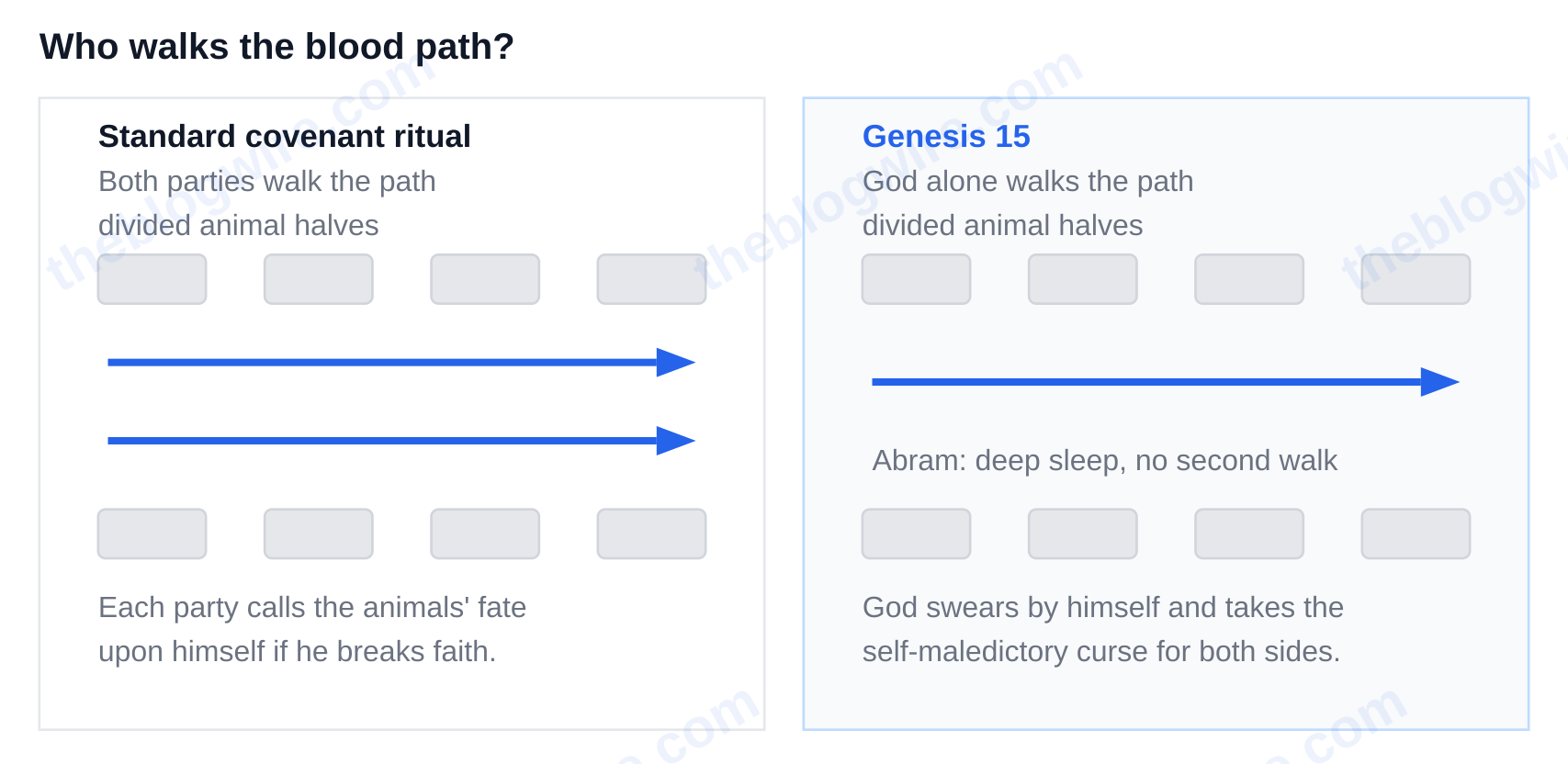
The ritual was plain and severe. The agreement was consummated when the parties took a fattened animal, cut it in two, laying the halves opposite each other. The parties then walked the path between the two halves as a ritual sign. The walk was the signature. The walk and the imagery signified: “Do to me what you are doing to that animal if I break faith.”
This was not experienced as mere symbolism. The stakes were life and death, and the imagery was in line with the agreement.
Why blood, and not ink, seals a biblical covenant
The major covenant ceremonies in Scripture are ratified by blood, and Jesus himself called the cup “my blood of the covenant” when he spoke at the Last Supper (Matthew 26:28). He used the oldest and most elementary language of covenant, and he explained nothing because it was self-evident to his audience. That language wasn’t invented centuries later by theologians reaching for a metaphor. We find covenant-cutting first in Genesis 15, and we’ll come back to it because it breaks one rule regarding covenants.
What is the difference between a covenant and a contract?
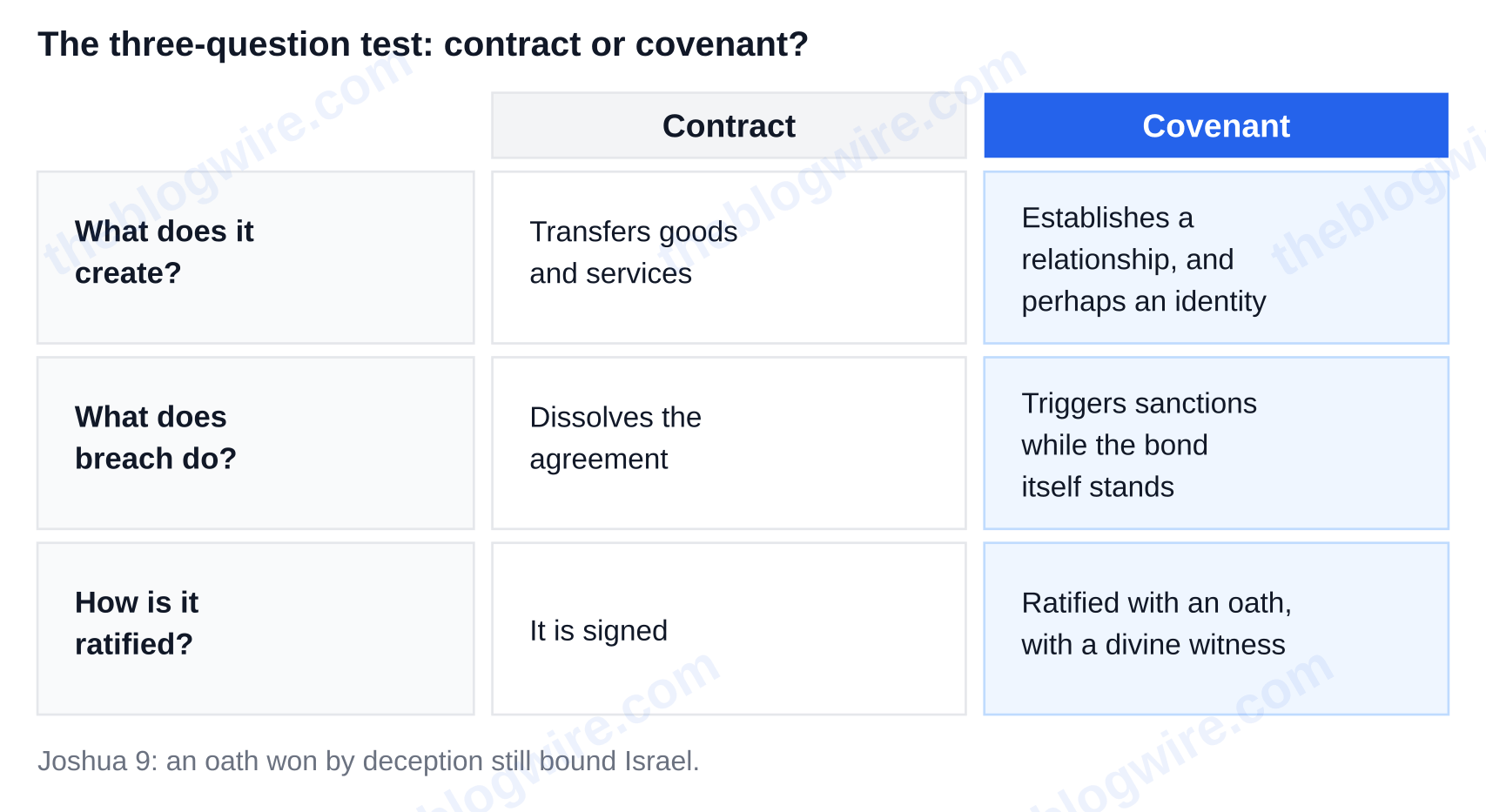
People often define covenant in the Bible by contrasting it with a contract. Rather than take the distinction on assertion, run any agreement through the following three questions:
- What does it create? A contract transfers goods and services. A covenant establishes a relationship, and perhaps an identity.
- What does breach do? Breach of a contract dissolves the agreement. Breach of a covenant does not; it triggers sanctions while the bond itself stands.
- How is it ratified? A contract is signed. A covenant is ratified with an oath, and a divine witness is called in to witness the oath.
Now let’s try this with the most difficult example from the Bible. In Joshua 9, the Gibeonites dupe the Israelites into a covenant by disguising themselves as travelers from a distant country. The Israelites swear the oath, then find out about the deception, and still keep the oath. Centuries later, when Saul breaks that covenant, God brings a three-year famine on Israel. A contract obtained by duplicity is null and void, and no one is obligated to perform. The famine does not make any sense under the contract theory, but perfectly under the covenant theory. There, the oath is binding not because the counterparty was fair, but because of who is witnessing the oath.
Lastly, consider a promise. A promise can be one-sided, and informal, and may not have any sanctions associated with it. A covenant is ratified, witnessed and carries sanctions. This distinction helps explain God’s responses to Israel’s waywardness in the Old Testament. Responses appear arbitrary if you look at them from a contract theory point of view, and perfectly explainable if viewed from a covenant theory point of view.
What are the major covenants in the Bible?
The backbone of the Bible consists of five covenants, made with Noah, Abraham, Moses and David, and fulfilled in Jesus. BibleProject describes them as the backbone of the Bible — God preserves the world through Noah, calls Abraham, forms Israel through Moses, promises David an eternal kingdom, and fulfills all of it in the new covenant through Jesus. Here are the five covenants side by side.
| Covenant | Parties | Core promise | Visible sign | Unilateral or conditional | Key text |
|---|---|---|---|---|---|
| Noahic | God with Noah and all living creatures | Never again to destroy the earth by flood | The rainbow | Unilateral | Gen. 8:20–9:17 |
| Abrahamic | God with Abraham and his offspring | Land, descendants, blessing to all nations | Circumcision | Unilateral | Gen. 12; 15; 17 |
| Mosaic (Sinai) | God with Israel as a nation | “You will be my treasured possession” | The Law and the Sabbath | Conditional | Ex. 19:5; 24; 34:28; Deut. 4:13 |
| Davidic | God with David and his line | An everlasting throne and kingdom | The enduring dynasty itself | Unilateral | 2 Sam. 7 |
| New | God with his people through Jesus | Forgiveness of sins; the law written on the heart | The cup of the Lord’s Supper | Unilateral | Jer. 31:31–34; Luke 22:20; Heb. 8:6 |
Unilateral or conditional: which ones depend on human obedience
That last column deserves a closer look. BibleStudyTools distinguishes bilateral covenants from unilateral covenants by the fact that in a bilateral covenant, the parties involved exchange mutual vows, and there is an equal sharing of both the privileges and responsibilities. In contrast, a unilateral covenant is initiated by God, who sets the terms, and he himself ratifies it, while the human recipients receive it and obey it. On that distinction, God’s covenants with humanity are unilateral in their initiation — he is the one who swears — even where, as at Sinai, the ongoing blessings are made conditional on obedience. The Mosaic covenant, in particular, follows the ancient suzerain-vassal treaty pattern: a great king presents himself, reviews the history, provides stipulations, attaches blessings and curses.
One detail of chronology is easy to miss, and it matters. Christianity.com notes that there is a gap of 430 years between the Abrahamic and the Mosaic covenants. The promise came first. The Law came four centuries later.
Covenants between people, not just between God and people
Covenants have also been recorded without a divine party in Scripture: between Abraham and Abimelech, Jacob and Laban, David and Jonathan, Israel and the Gibeonites, and marriage. Comparing these with the five reminds us that God’s use of a covenant communicated very clearly, since he was using a form that was ordinary social currency.
How many covenants are in the Bible — and why does the count keep changing?
You’ll find four on one page, five on the next, and eight on a third, usually with no explanation of why they differ. That is the genuinely frustrating part of researching this topic: the count is a framework decision, not a disputed fact, and almost nobody says which framework they are using.
The five nobody disputes, and the two that get added
Most people agree with the Noahic, Abrahamic, Mosaic, Davidic and New covenants. The main discrepancy occurs in the early covenants. Two additional covenants are included in some systems: an Edenic or Adamic covenant, and the theological category “covenant of works.”
Why Hosea 6:7 sits at the center of the argument
The textual reason for the discrepancy is quite simple. The word berith is not used in Genesis 1–3. Therefore, the case for an Adamic covenant relies largely on Hosea 6:7 and how ke’adam is translated. In the Septuagint and the KJV/NKJV tradition, it is translated “like men,” while in many modern translations it is translated “like Adam” with Job 31:33 cited as a supporting text for the latter. The verse has attracted a great deal of attention without producing consensus.
Covenant theology’s “covenant of works” and “covenant of grace” are organizing categories of the entire biblical story — Ligonier frames covenant as an oath-bound relationship in which God binds himself to keep his promises, and in the post-fall world, every covenant sits inside one arc of grace — not two extra covenants alongside the five. So a Reformed author’s number can be different from a Bible-survey author’s number, and neither is incorrect.
When you come across a number, then, ask which framework is counting. After that, read the five named covenants in their own texts and let the structure come from there.
Genesis 15: the covenant only one party walked
Look at the concrete example that illustrates “unilateral.” In the standard covenant ritual, both parties walk the blood path between the divided animals, and call down the animals’ fate upon themselves. In Genesis 15, the animals are cut and arranged to form the blood path, and Abram then falls into a divinely induced deep sleep. God alone walks the blood path, swearing by himself and taking the self-maledictory curse for both sides.
Read it slowly and the asymmetrical nature of the covenant is quite obvious. The party that could never fail took the consequences of failure of the party that would. This is the nature of unilateralism and is why the new covenant can be described as unbreakable without that being wishful thinking.
Why are the two halves of the Bible called the Old and New Testaments?
Diatheke just means “covenant” in Greek, and testamentum means the same thing in Latin. Thus, “testament” just means covenant in older English. The two parts of the Bible were split by the two covenants, and thus are named after them.
There are several places where the line is drawn in the text itself. In Jeremiah 31:31–34, centuries before Jesus, a new covenant is said to be written on the people’s hearts and not on tablets, and at the Last Supper Jesus identifies the cup as the new covenant in his blood (Luke 22:20; Matthew 26:28), and Hebrews 8:6 calls it a better covenant, established on better promises.
Watch the signs as you read, and the pattern stands out: rainbow, circumcision, Sabbath, cup. Each one is a visible marker of an invisible commitment and belongs to a specific covenant.
Is the old covenant still binding?
Most Christian traditions treat the Sinai covenant’s sacrificial and ceremonial administration as fulfilled and superseded in Christ, while the Old Testament remains Scripture and the moral character of God behind it does not change. Those traditions place that line differently, and the differences are real. However, the common ground is substantial, and covenant is the fabric that makes it visible — it’s the single most useful lens for reading the Bible as one connected story rather than sixty-six disconnected books.
What does a covenant relationship with God look like today?
For a Christian, the new covenant is a relationship received by faith in the Lord Jesus, whose blood ratified it, and not a ritual performed. Baptism and the Lord’s Supper are the signs of that covenant, which is why most churches value them beyond mere ritual.
It gives the assurance that God’s commitment is oath-bound, and the relationship is based on who he is rather than on how your week went. That’s what Genesis 15 is all about. And it still carries obligation: the law written on the heart (Jeremiah 31:33) is no longer a way to purchase the relationship, but a mandate that flows from it.
Key covenant verses to look up
Christianity.com points to the core covenant passages. Reading them in order provides a quick overview of the entire storyline of the scriptures: Genesis 9; 12; 15; 31; Exodus 19:5; 34:28; Deuteronomy 4:13; 1 Samuel 11:1; 2 Samuel 7; Jeremiah 31:31–34; Matthew 26:28; Luke 22:20; Hebrews 8:6; 9:15; 13:20–21.
So, to define covenant in the Bible in one line: a bond sealed by oath — relational, binding, and marked by a visible sign — that connects Noah, Abraham, Moses, David and Jesus into one story. So what happens next? Read Genesis 15 and Jeremiah 31:31–34 back to back, in one sitting. In Genesis, you will find the covenant God cut alone. In Jeremiah, you will find the covenant that God promised to write on our hearts. Between these two passages, you will find almost everything else described on this page. There’s plenty more to dig into on The Blog Wire.
FAQ
What is the simplest definition of a covenant in the Bible?
A covenant is a binding agreement created by an oath that establishes a lasting relationship between two parties — usually God and people. It comes with promises, obligations, a visible sign, and consequences for breaking faith. In the Old Testament, the word is berith (roughly 280 times, per BibleStudyTools), and in the New Testament the word is diatheke (at least 33 times).
What is the suzerain-vassal treaty, and how does it shape the Mosaic covenant?
A suzerain-vassal treaty is the ancient form a great king used to bind a lesser ruler: the king presents himself, reviews the history of the relationship, expresses the stipulations, and attaches blessings and curses. According to BibleStudyTools, this structure stands behind the Sinai covenant, which explains the format of the books of Exodus and Deuteronomy, as God introduces himself, reviews the history of the exodus, expresses commands, and attaches blessings and curses after them.
Can a biblical covenant be broken?
Of course. People break covenants constantly in Scripture — that’s the major plot of much of the Old Testament. However, the breach of a covenant works differently than contract breach: it triggers sanctions while the bond itself stands. For example, God sent a three-year famine upon Israel when Saul violated the covenant with the Gibeonites, rather than treating the agreement as cancelled. Also, in the unilateral covenants, where God alone swears the oath, the guarantee rests on his own faithfulness and not on human performance.
Is marriage a covenant or a contract in the Bible?
A covenant. Scripture lists marriage alongside other human-to-human covenants such as Abraham with Abimelech, Jacob with Laban, and David with Jonathan. Run it through the three-question test: it creates a relationship and an identity rather than transferring goods and services, it is sworn before God as witness rather than merely signed, and a breach of it is treated as broken faith, not a cancelled transaction.

