
Legal Latin’s term “nolle prosequi” means unwilling to pursue. It is a formal notification by a prosecutor to a court of law that a state will drop all or some of the criminal charges brought before the court before a verdict. An important element to consider is that a nolle prosequi is not a conviction or an acquittal. In most cases, the charges can be re-filed at a later date and the arrest remains on the individual’s record until it is expunged.
To better understand this, let’s take a scenario. A state brings charges of assault against you and about two weeks to your trial the only eyewitness to the incident stops answering the calls of the prosecutor. The prosecutor, in this case, files a nolle prosequi. Your trial date vanishes, your bond is exonerated, and you go home. Then the witness resurfaces eight months later, and — unless the timing rule below protects you — the state can charge you again.
What does nolle prosequi mean?
It is a formal document filed by a prosecutor to a court informing the court that the state will not proceed to prosecute the defendant. In the Wikipedia entry on the term, “to be unwilling to pursue” is the English translation of the term, and it is described as a form of prosecutorial discretion. In effect, this means that the state has exercised its discretion not to proceed to prosecute the defendant before trial or before a verdict is reached.
How to pronounce it and the short forms you’ll see on a docket
It is pronounced as NOL-ee PROSS-eh-kwye. You will also hear PRO-seh-kwee. On a docket or a disposition sheet, you will hardly see it in its full form. You will see it as nol pros, nolle pros, nolle prossed, nol-pros’d or just NP.
Who files it and what the court order actually says
A nolle prosequi order is filed by a prosecutor, but entered by a court clerk. A nolle prosequi may be filed to an indictment, an information or a criminal complaint. A nolle prosequi may be filed to a single count, several counts or all counts of the charges. That last part matters more than most readers expect. A nolle prosequi filed to a few counts leaves the other counts, and the pending trial dates for those counts, intact. Read the order and count the counts.
Does nolle prosequi mean the case is over?
It means the case is over for now, not for good.
An order to nolle prosequi by a prosecutor ends the prosecution immediately. There will be no trial, and there will be no further proceedings on the counts that have been filed by nolle prosequi. Bond and the conditions of pretrial release typically terminate. What does not happen is erasure. The case, charges, the arrest, and the docket entry remain in the public record.
Nolle prosequi is not an acquittal and not a finding of innocence
Many people have lost their jobs due to the misunderstanding of this distinction. An acquittal means a jury or court came to the determination that the state did not meet its burden of proving the case beyond a reasonable doubt. With a nolle prosequi, the state has determined it will not carry its burden at all. No person or entity found the defendant to be innocent; the prosecutor simply stopped. This result is more appropriately termed “resolved” than “cleared” by defense counsel.
Why do prosecutors enter a nolle prosequi?
The main reasons, as stated in the same entry of the encyclopedia, include the unavailability or unwillingness of a key witness, the evidence is too weak to prove its case beyond a reasonable doubt, evidence fatally flawed as to the specific charge filed, newly discovered evidence of the defendant’s innocence, or the death of the defendant.
Two more reasons that are frequently seen on actual dockets, include suppression and charge management. First, suppression: a defense motion knocks out the search, and the state’s proof collapses. Second, charge management — the conduct is folded into another pending case, resolved by a plea on other counts, or cleared after the defendant completes a diversion or deferred-prosecution program. High-volume courts also triage, and some cases lose that competition.
Finally, it is important to emphasize that a prosecutor still makes the final determination on a case regardless of a victim’s position, even if the victim declines to proceed or recants.
Can the charges be refiled after a nolle prosequi?
By default, yes. A nol pros usually functions like a dismissal without prejudice, meaning the State can recharge. In Maryland for instance, practitioners note that it does not prevent the prosecutor from recharging the same offense.
There are two factors that restrain the State’s time window. The statute of limitations of the underlying offense continues to run and for the most serious felonies, many States have no limitations period. Additionally, constitutional and statutory speedy-trial limitations also constrain how long the State can sit on a case and still revive it.
Practically speaking, the large majority of cases that are nol prossed are never recharged. The cases where the obstacle is temporary are the most at risk of being recharged. Some witnesses are hard to reach, and may move away. Others may take a while to produce results. Keep your own case file until the limitations period expires. Witnesses contact info, receipts, messages. People discard that evidence the week the case is dismissed, which is the wrong week.
The timing rule that decides whether your case can ever come back
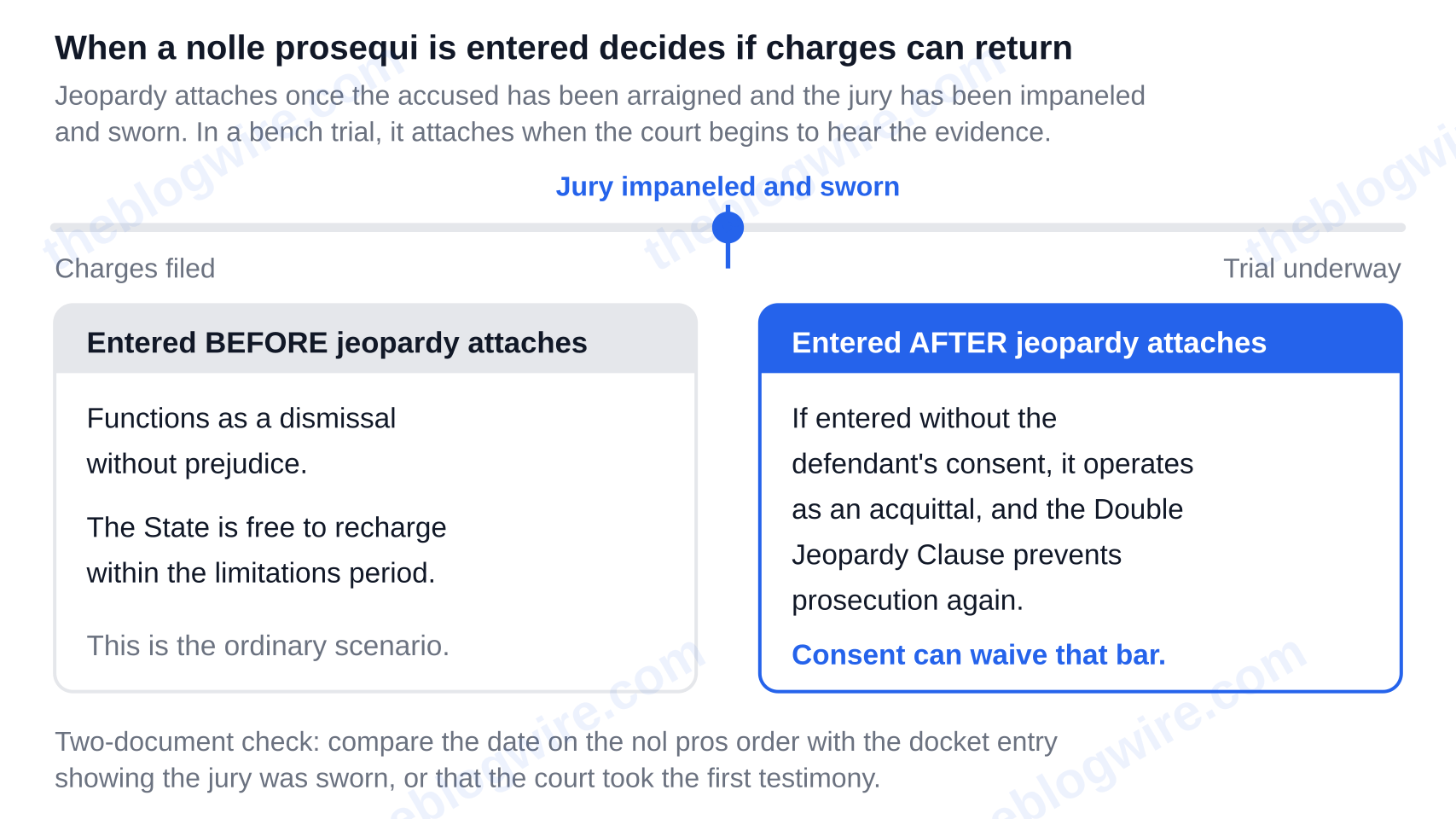
Here is the piece almost every other explainer skips. One moment in time determines whether a nolle prosequi is temporary or permanent. That moment is when jeopardy attaches.
Entered before the jury is sworn: refiling stays open
Generally, if the State dismisses the case before jeopardy attaches, it is free to recharge within the limitations period and it is a true dismissal without prejudice. That’s the ordinary scenario.
Entered after jeopardy attaches: it works as an acquittal
From the Suffolk University Law School double jeopardy materials, if the prosecutor enters a nolle prosequi after jeopardy has attached, and does so without the defendant’s consent, it operates as an acquittal and, pursuant to the Double Jeopardy Clause, prevents the defendant from being prosecuted again. Those same materials fix the attachment point — jeopardy attaches once the accused has been arraigned and the jury has been impaneled and sworn. In a bench trial, jeopardy attaches when the court begins to hear the evidence.
The consent clause is the trap. Agreeing to a mid-trial dismissal can waive the bar. That means it is a decision for counsel, not a sigh of relief for the defendant.
How to read your own docket to find which side of the line you’re on
In practice, this is a two-document check. To locate this information on your own docket, pull the nol pros order and note the date. Next, pull the docket sheet to find the entry which shows the jury was sworn or the entry which shows the court took the first testimony. Compare the two dates. If the nol pros order was entered after, raise double jeopardy with a lawyer before anyone refiles. Notice where you’ll find this information: in double jeopardy doctrine, not on the definitional pages which dominate search results. That’s why most people searching miss this information.
Nolle prosequi vs. dismissal, acquittal, and a stet docket
The conflation to clear up first: with a nol pros the state abandons the case; with a dismissal the court ends it. From there, what actually differs is refiling risk and how soon your record can be cleaned up.
| Outcome | Who decides | Can charges be refiled? | Does double jeopardy bar reprosecution? | Record and expungement posture |
|---|---|---|---|---|
| Nolle prosequi | Prosecutor (court approval required in federal court and some states) | Usually yes, within the limitations period | No — unless entered after jeopardy attached without your consent | Arrest and charge stay public; you must petition to expunge or seal |
| Dismissal without prejudice | Court | Yes | No | Record remains; petition required |
| Dismissal with prejudice | Court | No — permanently barred | Effectively yes as to that charge | Record remains; petition required |
| Acquittal | Jury or judge, on the merits | No — never, on that charge | Yes, absolutely | Record remains; petition required |
| Stet docket (Maryland) | Court, on agreement | Case can be reopened by either side for any reason within one year; after that only for good cause shown | No | Charge sits on an inactive docket; expungement timing is its own schedule |
The Maryland stet is its own animal, and the one-year reopening window is the detail people miss when they treat a stet and a nol pros as interchangeable.
Does a judge have to approve a nolle prosequi?
Often, yes. It’s not uncommon for people to think that, in the absence of a judge’s order, prosecutors can exercise that authority on their own. This is not the case — that claim is outdated in federal court and simply wrong in some states.
Federal Rule 48(a) and the “leave of court” requirement
Federal Rule of Criminal Procedure 48(a) says the court must give permission for the government to dismiss an indictment, information, or complaint, and, in the absence of a defendant’s consent, the prosecution can’t dismiss charges during a trial. The Advisory Committee’s note to the rule is blunt that this changed existing law: at common law public prosecutors had the authority to enter a nol pros at their own discretion, without the court’s involvement.
The reasoning is not what most people assume. Stanford Law Review Online’s examination of the rule concludes that the requirement to get the court’s permission had almost nothing to do with the rights of the accused — it was more about giving district judges authority to limit unwarranted dismissals by corruptly motivated prosecutors.
State standards: Virginia’s “good cause shown” example
Virginia Code § 19.2-265.3 is the cleanest statutory counterexample: it states that a nolle prosequi shall be entered only in the discretion of the court, on motion of the Commonwealth, upon showing of good cause. Elsewhere, states tend to stay closer to the common-law model, where entry of a nolle prosequi is treated as essentially ministerial. Check local rules before assuming either way.
Will it show up on a background check?
Yes, by default. In the absence of a court sealing or expunging order, the arrest, the charge, and the disposition stay public. A typical report shows the charge, the filing date, and a disposition line reading “nolle prosequi” or “nolle prossed” — a disposition line commonly read as ambiguous rather than exonerating by prospective employers.
It is rare for a nolle prosequi to be sealed or expunged automatically. A good illustration is Florida, where a nol pros, in and of itself, does not automatically seal or expunge a criminal history record, and the person must take affirmative action to obtain a court-ordered expunction.
Maryland adds a tradeoff worth knowing before you file. A petition to expunge a nol pros generally cannot be filed until three years after the disposition — unless you file a written General Waiver and Release of tort claims arising from the charge. In essence, the fast path costs you any false-arrest or malicious-prosecution claim. That is a real decision, not paperwork.
Expungement won’t necessarily provide the universal relief that people assume it will. Federal and FBI-level checks, as well as certain government agencies, professional licensing boards and security-clearance applications may still reach the record, and several impose their own disclosure duties. You must disclose the record if an application asks and you have not had it expunged. Answer accurately, and be sure to include the order showing the disposition with your response.
What to do after a nol pros is entered
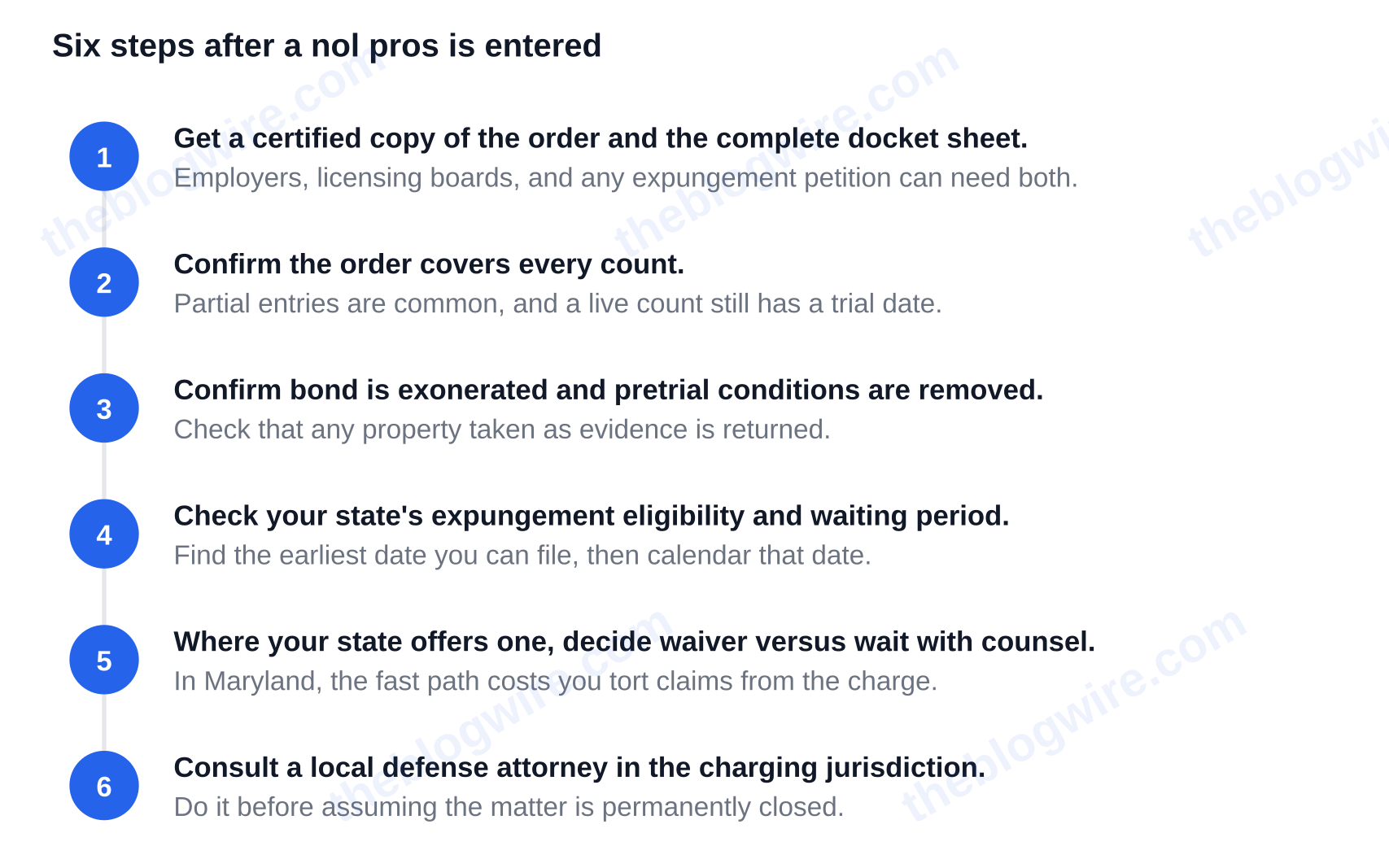
- You’ll want to obtain a certified copy of the order and the complete docket sheet, as you may need both for employers, licensing boards, and any expungement petition.
- You’ll want to make sure that all of the counts are covered — partial entries are common, and a live count still provides for a trial date.
- You’ll want to make sure that bond is exonerated, the conditions of pretrial release are removed, and any property that was taken as evidence is returned.
- Check the law for your state and see when you are eligible for expungement and what the waiting period is. Once you’ve checked the statute, see when the earliest you can file is, and then calendar that date.
- Where your state offers one, decide the waiver-versus-wait question with counsel.
- In the charging jurisdiction, you will want to consult a local criminal defense attorney before assuming the matter is permanently closed.
If you want the short version of the terminology itself, this site’s plain-English breakdown of what nolle prosequi means covers the definition without the procedure.
How it works outside the United States
The terminology is not exclusively American, and in other countries the power sits in very different hands. In England and Wales, only the Attorney General can enter a nolle prosequi, and that decision is answerable to Parliament rather than to the courts. In Ireland, it is the Director of Public Prosecutions. In Canada, there is no nol pros as such, but the equivalent is a Crown-directed stay of proceedings, which suspends the prosecution for one year, after which the charge is treated as ended.
If you are reading this from outside the U.S., that difference is significant, because the guidance that the U.S. offers regarding refiling, expungement, and background checks, does not apply to you.
What to remember
A nol pros stops the prosecution. It does not, on its own, end a case or clear your name. Two things decide what it actually means for you: when it was entered relative to jeopardy attaching, and whether your state lets you expunge now or makes you wait. You need a certified order and your docket sheet. Then you need to consult a defense attorney in the charging jurisdiction to verify two dates — your refiling exposure and your earliest expungement filing date. Those are the only dates that are relevant to your case.
Quick Answers
Is nolle prosequi the same as charges being “dropped”?
As far as practical effects go, yes — the prosecution stops and you stop going to court on those counts. The difference is permanence. “Dropped” charges sound final, but a nolle prosequi usually works like a dismissal without prejudice. The State can still recharge within the statute of limitations unless jeopardy had already attached when the order was entered.
Who decides a nolle prosequi — the prosecutor, the judge, or the victim?
The prosecutor makes the motion. The victim does not make the decision, even if they recant and/or refuse to participate. Whether a judge has to sign off on it depends on the court: Federal Rule of Criminal Procedure 48(a) permits dismissal only with leave of court, and Virginia Code § 19.2-265.3 requires the court’s discretion upon good cause shown. Some states still treat entry as essentially ministerial.
Can I answer “no” to a criminal charge question on a job application if my case was nolle prossed?
Probably not — not safely, unless the record has been expunged or sealed and the question’s wording genuinely excludes it. A nolle prosequi does not remove the arrest, charge and disposition from the public record, therefore, a background check will probably show it. Be careful what question you answer — some job applications ask about arrests and/or charges and not just convictions — and have the certified order ready to explain the disposition.
How long does a prosecutor have to refile a nolle prossed case?
Until the statute of limitations on the underlying offense expires, which varies by state and by charge — and many states impose no limitations period at all for the most serious felonies. Constitutional and statutory speedy-trial protections also limit how long the state can sit on a case and still revive it. Ask a lawyer in the charging jurisdiction for your specific date.
Does a nolle prosequi end my bond and pretrial conditions immediately?
Generally yes, for the counts it covers — bond is exonerated and pretrial conditions lift. There are two things to verify in writing: First, that the order covers all the counts. A partial entry is common. A surviving count keeps the conditions. Second, that the clerk actually processed the bond exoneration and the release of any property held as evidence.