Most people view democracy and republic as alternatives. In fact, the US is a republic and a democracy, given that power is held by the people either way. Democracy describes who holds power — the people, directly or through elected representatives. Republic merely specifies the form of the state: no hereditary monarch, power held under law. They sit on different axes, and the United States is both.
What is the difference between a democracy and a republic?
A democracy and republic differ in who rules and the form of the state. Everything else derives from that.
Democracy: rule by the people (dēmokratia)
A democracy is a state where power is vested in the people, either by the people themselves or through elected representatives. Direct democracy is rare. Rule by the people was practiced in ancient Greece, where citizens themselves made the laws. Modern usage, however, describes states where the people elect representatives to act on their behalf. Power is still in the hands of the people but exercised by their elected representatives.
Democracy comes from the Greek dēmokratia, “rule by the people.” As Merriam-Webster explains, the term originally denoted the direct participation of the people in making the laws — citizens showing up and voting on the laws themselves. Modern usage, however, covers rule by all eligible members of a state, whether directly or through elected representatives.
Republic: a state with no monarch (res publica)
A republic, in general, is a state with no hereditary monarch and power is held by a body of voting citizens. That power is exercised with law and represented with elected officials. The word comes from the Latin res publica, “public affair” or “public good.” In Rome it meant, plainly, the state.
Britannica notes that republic denotes absence of a monarch and democracy denotes rule by the people. A democracy may or may not have a monarch as head of state. Because of this, in essence they are measuring different things and this is why, in truth, the two things cannot be opposites.
So carry two questions instead of one label. Is the head of state hereditary? Is government power bound by enforceable law? The name on the country’s letterhead answers neither.
Democracy vs republic: the dimensions that actually differ
Here is the short version. Only the rows where the two words actually mean different things are included.
| Dimension | Republic | Democracy |
|---|---|---|
| Head of state | Elected or appointed — never a hereditary monarch | May be a hereditary monarch |
| What the word describes | The form of the state | The source of sovereignty |
| Who makes the laws | Elected representatives, governing under law | The people, directly or through representatives |
| Limits on the majority | Power bound by law, built into the definition | Not specified by the term itself |
| Minority rights | Protected by the constitution, not by the label | Depends entirely on the constitution |
| Real-world examples | France, India, Germany, United States | United Kingdom, Japan, Switzerland, United States |
Compare the rows again. Note how similar they are. The only reliable case of different meanings is the case of head of state. This is the core of the comparison, and this is why the USA appears in both sections.
The case of minority rights, which many expect to be the case of different means, actually does very little work. The next part will show why.
Which countries are democracies, which are republics, and which are both?
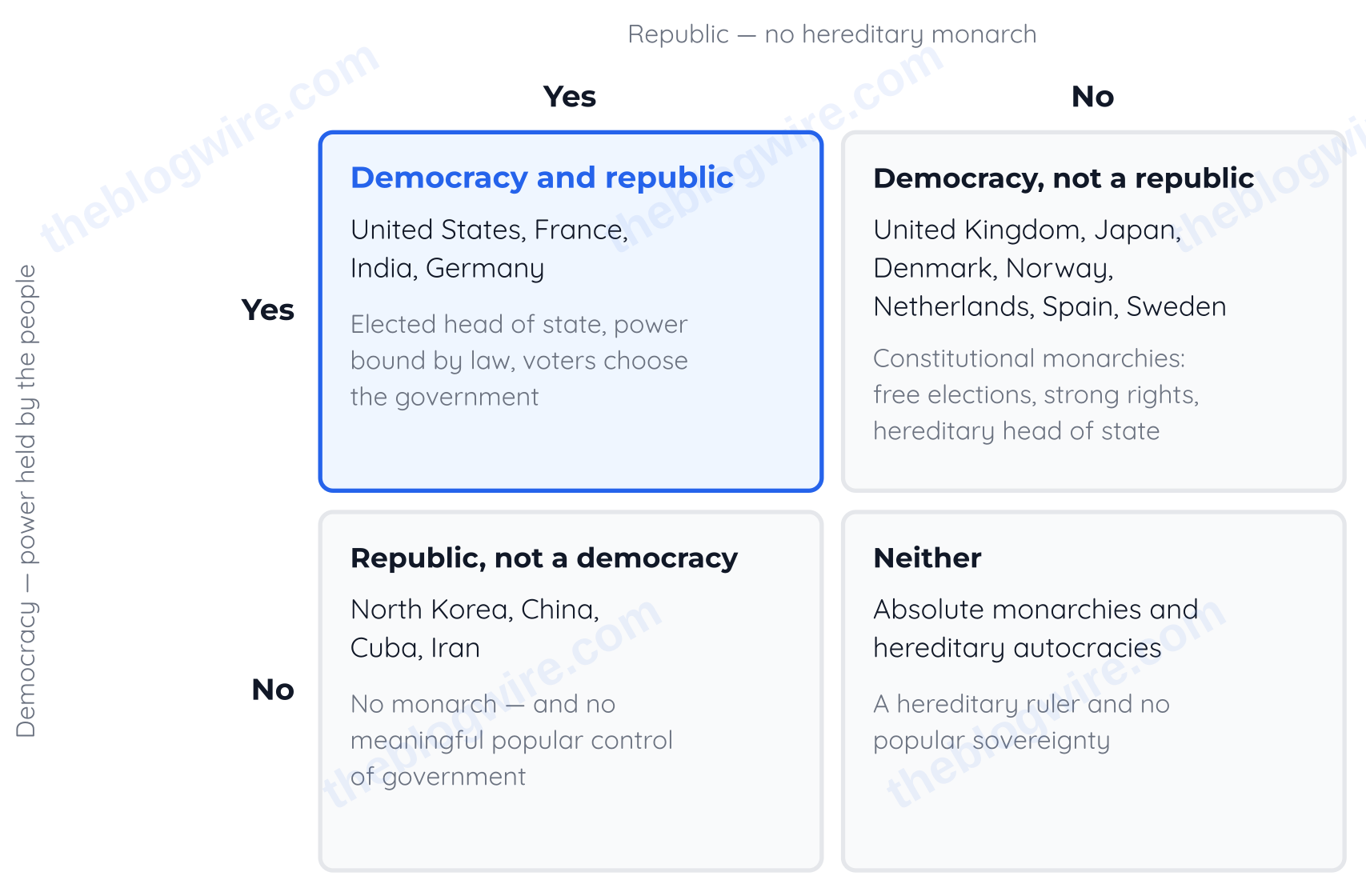
Four boxes will help us solve this faster than any definition will. If the two terms meant opposites of one another, two boxes would be empty. None are.
The four-box matrix at a glance
| Category | Countries | Why |
|---|---|---|
| Democracy and republic | United States, France, India, Germany | Elected head of state, power bound by law, voters choose the government |
| Democracy, not a republic | United Kingdom, Japan, Denmark, Norway, Netherlands, Spain, Sweden | Constitutional monarchies: free elections and strong rights protection, hereditary head of state |
| Republic, not a democracy | North Korea, China, Cuba, Iran | No monarch — and no meaningful popular control of government either |
| Neither | Absolute monarchies and hereditary autocracies | A hereditary ruler and no popular sovereignty |
Where the “republic protects minorities” shortcut breaks down
The simple statement “In a democracy, the rule of the majority prevails. In a republic, the rule of the majority prevails, but the minority is protected by the constitution”, which you have read a dozen times, is misleading. The United Kingdom limits the majority and protects rights to a standard which most republics would envy, and it is a monarchy. North Korea is formally the Democratic People’s Republic of Korea and protects nothing.
The label tells you very little about a nation. Run these two checks: is the head of state hereditary; and, is government power actually bound by enforceable law? A country’s official name is a form of marketing, not a classification.
Is the United States a democracy or a republic?
Both. The Merriam-Webster dictionary says both “republic” and “democracy” describe forms of government where supreme power is vested in the citizens. In the United States we have elected representatives; we also have a written constitution that limits the power of government and laws. In addition, sovereignty rests in the people. The people of the United States vote to select their elected representatives who, in turn, vote to make the laws that bind the citizens (including themselves) of the United States.
It is a republic because there is no hereditary monarch and power is exercised by elected officials bound by a written constitution. It is a democracy because sovereignty rests with the people, who choose those officials in regular elections. Representative democracy is a form of democracy, not an alternative to it. So, the US is a representative democracy and a constitutional republic.
What the US is not is a direct democracy. In a direct democracy citizens generally vote to make laws that bind themselves. Some state and local laws are made in this manner, however, they are the exception rather than the rule — a tiny fraction of the total. Writing for the Volokh Conspiracy in October 2026, Eugene Volokh noted that in reality a representative democracy is effectively the only democracy operating at any state or national level today. This is why the “representative” qualifier is usually redundant.
The sentence to keep in your pocket: the US is a representative democracy and a constitutional republic, and these are not competing statements.
Why the Constitution says “Republican Form of Government” — and what Madison meant
Article IV, Section 4 states, “The United States shall guarantee to every State in this Union a Republican Form of Government, and shall protect each of them against Invasion.” The Cornell Legal Information Institute states the Guarantee Clause is attributed to James Madison and originated in Edmund Randolph’s Virginia Plan at the Constitutional Convention.
This has typically been understood to mean that each state must have a form of government where the people govern through representation as opposed to a monarchy or dictatorship. There are two details that undercut the argument based on this. The Supreme Court has held that questions that arise with respect to this clause are, in essence, political rather than judicial questions, and therefore, the courts have never defined the word the clause guarantees. Furthermore, the clause does not define the form of government for the federal government; rather it is a commitment made to the states.
What “pure democracy” meant to Madison
In Federalist No. 10, Madison defined a pure democracy as “a society consisting of a small number of citizens, who assemble and administer the government in person,” and a republic as “a government in which the scheme of representation takes place.” The two major differences he noted between these two forms of government were the delegation of government to a small number of elected citizens, and the greater population and territory a republic can cover. Scale and representation. Not the protection of the rights of citizens, which is what the comparison pages of more modern times attribute to him.
How founding-era writers actually used the word
The Founders didn’t always take the position that we’ve drawn a firm line. The term “representative democracy” was ordinary terminology: John Adams used it in 1794; Noah Webster, 1785; St. George Tucker, 1803; and Thomas Jefferson, 1815. James Wilson, a drafter of the Constitution and an original justice of the Supreme Court, described the principles of the Constitution as purely democratical. John Marshall defended it at the 1788 Virginia Convention as a well-regulated democracy.
The clincher: Rome, which legislated directly rather than through a representative legislature, was frequently referred to by the Founders as a republic. So “republic” could not have meant “representative, unlike a democracy” to them.
None of which makes “we’re a republic, not a democracy” a foolish thing to say. Often the attempt is a substantive point — that constitutional limits and minority rights constrain majorities — wearing a definitional costume. It is a good point and a worthy defense. The definition is not worth defending, and the underlying question stays genuinely contested among scholars; the Liberty Fund ran a full discussion on it in January 2025.
Where does direct democracy still exist today?
Direct democracy, as practiced in ancient Athens, means laws are passed by citizens assembling and voting in person. Representative, or indirect, democracy means citizens elect officials who legislate on their behalf. In all modern national governments, laws are made by elected representatives of the citizens.
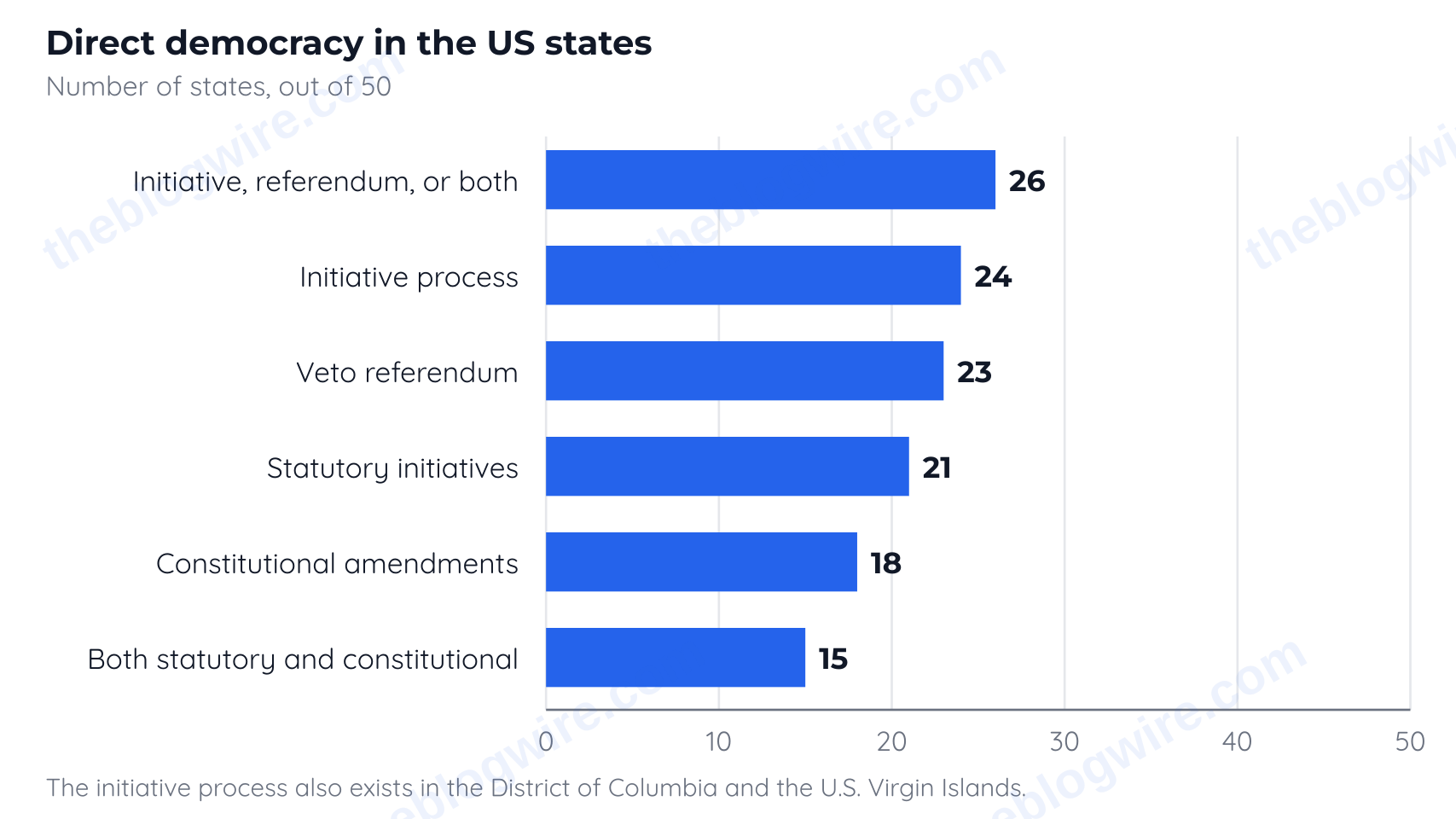
But part of the first is kept by the US and can be counted instead of waved at. According to the National Conference of State Legislatures, 24 states plus the District of Columbia and the U.S. Virgin Islands have an initiative process, and 26 states have an initiative process, a referendum process, or both at statewide level. Twenty-one states allow statutory initiatives, 18 permit constitutional amendments, and only 15 allow both. Twenty-three states allow veto referendums. South Dakota was the first state to adopt the initiative, in 1898; Mississippi was the most recent, in 1992.
For comparison, look at Switzerland. Swiss voters have been called to decide roughly 689 national issues since 1848, thus placing it way ahead of other countries in direct-democratic voting. This is what a real semi-direct system looks like. Switzerland, however, does not lose anything in terms of its republican character from having this system.
The three things to remember
One: democracy asks who hold power; republic asks whether there is a hereditary monarch and whether the state functions according to law. These are different questions, different axes.
Two: these terms are independent. Therefore, a country can be one, both, or neither — the UK is a democracy and not a republic, North Korea is a republic and not a democracy, and the United States is both.
Three: when someone says, “we’re a republic, not a democracy”, ask which check they mean. Do they mean a hereditary head of state, or do they mean constraining the power of the majority. The second is a real argument about constitutional constraints, and it is worth having on its own terms. Read Federalist No. 10 and Article IV, Section 4 and judge the primary sources yourself. You’ll find related pieces under Law.