

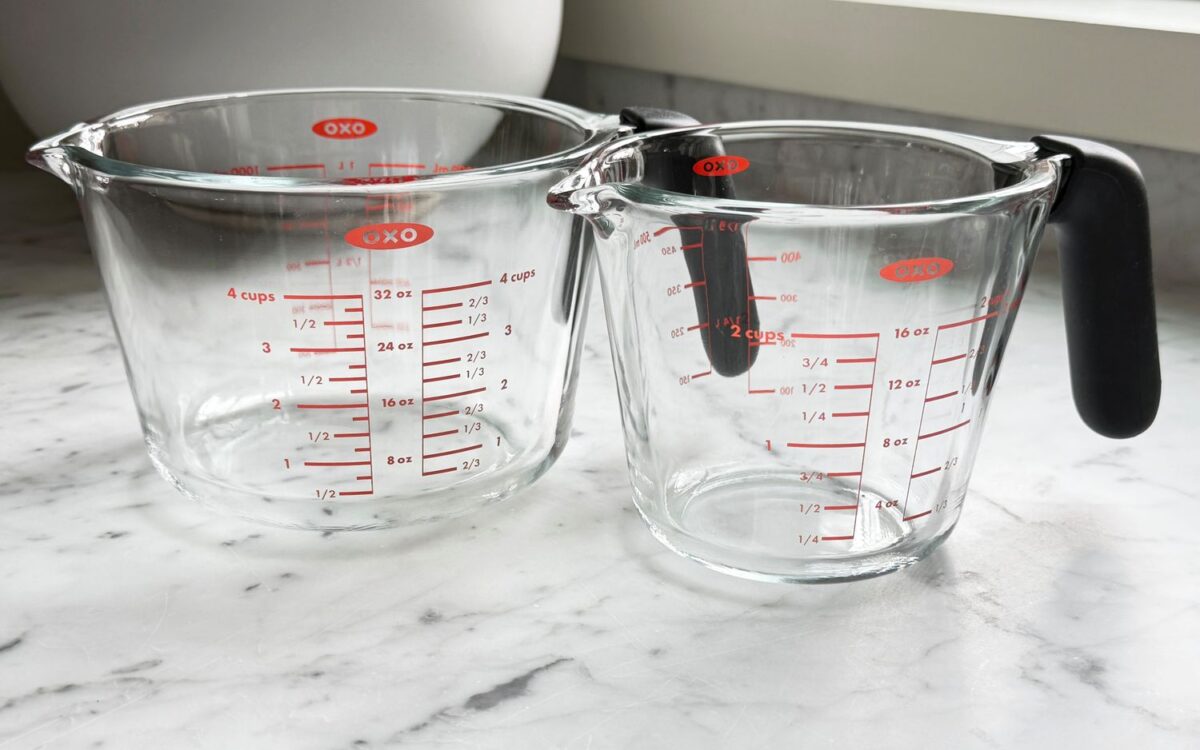
One US liquid gallon holds exactly 128 US fluid ounces, so converting ounces to gallons is one division: fluid ounces ÷ 128. Pour 64 fl oz and you have 0.5 gallon; go the other way by multiplying gallons by 128. Imperial (UK) gallons hold 160 imperial fluid ounces instead, which is where most people go wrong.
My position after reading the pages ranking for this is the arithmetic is not the issue. Each one provides 128 and a chart. Almost none of them ask the only question that determines the answer and settles it: what kind of ounce are you holding before you divide? Get it wrong and 128 is a confidently wrong answer. Get it right and you never think about this again.
How Do You Convert Ounces to Gallons?
Gallons = fluid ounces ÷ 128. Reverse it with fluid ounces = gallons × 128.
That divisor is not folklore and is not changing. In the 2026 edition of NIST Handbook 44, Appendix C, it states that 1 gallon = 231 cubic inches = 4 quarts, and 1 fluid ounce = 1.8046875 cubic inches. Divide 231 by 1.8046875 and you get exactly 128. This is not rounded or drifted and there is nothing to re-check next year.
Two Worked Examples (256 oz and 500 oz)
The clean case: 256 ÷ 128 = 2 gallons. Done.
The case that trips people up: 500 ÷ 128 = 3.90625 gallons, the same figure Inch Calculator shows as 3.9063 gal. Do not stop at the decimal — turn it back into something you can pour. Take the 0.90625 left over and multiply by 128: that is 116 fluid ounces. So 500 fl oz is three full gallons plus 116 oz, which is a gallon jug three times over and most of a fourth. That is the form you can actually measure into a container.
For quick mental math, keep in mind that 100 fluid ounces is a little under 0.8 gallons, and halving 128 twice gets you to a quart. This is accurate enough for a sprayer, but not for a lab.
Which Divisor Should You Actually Use?
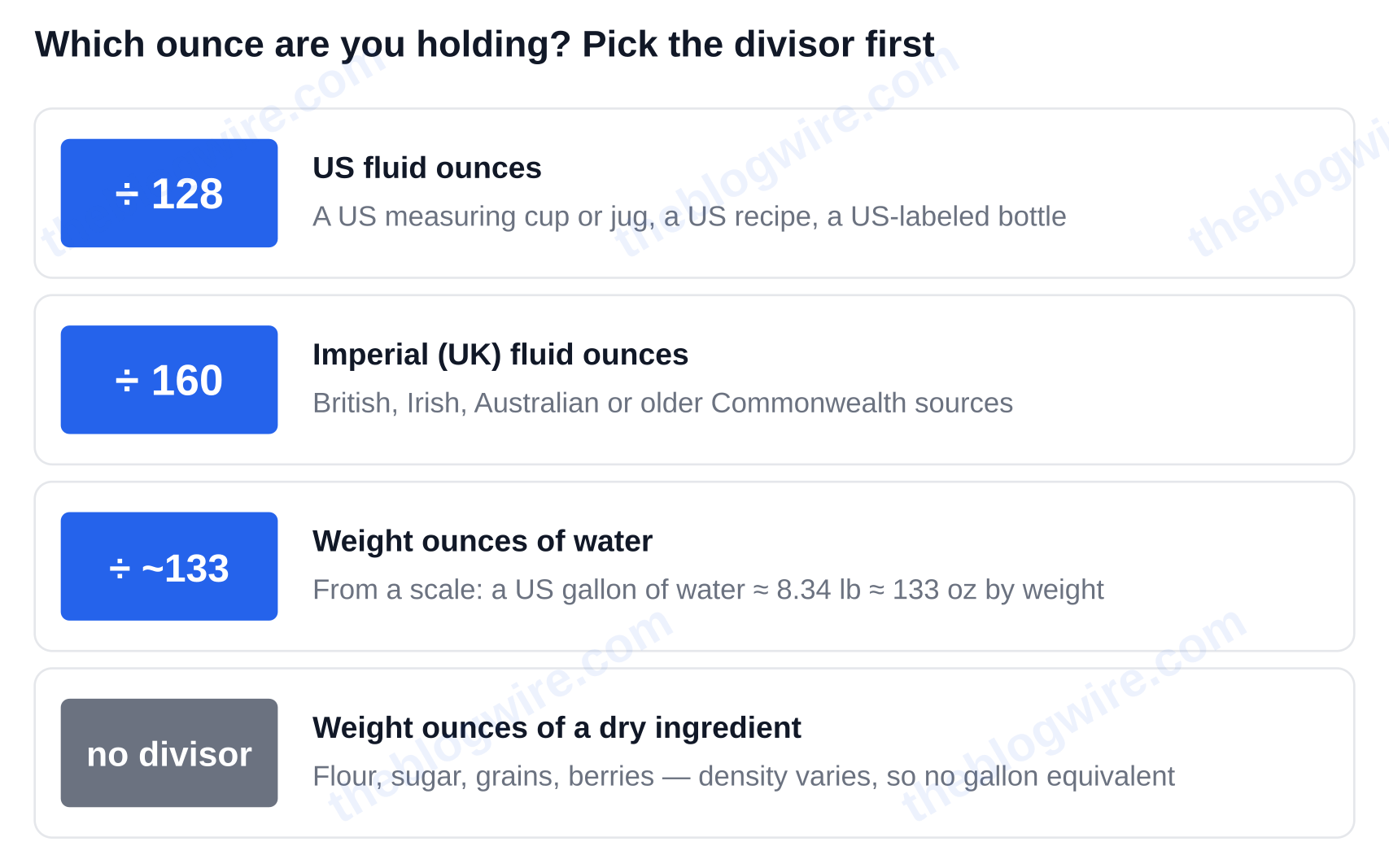
This is scattered across five different pages and assembled on none of them. Before you divide, pick your branch:
- Divide by 128 — US fluid ounces. The number came off a US measuring cup or jug, US recipe or a US labeled bottle. This is the default case and the one all the charts assume.
- Divide by 160 — imperial (UK) fluid ounces. British, Irish, Australian or older Commonwealth sources. One imperial fluid ounce is defined as 1/160 of an imperial gallon, therefore 160 is the correct divisor and not 128.
- Divide by about 133 — weight ounces of water. If the ounces are from a kitchen scale and you are measuring water, use weight. A US gallon of water weighs approximately 8.34 pounds at room temperature per sciencenotes.org, and that is roughly 133 ounces by weight, not 128, and it can vary slightly with temperature.
- Do not divide at all — weight ounces of a dry ingredient. Flour, sugar, grains, berries. Weight ounces of a solid do not have a defined gallon equivalent because density varies. An example from Live Eat Learn states that a pint of blueberries weighs about 12 ounces, when a pint is defined as a 16 fluid ounce measure. There is no gallon equivalent that will help fix this; you need a density or a volume measure.
A 10-Second Test for Which Ounce You’re Holding
Two questions will help determine this. Was the number obtained from a measuring cup or jug? From a scale? A number obtained from a measuring cup is a volume, and a number obtained from a scale is a weight. Is the source American or British? A number from a source that is American means use 128, and a number from a source that is British means use a divisor of 160. If the answer was “scale”, and the thing on the scale is not water, stop converting and find the volume some other way.
Ounces to Gallons Conversion Chart
| US fluid ounces | Gallons (exact) | In plain terms |
|---|---|---|
| 1 fl oz | 0.0078125 gal | A shot-ish pour |
| 8 fl oz | 0.0625 gal | 1 cup |
| 16 fl oz | 0.125 gal | 1 pint (pint of cream) |
| 32 fl oz | 0.25 gal | 1 quart (carton of broth) |
| 48 fl oz | 0.375 gal | 6 cups |
| 64 fl oz | 0.5 gal | Half gallon carton |
| 96 fl oz | 0.75 gal | 3 quarts |
| 128 fl oz | 1 gal | Standard US milk jug |
| 160 fl oz | 1.25 gal | A jug plus a quart |
| 192 fl oz | 1.5 gal | A jug and a half |
| 256 fl oz | 2 gal | Two jugs |
| 500 fl oz | 3.90625 gal | 3 gal + 116 oz |
| 640 fl oz | 5 gals | A five-gallon bucket |
| 1000 fl oz | 7.8125 gal | 7 gal + 104 oz |
We use US fluid ounces. An imperial column would look different the whole way down, because 160 imperial fluid ounces make up an imperial gallon.
Half Gallon, Quarter Gallon, and the Full Ladder
Half a gallon is 64 fluid ounces. So, a 64 ounce bottle is not a full gallon, it is only a half gallon. Misreading a 64 ounce bottle and thinking it is a full gallon is the biggest mistake when it comes to hydration math. Quarter of a gallon is 32 fluid ounces, also known as a quart. An eighth is a pint, which is 16 fluid ounces. A sixteenth is a cup, which is 8 fluid ounces.
Chained together, the US volume ladder runs: 8 fl oz = 1 cup, 2 cups = 1 pint (16 oz), 2 pints = 1 quart (32 oz), 4 quarts = 1 gallon (128 oz). Which also means a gallon is 16 cups and 8 pints. If you scale recipes often, the old “gallon man” drawing — a G holding four Qs, each holding two Ps, each holding two Cs — is faster to recall than any chart.
Why Some Sources Say 160 Imperial Ounces and Others Say 153.6
You will see both numbers on the highest authority pages, side by side, with no explanation. One large food page states flatly that an imperial gallon is 153.6 fluid ounces, others state it is 160. I think it is one of the most irritating aspects of the current search results because both numbers are defensible and neither state why.
They are counting different ounces. An imperial gallon is exactly 160 imperial fluid ounces because Wikipedia’s fluid ounce entry defines one imperial fluid ounce as 1/160 of an imperial gallon, or exactly 28.4130625 mL. Same imperial gallon is roughly 153.7 US fluid ounces: 4.54609 L / 29.5735295625 mL. The 153.6 you see is that second calculation, rounded. Same amount of liquid, different measuring spoons.
What causes the difference? The fluid ounce in the US is about 4.084% larger than the imperial fluid ounce, a leftover of a British redefinition the US never adopted. The difference causes problems for the pint. An imperial pint is 20 imperial fluid ounces and not 16, which is about 19.2 US fluid ounces. A recipe scaled with US measuring cups will quietly short or flood the mix by about a fifth.
Here are two things to know before you trust an old British source. The first is that, per the UK’s Weights and Measures Act 1985, the imperial gallon is exactly 4.54609 litres. However, it is no longer legal to sell goods by the imperial gallon in Britain, meaning that current UK packaging is in litres even when a recipe text says gallons. The second is that a US dry gallon is a third unit entirely and is, per Wikipedia’s gallon entry, 268.8025 cubic inches, which is 4.40488377086 L, noticeably larger than the 231-cubic-inch liquid gallon, and never the right unit for a liquid.
Where the Division Actually Costs You: Bottles, Ratios, and Labels
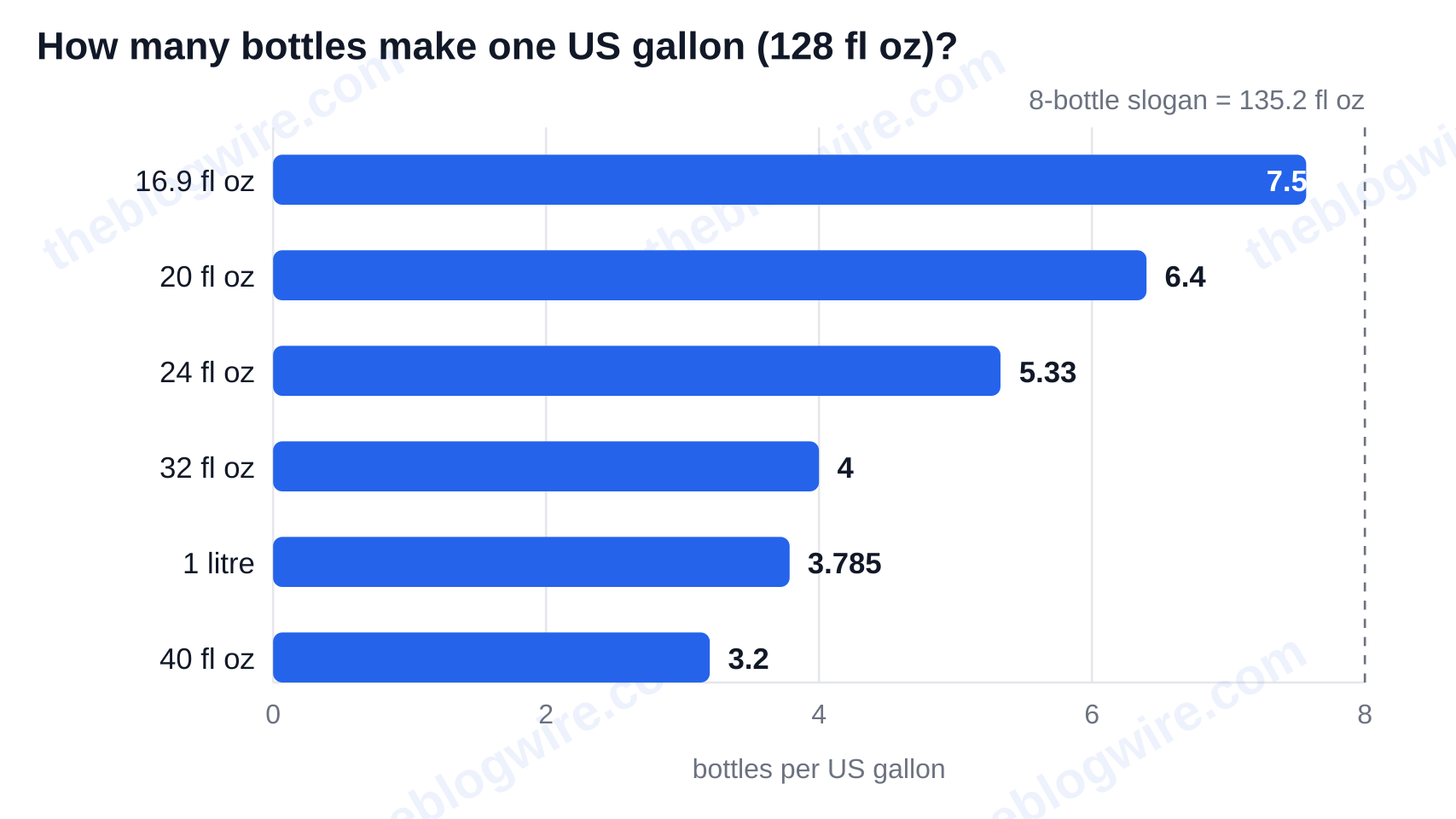
Most people are familiar with the “eight bottles equals a gallon” slogan. While this is a good short-term memory aid, a more accurate version is that a gallon is equal to 7.57 of the 16.9 fl oz bottles, per asknumbers.com. So, the slogan actually delivers 135.2 ounces, which is about 7.2 ounces more than a gallon. So if you are trying to keep track of your fluids for some reason, then this is not a rounding error.
Divide 128 by your bottle size and the rest fall out: 20 oz gives 6.4 bottles, 24 oz about 5.33, 32 oz an exact 4, 40 oz exactly 3.2, and a 1 litre bottle roughly 3.785 per gallon. For a daily target, either round up and accept the overshoot or fill the last bottle partway. Just know which one you are doing.
In dosing that fractional part plays a big role. With a label calling for 2 oz per gallon, a 4-gallon sprayer needs 8 oz; multiply the ratio by the gallons, never by the final volume. Over-pouring by 7 oz per gallon is a common mistake in pool chemistry, fertilizer, and paint thinner.
The Exact Numbers, and the 30 mL Label Ounce
For lab, chemical or label work, use the exact definitions, not the rounded ones. A US liquid gallon is exactly 231 cubic inches = 3.785411784 litres. One US fluid ounce is exactly 1.8046875 cubic inches = 29.5735295625 mL. Imperial, for comparison: 1 gallon = exactly 4.54609 L, 1 fluid ounce = exactly 28.4130625 mL. For rough kitchen work, 1 gallon ≈ 3.785 L and 1 fl oz ≈ 29.57 mL.
Here’s an explanation for one of the anomalies people love to pursue. For US nutrition labeling, 21 CFR 101.9(b)(5)(viii) defines one fluid ounce as exactly 30 mL. So by definition, that label ounce is slightly larger than the real 29.5735295625 mL ounce. So when you do the serving math for a bottle and do a precise conversion, they will disagree by a hair. Again, neither is broken. Each is using its own definition of ounces, same as the imperial mess above.
The Bottom Line
Ounces to gallons is one division, but only after you identify which ounce you possess. US fluid ounces divide by 128. Imperial fluid ounces divide by 160. Weight ounces of water divide by about 133. Weight ounces of a dry ingredient do not convert at all.
If you are filling a bottle or scaling a US recipe, the chart above is all you need and the fine print is noise. If you are working from a British recipe, dosing a chemical, or reading a scale instead of a cup, skip the chart and use the decision rule — that is where ÷128 actually fails people.
You need to trace your number’s origin. Measuring cup or scale? US or British? Pick your divisor based on that. Then, compare the number to the conversion chart. Only then should you measure, mix, or buy. Browse more explainers on The Blog Wire for related reads.

