

While people usually think of a song as something with a chorus, the oldest song structure in Western music actually doesn’t need one. Strophic form in music, also known as AAA form, is when the same music is repeated with each stanza, or verse. Analysts label it AAA, because one complete musical unit — the strophe — simply repeats. Strophic form is the basis for several traditional songs, like “Amazing Grace.” Traditionally, the song has six verses and no chorus or bridge.
Strophic form is the simplest and most durable song form, and has alternate names like “verse-repeating form” or “one-part song form.” Wikipedia’s entry on strophic form lists the others you will meet in a textbook or a quiz: chorus form and AAA song form.
What is strophic form in music, and what does AAA mean?
Explanation for strophic form and AAA: All stanzas of the text are set to the same music, and no new musical section is introduced.
Each A represents a strophe, and a strophe is not a single phrase or a single line. In Open Music Theory, it describes strophic form as “repeating the same basic multi-phrase unit.” Another way to describe it is repeating a complete, self-contained section of music with a beginning, a middle and a cadence. Four verses of a hymn give you AAAA. Twenty verses of a ballad give you twenty As. The number of repeats changes nothing about the song form.
The word ‘strophic’ has its roots in the Greek word strophē, which means ‘turn.’ The melody turns back and returns to the beginning just like the stanza of the poem it’s setting.
The strophe: the unit the letters count
In basic strophic form, there are three negatives. There is no chorus, no bridge, and no contrasting section. An intro or outro, or an instrumental solo does not count against the strophic form. In fact, they are supporting modules or scaffolding to the stanza and, therefore, do not present an idea of their own. A folk song with a 16-bar fiddle break between the verses is still plain AAA.
Why strophic songs have no bridge and no chorus
There is one consequence worth mentioning and understanding. As the melody does not change, the variety and narrative is carried by the words. That’s why a song in strophic form is easy to memorize and sing in a group: learn the tune once and you can sing every verse, including the ones you haven’t heard yet.
How do you tell if a song is strophic? A three-step test
The definition doesn’t help with identifying a song in strophic form, and it is where a lot of people lose marks. There are three steps, and if the answer is clear in one of the steps, stop there.
Step 1: Is there a second main musical idea?
Decide whether any section carries new melodic and harmonic materials, other than repeating verse and ignoring the intros, outros and instrumental solos. Open Music Theory states that, in general, if a song has more than one main musical idea other than strophes and auxiliary modules, it is not strophic.
If there is, determine it. A single contrasting section that appears once in the middle and adds tension is a bridge and the song is AABA. The Beatles’ ‘I Want to Hold Your Hand’ is a good example of this. A contrasting sung section that alternates with the verse and usually carries the title hook is a chorus and the song is verse-chorus. Harmony is the quickest way to determine this, listen for the point where the chord progression deviates from the verse.
Step 2: Is it a refrain or a chorus?
If the repeating element other than the verse is a recurring line with identical melody and identical lyrics that appears inside the verse, that is a refrain, not a chorus. A refrain is part of a verse; a chorus is a separate formal section. The song is strophic, label it “strophic with refrain.”
Most students get this part wrong. Bob Dylan’s ‘Blowin’ in the Wind’ is listed as a strophic song on page after page, but each verse returns the line “the answer, my friend,” making it strophic with refrain. ‘Desolation Row’ is the same case with the title line doing the work.
Step 3: Is the repetition exact or varied?
If each strophe returns with the same underlying material but an altered melody, harmony or accompaniment, it is modified strophic (A’ A”), not flat AAA. Ask whether the lyric text changes on each return, and whether anything else changes with it.
Running the test on three real songs
- ‘Amazing Grace’ — passes step 1 with no second idea, has no refrain line, repeats exactly. Plain strophic.
- ‘Blowin’ in the Wind’ — stops at step 2. It is strophic with refrain.
- Schubert, ‘Die Forelle’ — stops at step 3. It is modified strophic.
The sentence to write in the assignment: “Strophic, because the only main musical idea is the repeating strophe.”
What is modified strophic form, and where does it appear?
Modified strophic form is a variation of A, A’ and A” where the formal section that returns is the same, but each return varies the melody, harmony, register or accompaniment. Wikipedia likens it to a rudimentary theme and variations. What usually gets varied is the piano or guitar accompaniment, the ornamentation of the vocal line, the key or vocal register, or the final cadence of a late strophe.
‘Die Forelle’: the example most students label wrong
Schubert’s ‘Die Forelle’ (D 550, Op. 32) was composed in early 1817 to a poem by Christian Friedrich Daniel Schubart, written in 1782 and published the following year. It is widely taught as strophic. It is in fact a varied strophic with an Abgesang. The third verse breaks the pattern and describes the catch of the trout.
An instrumental cousin of the same idea is variation form. Britannica compares this directly. Theme and variations, where a theme is stated and then repeated with variations, is the instrumental equivalent of the strophic type. Strophic variation is evident in the string quartets and symphonies of Haydn for this reason.
Two marking errors arise from this. Calling a modified strophic song flat AAA is one. Treating any variation whatsoever as grounds for calling the song through-composed is the other, and it is worse.
Strophic vs through-composed, verse-chorus, AABA, and bar form
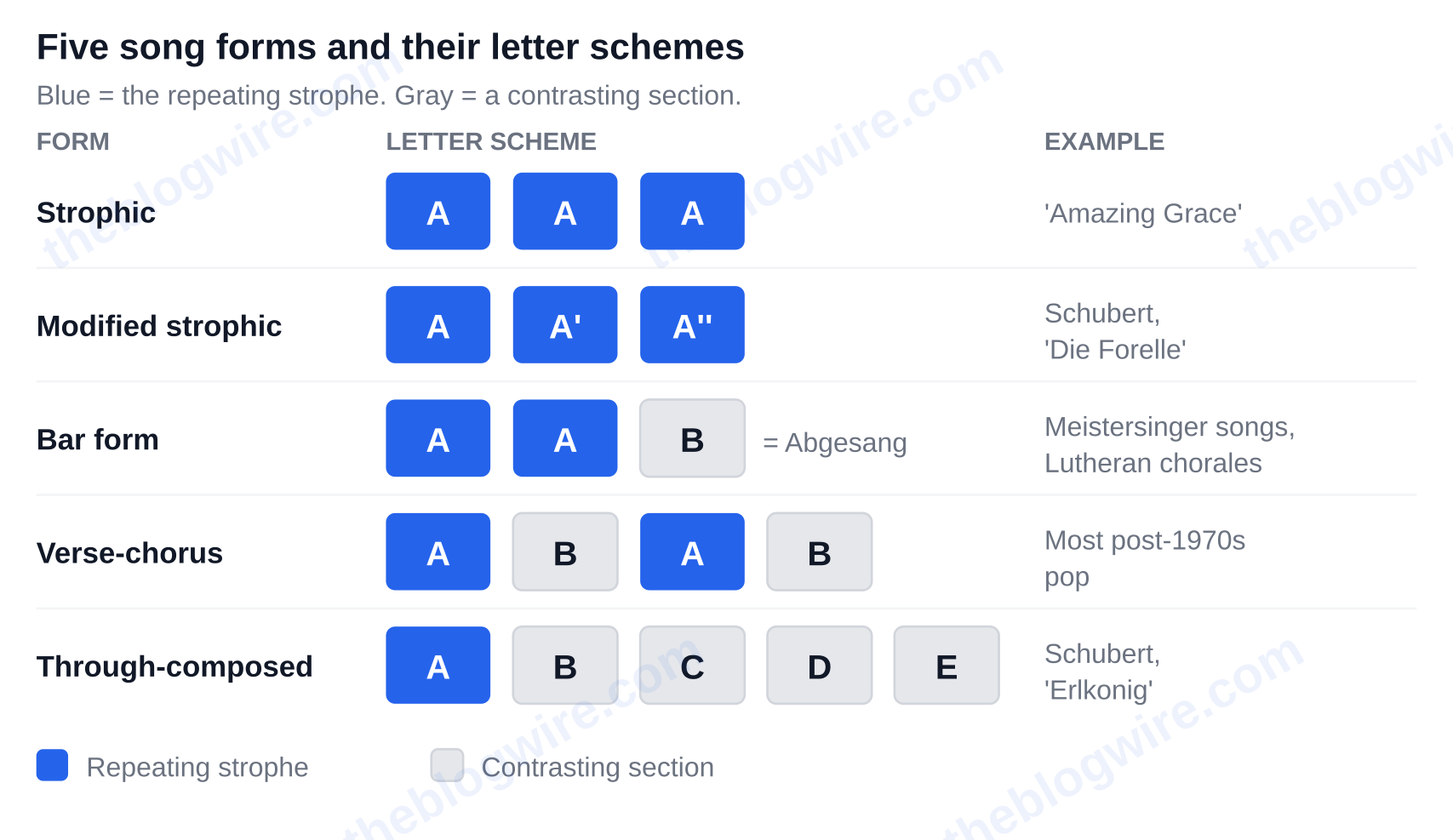
Five basic forms are what you are usually required to identify. Each has a letter scheme, an easy one-liner distinction, and an example song that you can hum to test yourself.
| Form | Letters | Distinguishing test | Example |
|---|---|---|---|
| Strophic | AAA | Same music every stanza; no second main idea | ‘Amazing Grace’ |
| Modified strophic | A’ A” | Same material, varied melody or accompaniment | Schubert, ‘Die Forelle’ |
| Bar form | AAB | First two stanzas identical, third contrasting (the Abgesang) | Meistersinger songs and Lutheran chorales |
| Verse-chorus | ABAB | Binary alternation with a contrasting sung chorus | Most post-1970s pop |
| Through-composed | ABCDE | New music for every stanza | Schubert, ‘Erlkönig’ |
The dividing lines, one sentence each. A bridge separates strophic from AABA. A contrasting sung section separates it from verse-chorus. A third contrasting stanza separates it from bar form. Wholly new music for every stanza separates it from through-composed — and that strophic/through-composed pair is the contrast quizzes ask about most.
For completeness: contrasting verse-chorus form can itself be understood as a larger strophic verse-refrain form. The verse and chorus form a larger unit that is repeated. This is probably not what the exam wants, but it is an interesting observation.
Which famous songs use strophic form?
Folk ballads use it the most. This is because the form is well suited to carry the lengthy narratives of a ballad. Some examples are: ‘Barbara Allen’, ‘Scarborough Fair’, ‘Oh! Susanna’, ‘Michael, Row the Boat Ashore’, ‘This Land Is Your Land’, ‘Erie Canal’. Hymns and children’s songs are also strophic, mainly because a congregation needs to be able to sing six stanzas from a hymnal with no rehearsal. Some examples are: ‘Amazing Grace’, ‘Holy, Holy, Holy’, and ‘Be Thou My Vision’, ‘Old MacDonald Had a Farm’ and ‘Hush, Little Baby’.
Art song: Schubert and the German Lied
The air de cour of 17th century France uses the strophic form, as do the German Lieder of the 19th century, where it becomes prominent. Schubert strophic songs include: ‘Heidenröslein’ and ‘Das Wandern’ from Die schöne Müllerin, and Brahms’s ‘Lullaby’ is also of this family.
Rock, pop and the blues — with one correction
In rock and the folk revival, some examples are: Carl Perkins’s ‘Blue Suede Shoes’, Bob Dylan’s ‘Don’t Think Twice, It’s Alright’ and ‘The Times They Are A-Changin”, Bobby Darin’s ‘Mack the Knife’, Gordon Lightfoot’s ‘The Wreck of the Edmund Fitzgerald’.
Here is the correction. Nearly all pages say the blues and the 12-bar blues are strophic, citing Robert Johnson’s ‘Crossroads’ as an example. A March 2025 article in Music Theory Online by Carter, ‘Beyond Strophic’, analysed 113 blues recordings made between 1923 and 1966 and found that many of the genre’s most famous recordings venture beyond a strophic approach and contain contrasting sections — bridges or choruses. It also discusses what it means to treat “chorus quality” and “bridge quality” as a continuum, rather than as binary labels. So the accurate phrasing is that the blues is usually associated with strophic form, not that it is strophic.
Finally, this explains your playlist. Open Music Theory notes the form was far more common in the rock-and-roll of the 1950s and 1960s than from the 1970s on, when AABA and verse-chorus took over. Thus, the reason that true AAA is rare in contemporary music.
Why songwriters still choose it — and what its limits are
One melody, learned once and reused, is a practical advantage. It suits congregational singing, campfires, protest marches and any music transmitted by ear rather than from print. The format is easy to teach to a band or a crowd, and requires no extensive rehearsal. As mentioned before, strophic form is especially used in story-ballads. The reason is because a fixed musical frame ensures that the audience remains focused on the lyrics. Strophic form also gives a songwriter the fastest structure to write, and the one least likely to bury the lyric under a competing hook.
Boredom is the limit. Across a dozen identical strophes, attention drifts — which is exactly why the form lost ground to AABA and verse-chorus.
How to keep a strophic song from getting monotonous
- Vary the accompaniment from strophe to strophe.
- Drop in an instrumental verse or solo.
- Change key or sing the strophe an octave up late in the song.
- Thin the arrangement out, then build it back up.
- Add a refrain line to give each verse a landing point.
If your song needs an emotionally charged payoff or a repeatable title hook, it’s best to rely on a chorus or bridge rather than a 4th identical strophe.
The one thing to remember
The definition is easy; the labelling is where marks are lost. Take the song you need to classify, play it through once with the lyric sheet in front of you, and run the test in order — second main musical idea, then refrain versus chorus, then exact versus varied repetition. Write down the point at which you stop. That step is your answer, and your reason for it. Browse more explainers on The Blog Wire for related reads.
Quick Answers
Is ‘Amazing Grace’ in strophic form?
The answer is “yes,” and it is the cleanest example you can cite. Each stanza is sung to the same melody, there is no chorus and no bridge, and there is no recurring refrain line sitting inside the verse. So it’s just good old plain AAA instead of strophic with refrain. Britannica includes hymns and traditional ballads squarely in the strophic type for the same reason: different poetic strophes, one melody.
Can a strophic song have a refrain?
Yes. A refrain is a recurring line with identical melody and lyrics that is part of the verse. A refrain does not add a second main musical idea, and so a song remains strophic. It is, however, labeled “strophic with refrain.” A chorus, on the other hand, is an independent formal section with its own material, and its presence makes the song verse-chorus form. Bob Dylan’s ‘Blowin’ in the Wind’ is the classic refrain case, not bare AAA.
Is the 12-bar blues strophic?
Typically, yes. However, the flat claim is out of date. As stated in Carter’s article, ‘Beyond Strophic’, published in Music Theory Online in March 2025, an analysis of 113 blues recordings from 1923 to 1966 showed that many of the genre’s best-known records include sections that are bridges or choruses, rather than pure strophic repetition. Carter argues that “chorus quality” and “bridge quality” should be considered on a continuum. So, the safest thing to say is that the blues is usually associated with strophic form.
What is the difference between strophic form and theme and variations?
They are really the same principle in two different media. Strophic form repeats one musical unit for successive stanzas of a sung text; theme and variations states an instrumental theme and then repeats it with alterations. Britannica describes variation form as the instrumental equivalent of the strophic type. Modified strophic form (A’ A”) sits between the two — a sung form that varies each return, which is why Wikipedia calls it a rudimentary theme and variations.

