
What is author’s purpose? It’s the reason for writing, what the author wishes to accomplish. In class, this is called PIE, to persuade, to inform, or to entertain. This is determined by the tone of the text, content, audience, and the word choice.
A flyer that reads, “Our streets are unsafe — demand a crossing guard at Oak and Main” is clearly to persuade. However, a paragraph that says, “Oak Street has recorded 14 collisions since the council began counting” is to inform. Same street, different job.
What is author’s purpose in plain English?
It is the goal of the writer. It is not the subject of the text, and it is not a summary. Literacy Ideas calls it the author’s reason or motivation for writing a specific text.
Purpose vs. topic: the mistake that costs the most marks
Two questions that are always confused are:
- “What is this about?” — the subject. This is pollution, the moon landing, a boy and his dog, etc.
- “Why did the author write this?” — the function. This is to convince you to recycle, to show you how a rocket stages, or to make you laugh.
Answering the first question when the second was asked will cost you the mark, even if everything you said is right.
What the PIE framework stands for
This is the version almost every reader meets first:
- Persuade — speeches, advertisements; try to get you to agree or act.
- Inform — give facts about a real-world topic; textbooks, encyclopedias.
- Entertain — novels, poems; tell a story, amuse, move you.
PIE gets taught first for a reason: three categories, one memorable word, and it aligns nicely to the ad/textbook/novel trio the students can already name. But the PIE model is a simplification. This page describes the extended model, the evidence step that actually earns the marks, and the point where the school model breaks down.
Where did the idea of author’s purpose come from?
“Author’s purpose” is a reframe of reading comprehension of a much older idea of literary theory, namely, authorial intent. The intent of the author that is embodied in the work is what we are interpreting. In the Romantic period, Friedrich Schleiermacher and August Boeckh treated interpretation as recovering the author’s original conception. The stronger position, authorial intentionalism, is the hermeneutical view that the intentions of the author should constrain how a text is properly interpreted.
The Intentional Fallacy (1946) and The Death of the Author (1967)
The two famous objections were W. K. Wimsatt and Monroe Beardsley’s “The Intentional Fallacy” (1946), and Roland Barthes’s “The Death of the Author” (1967).
Wimsatt and Beardsley state the design or intention of the author is “neither available nor desirable as a standard for judging the success of a work of literary art.” Barthes goes further to state with the publication of the work, the author’s authority dissolves, and meaning is produced in the engagement of the reader with the text.
New Criticism’s alternative was close reading, or judging the work by the words on the page, not the biography behind them. That is the direct ancestor of the “cite text evidence” instruction given students today.
Why the theory still changes how you answer the question
Stated plainly: a 200-year argument about whether a writer’s meaning is recoverable got compressed into a multiple-choice question asking you to pick P, I, or E.
That’s more than trivia, because it tells you what the task actually is. When a question asks “What is author’s purpose?”, it is not asking you to mind-read the writer. You are inferring a function from textual evidence. Which is precisely why the standards ask you to explain how the purpose is conveyed in the text. Literary theory moved past authorial intent decades ago, and the school skill managed to survive, because reading a text’s features to figure out the job it’s doing is really helpful, regardless of the writer’s true motivation.
What are the types of author’s purpose, and how do you spot each one?
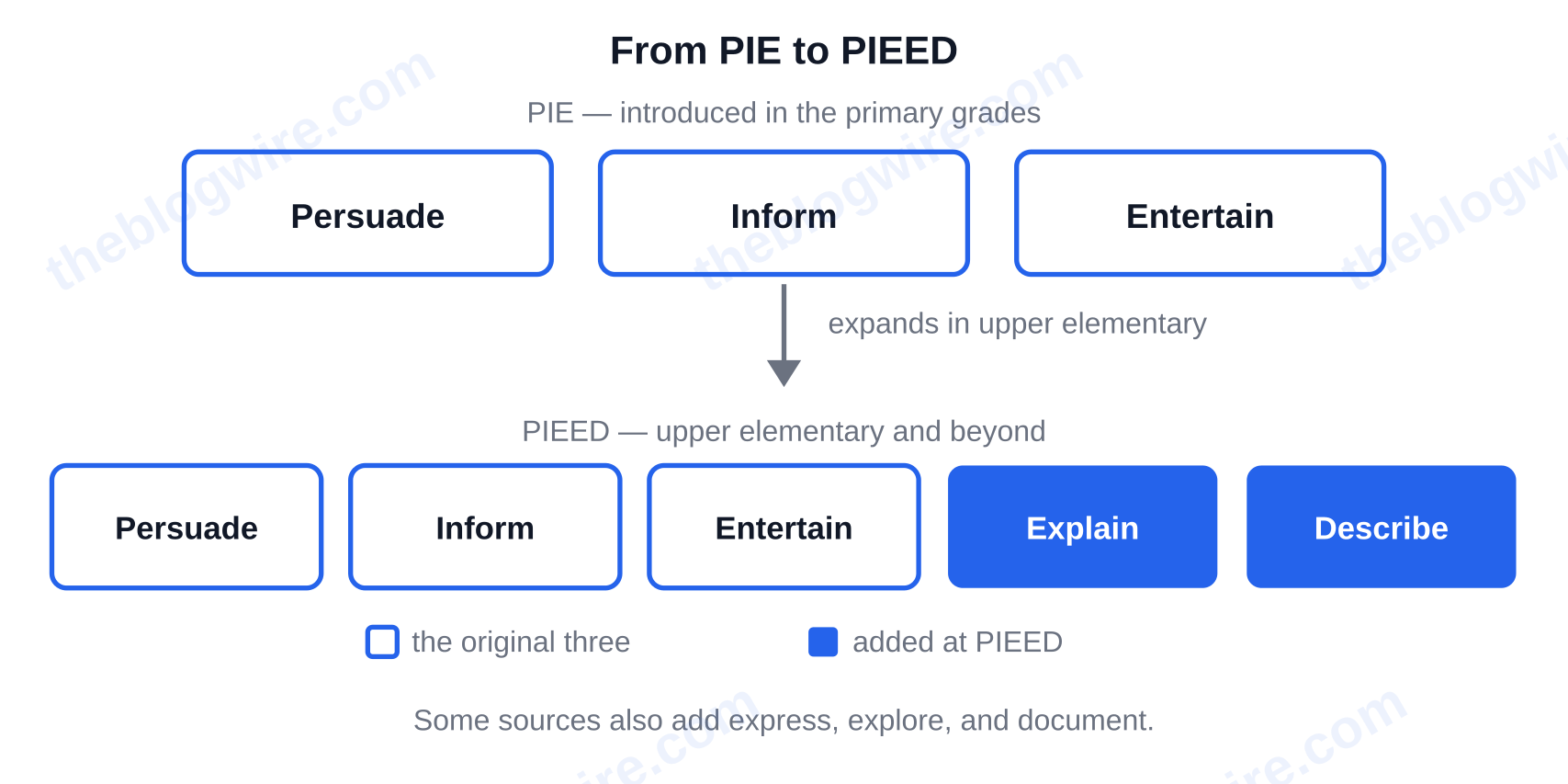
Starting in upper elementary school, PIE expands to PIEED — Persuade, Inform, Entertain, Explain, Describe. Some sources add other categories, such as express, explore, and document. Here are each of those, along with their tells, in one easy chart.
| Purpose | Typical text types | Signal words | Tone | Giveaway clue |
|---|---|---|---|---|
| Persuade | Political speeches, advertisements, editorials, campaign letters | “should”, “must”, “need to”, “best”, “worst”, “unfair”; emotional words like “heartbreaking”, “outrageous”, “incredible”; calls to action such as “Join us” or “Write to your representative” | Urgent, one-sided | The text wants you to change your mind or do something |
| Inform | News articles, textbooks, encyclopedias, scientific journals | Dates, statistics, measurements, definitions | Neutral, takes no side | Facts are given without being argued for |
| Entertain | Novels, short stories, poems, comedy scripts | Characters, dialogue, imagery, humour, suspense | Playful or emotive | You keep reading for what happens next, not what you learn |
| Explain | User manuals, how-to guides, recipes, process articles | “first”, “next”, “because”, “this happens when”; numbered steps | Instructional, patient | The text shows how or why something works |
| Describe | Travel writing, product reviews, nature writing, character sketches | Sensory detail, comparisons, adjectives of appearance and feel | Vivid, observational | The text builds a picture rather than an argument. |
The four clues: tone, audience, content, word choice
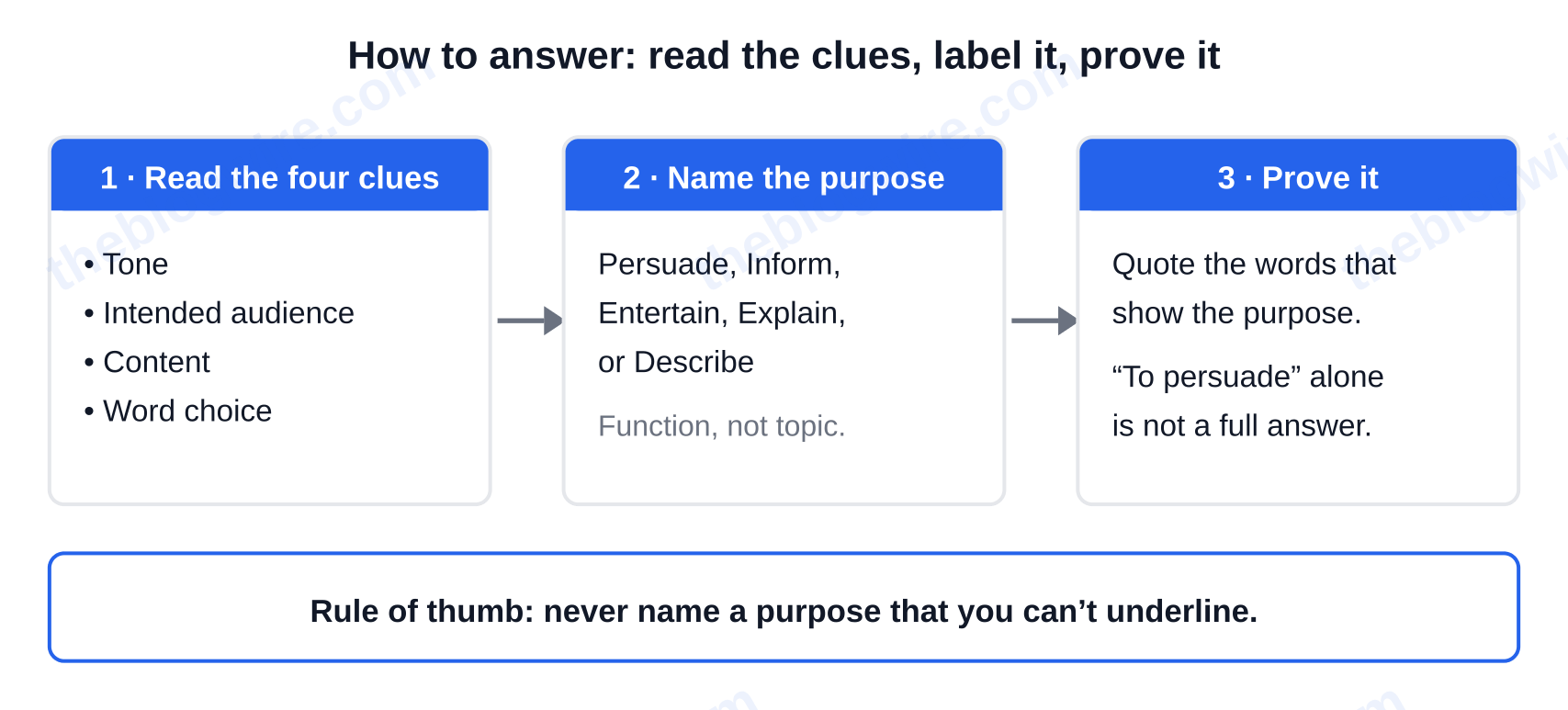
Many texts hand you no signal words whatsoever. You can always use the four clues: tone (urgent, neutral, playful), intended audience (specialists, shoppers, eight-year-olds), content (facts, steps, story, opinion), and word choice (loaded or plain). Check each of these before you hand in your work.
How to answer in two parts: label it, then prove it
A response to the question “What is author’s purpose?” has two parts. Name the author’s purpose, and quote the text which proves it. “The author’s purpose is to persuade, shown by ‘we must act before another child is hurt'” is a complete response. “To persuade” alone is not a complete response.
Where does PIE break down, and what should you use instead?
The failure point of PIE is well known among teachers, and open game for critique. According to one practitioner, the acronym “works well in the primary grades, but it misses the boat by a long shot for upper elementary and middle school” and some even say for third grade.
Why “to inform” is usually the wrong answer
Misconceptions about non-fiction usually derive from labeling all non-fiction “to inform.” Technically, it’s true. Analytically, it’s useless, and gives a vague answer to a question that asked for something specific. With informational text, you should ask sharper questions. Is the author describing, comparing, explaining, or showing causes and effects? Identifying the author’s move shows what the author is trying to do inside the text.
When a text has more than one purpose
Many texts do have multiple purposes. A satirical essay both entertains and persuades. A nature documentary script informs and describes. An advertisement may entertain its way to persuading you. Generally, to determine the main purpose, ask what the other one serves. For example, in a satirical essay, the jokes serve the argument, so the main purpose would be to persuade.
Author’s purpose vs. point of view, tone, and perspective
These are confused the most:
- Purpose — why did the author write this?
- Point of view — what does the author think or feel about it?
- Tone — the clue in the writing that reveals the point of view.
- Perspective — the position or experience shaping that view.
The reason these get confused is mostly due to how they are structured. Common Core bundles purpose and point of view together into one standard.
What the standards actually ask for (RI.6.6, RI.8.6, TEKS ELA.8.9.A)
The 6th-grade informational-text standard, CCSS.ELA-Literacy.RI.6.6, which continues at 8th grade as RI.8.6 with a parallel in the Texas TEKS as ELA.8.9.A, reads: “Determine an author’s point of view or purpose in a text and explain how it is conveyed in the text.” The weight lies in the second half, “how it is conveyed,” not the label. You don’t earn the mark with an acronym.
When you’re working on rather than being assessed on the skill, the resources that help are anchor charts listing signal words rather than just the acronym, purpose-sorting activities using real text excerpts, and short passage practice where every answer must carry a quotation.
There’s a payoff well beyond the worksheet. Once you know a text was written to persuade you, you can read its claims with a more sceptical eye — and you can match what you pick up to what you actually need from it.
The one line to remember
So what is author’s purpose? A simple idea with a complicated history: the reason a writer wrote something, borrowed from a two-century argument about whether a writer’s intentions are knowable at all. The usable version isn’t the acronym — it’s the method. To answer why a writer wrote something you must consider the tone, the audience, the content, and the word choice, then name the purpose and point to the words that prove it.
Test yourself. Take any text within arm’s length — an email, news article, the back of a box of cereal — and name the text’s primary purpose in one sentence. Next, underline the three words that led you to your answer.
A good rule of thumb is to never name a purpose that you can’t underline. For other pieces in this vein, see The Blog Wire.
Common Questions
What is the author’s purpose in simple terms?
This is the reason the author wrote the text — what they were trying to achieve. It’s not the same thing as the text’s subject matter, but why it exists. Recipes are written to explain, advertisements are written to persuade, and novels are written to entertain.
What does PIE stand for in author’s purpose?
PIE stands for Persuade, Inform, and Entertain. Persuade means that the author wrote the text in order to convince you to agree or act (ex. a speech, an advertisement). Inform means that the author wrote the text to give you facts about a real world subject (ex. a textbook, an encyclopedia). Entertain means that the author wrote the text to amuse you or to tell you a story (ex. a poem, a novel). From upper elementary it often expands to PIEED, adding Explain and Describe.
What is the difference between author’s purpose and author’s point of view?
Purpose is the reason the author wrote the text; point of view is what the author thought or felt about it. Purpose is the goal; point of view is the author’s stance; and tone is the clue in the writing that reveals the point of view. They’re often confused because in the Common Core State Standards, both are lumped into the same standard RI.6.6.
What grade is author’s purpose taught in?
Introduced in the primary grades, the PIE model expands to PIEED — adding Explain and Describe — from upper elementary. It’s formally assessed in 6th grade as CCSS.ELA-Literacy.RI.6.6 and again in 8th grade as RI.8.6, with a Texas TEKS parallel at ELA.8.9.A. Teachers note that PIE serves primary students well, but is seen as providing little to upper elementary and middle school readers.
Can a text have more than one author’s purpose?
Yes, and many do. A satirical essay entertains and persuades; a nature documentary script informs and describes; an advertisement may entertain you to the point of persuading you. To name the primary purpose, ask what goal the other one serves — in satire, the humour serves the argument, so persuade comes first.