How does dry cleaning work? Your garments are washed in a liquid chemical solvent instead of water — the “dry” means water-free, not liquid-free. The solvent dissolves oily, greasy soils without soaking into and swelling the fibres the way water does, so wool, silk and tailored pieces come out clean without shrinking or losing their shape.
You hand over a wool suit on Monday and collect it on Thursday: same size, same drape, the shoulder still sitting where it should. Wash that same suit at home, and it comes back smaller, fuzzier and out of shape. The entire difference is the liquid in the drum.
So how does dry cleaning work without water?
Start with the naming, because it confuses almost everyone. Your clothes are fully immersed in liquid for the whole cycle. That liquid just isn’t water, which is why “water-free cleaning” describes the process better than “dry” does.
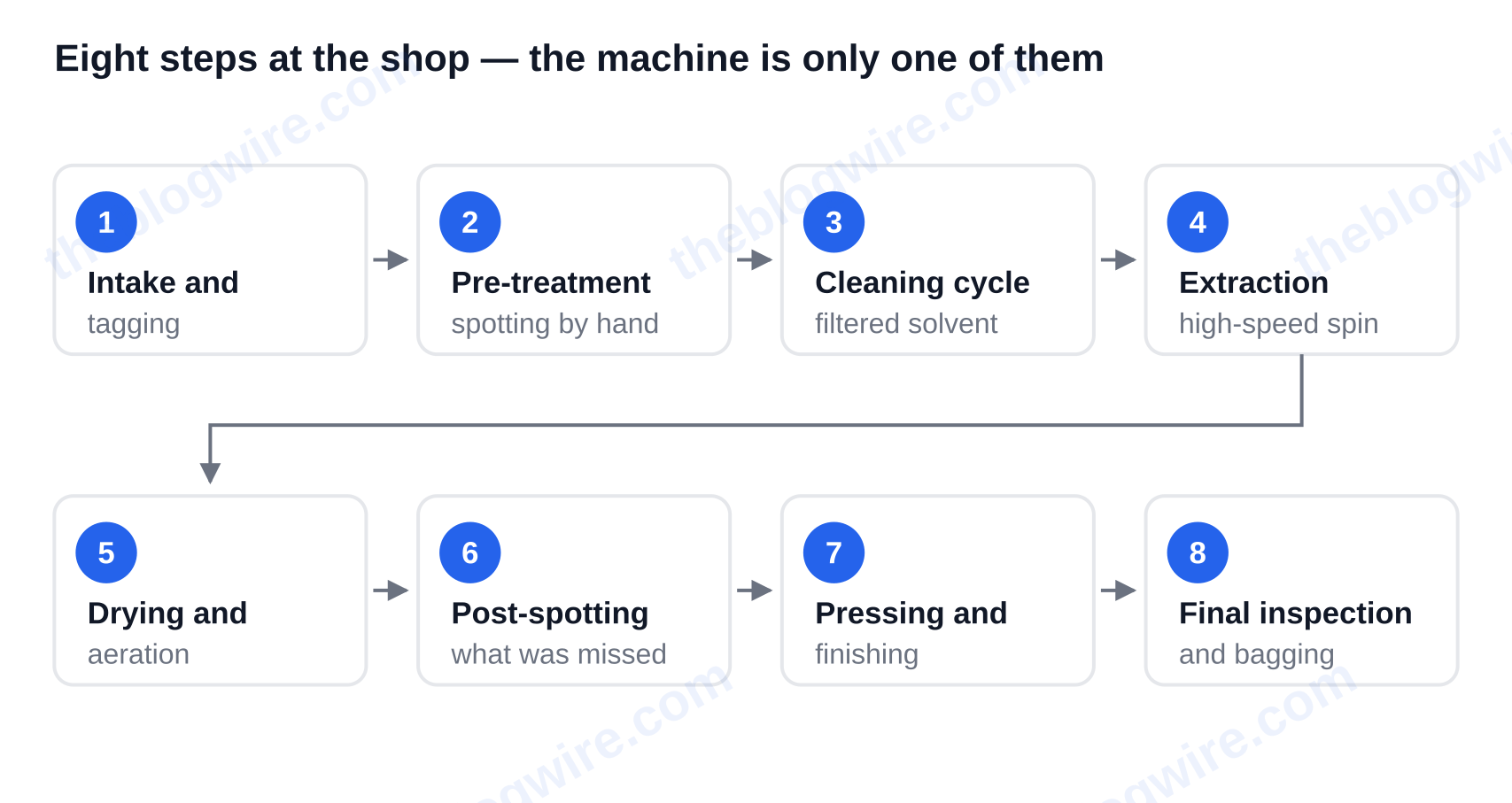
The part most explainers skip is the chemistry. Dry cleaning solvents are non-polar, and non-polar liquids dissolve non-polar soils — body oils, sebum, grease, make-up, food fats. Like dissolves like. Water is polar, which is a different job entirely.
Why solvent lifts grease, but water lifts salt and sugar
Water doesn’t just sit on a fibre, it penetrates it. In natural protein and cellulose fibres — wool, silk, cotton — that water is absorbed, the fibre swells, and when it dries it doesn’t return to the same dimensions. That swelling is the mechanism behind shrinkage, felted wool and a jacket that no longer hangs straight. Solvent wets the surface of the fibre and the soil on it, but barely enters the fibre itself, so the garment’s structure is never disturbed. Mechanical action does the rest: friction from tumbling loosens particulate soil like dust, grit and lint, which the solvent then carries away.
There’s a consequence here you can act on, and it shapes everything below. A liquid that refuses to mix with water also can’t carry water-soluble soils out of a garment. Salt, sugar, perspiration residue, coffee, wine — none of that is grease. Shops add a small amount of detergent and moisture to the solvent bath to pick up light water-side soil, but that is nowhere near a water wash.
What actually happens to your garment at the shop
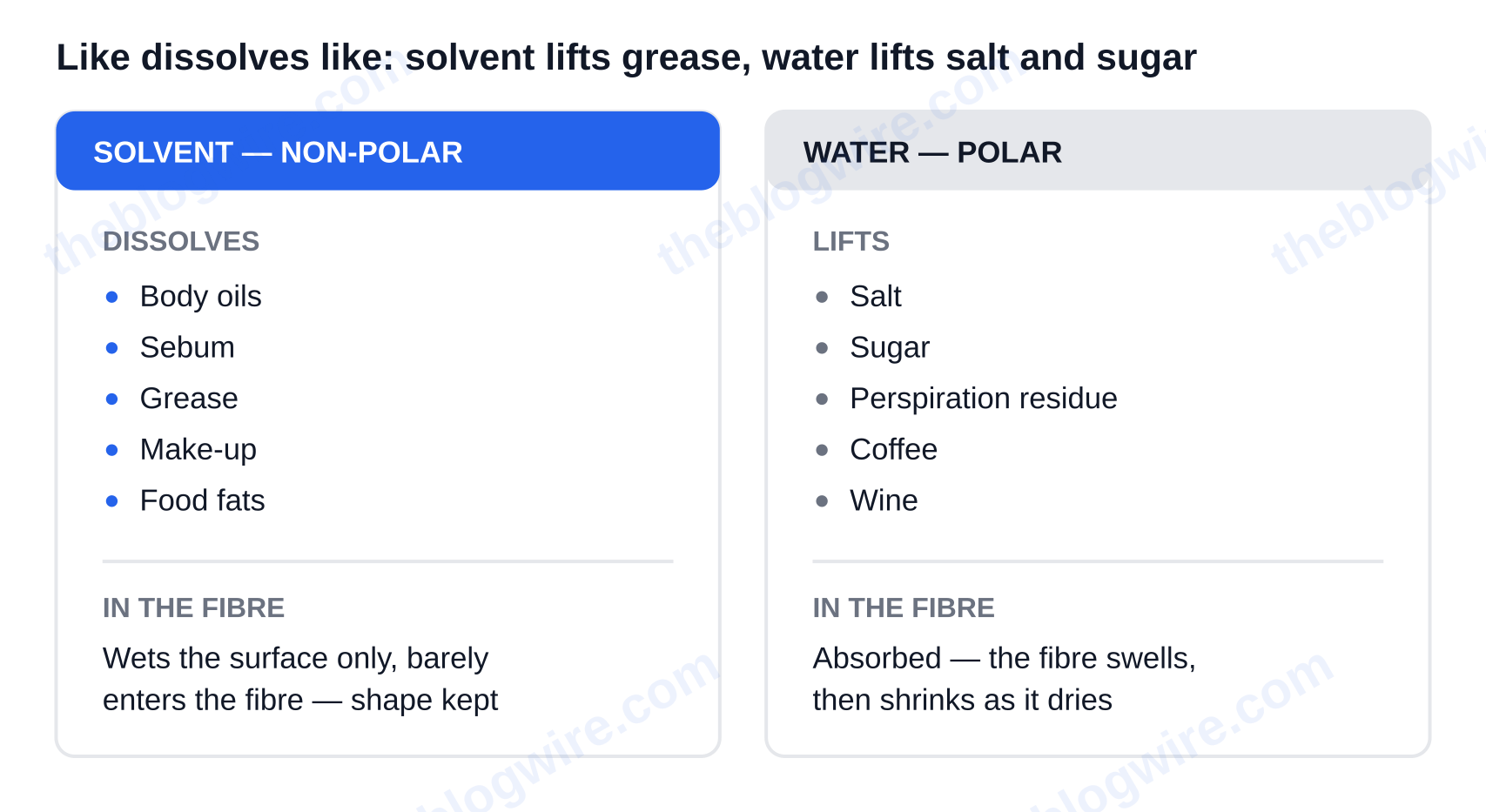
The machine is only one step of eight. NBC Select’s walkthrough with Rinse co-founder James Joun and Steamery co-founder Frej Lewenhaupt describes the shop process in five stages; here is the same sequence broken out as an operator actually runs it.
- Intake and tagging. Counter staff log existing damage, missing buttons and loose beading, note stains, and tag the garment so it finds its way back to you.
- Pre-treatment spotting. On a spotting board, the operator identifies each stain type and treats it by hand with wet-side or dry-side agents. Most real stain removal happens here, before any machine runs.
- The cleaning cycle. Garments tumble in continuously filtered liquid solvent with gentle agitation — usually a short cycle at low temperature.
- Extraction. A high-speed spin throws the solvent out of the fabric, much like the spin cycle on a washing machine.
- Drying and aeration. Warm air in the same drum evaporates the residual solvent, which is captured and condensed rather than vented. The garment leaves the machine dry.
- Post-spotting. Anything the cycle didn’t lift gets treated again — stains are far easier to see on a clean garment.
- Pressing and finishing. Steam presses, form finishers and steam air tunnels restore drape and crease lines.
- Final inspection and bagging. Buttons and seams checked, then bagged for transport.
Why pressing is half of what you’re paying for
A suit washed at a laundromat can be perfectly clean and still look wrong. Finishing is what puts the shape back: the lapel roll, the trouser crease, the smooth shoulder. That is why a dry-cleaned garment looks better than a merely clean one — and why the price covers labour, not just chemistry. One small thing to do when you get home: take the poly bag off. It’s designed for the trip home, not for storage.
Where the process quietly fails — sweat, odour and bacteria
This is the gap in almost every explainer, and it follows directly from the chemistry above. Perspiration is a water-based soil. A non-polar solvent is chemically incapable of dissolving it. That isn’t a quality problem at your shop; it’s physics.
How does dry cleaning work on sweat? It doesn’t — on its own.
There is a standard fix, and it happens before the machine. As the fabric care specialists at Rave FabriCare explain, when water-soluble stains are present it is customary to apply live steam to the area first, re-wetting the salt and protein residue so it can be flushed out. Skip that step and the garment can come back looking clean and still smelling of sweat. Worse, repeated cycles without wet-side spotting can set the residue and the yellowing that comes with it, making it harder to remove later.
Does dry cleaning kill germs?
No. Dry cleaning is not a sanitising process — the solvents aren’t formulated to kill bacteria, and odours caused by bacteria and mould can survive the cycle intact. What the process does instead is remove the oils and soils that feed odour-causing bacteria, which reduces smell without disinfecting the garment. Solvent is also poor at water-based spills such as coffee, wine, juice and ink, at old heat-set stains, and at perspiration oxidation that has already bleached or altered the dye.
What to say at the counter
Point at the problem areas out loud: underarms, collar, cuffs, any sweat ring. Ask for wet-side spotting, and say what caused each stain if you know. A garment handed over with no note gets a standard cycle — and a standard cycle can’t see sweat.
Which solvent is in the machine — and is perc being phased out?
Early cleaners used flammable liquids: Jean-Baptiste Jolly opened the first Parisian dry cleaning business in 1845 after a spilled kerosene lamp cleaned a linen tablecloth, and Thomas L. Jennings had patented a method he called “dry scouring” back in 1821. Perchloroethylene — perc, PCE, tetrachloroethylene — became the post-war standard precisely because it cleaned well and, unlike kerosene and gasoline, wouldn’t catch fire. It is also classified by the International Agency for Research on Cancer as a probable human carcinogen, Group 2A.
| Method | How it cleans | Health and environmental standing |
|---|---|---|
| Perc (PCE / tetrachloroethylene) | Chlorinated solvent, non-flammable, very effective on grease | IARC Group 2A probable human carcinogen; now under a federal ten-year phase-out |
| Hydrocarbon (petroleum-based, e.g., DF-2000) | Petroleum solvent; gentler and slower than perc | Lower risk than perc in the Sierra Club comparison, but petroleum-derived and contributes to smog |
| GreenEarth silicone (siloxane) | Liquid silicone; gentle on colours and delicates | Ranked behind hydrocarbon on documented health risk |
| Liquid CO2 | Pressurised carbon dioxide, recycled within the machine | Among the lowest documented risk; uses recaptured industrial by-product so no new CO2 is produced; recognised as non-toxic and non-smog-forming |
| Professional wet cleaning | Water plus biodegradable detergent in computer-controlled machines | Lowest documented health risk alongside liquid CO2 |
The ranking that falls out of the Sierra Club’s review of cleaning methods: professional wet cleaning and liquid CO2 first, then hydrocarbon, then silicone, with perc last.
What the EPA phase-out means for the shop you use
The answer to “how does dry cleaning work?” now comes with dates attached. EPA released its final TSCA risk management rule for PCE on December 9, 2024, and it took effect on January 17, 2025. Use of PCE in newly acquired dry cleaning machines was prohibited after six months. Three years after December 19, 2024, PCE is banned in third-generation machines and in spot cleaning. Ten years after December 19, 2024, it is banned in all dry cleaning and spot cleaning — including fourth- and fifth-generation machines — along with its manufacture, processing, and distribution for that use. EPA has published compliance guides for cleaners, and the final rule itself is in the Federal Register; a technology review of the perchloroethylene dry cleaning air-emissions standard followed on January 7, 2025.
Machine generation is the number that matters to you. Fourth- and fifth-generation closed-loop machines capture and recondense solvent vapour instead of venting it, and they have the longest runway under the rule. A shop still running a third-generation machine is on the short clock. In either case the solvent is filtered and distilled — vaporised, then condensed back to clean liquid — and reused, which is why a dry cleaner gets through a fraction of the water a laundry does.
When “dry clean only” doesn’t mean solvent
Solvent genuinely earns its place on wool and wool blends, silk, velvet, leather, suede, fur, structured tailoring, pleats, and anything beaded or embellished. Washing those at home risks shrinkage, distorted shape, changed texture, permanently set stains and uneven colour loss, and none of that reverses. But the label isn’t the whole decision. “Dry clean only” is the manufacturer’s liability-safe instruction; “dry clean” on its own is a recommendation. And professional wet cleaning can reportedly handle up to 90% of garments traditionally dry cleaned, silk, wool, and cashmere included. If you have a chemical sensitivity, or you’d rather not have perc near your clothes, ask for wet cleaning by name. Meanwhile, cotton and linen shirts, most knitwear, and anything you can handwash cold and dry flat don’t need a cleaner at all.
So that’s how dry cleaning works: cleaning in a non-polar liquid instead of water, which protects wool, silk, and tailoring and leaves it structurally unable to deal with sweat, water-based spills and bacteria. Before your next drop-off, do two things — point out every stain and say what caused it, and ask the shop which solvent they run, which machine generation it runs in, and whether they offer professional wet cleaning for your garment. You’ll find more guides like this across The Blog Wire.
Quick Answers
How long does dry cleaning take?
Standard turnaround at most shops is two to five days, with same-day or next-day service usually charged at a premium. The cycle itself is short — the time goes into spotting, pressing and finishing, which are hand processes. If a garment has a stain you want treated properly, give the shop the longer window rather than rushing it.
Does dry cleaning shrink clothes or wear fabric out faster?
Done properly, no — the solvent barely penetrates the fibre, so it doesn’t swell wool or silk the way water does, and that is exactly why tailoring keeps its shape. The wear that does happen comes from mechanical action and heat in pressing, so there’s no reason to clean a garment that’s merely been worn once. Air it, brush it, and send it when it’s actually soiled.
Is ‘organic’ or ‘eco-friendly’ dry cleaning actually better?
It depends entirely on what’s in the machine, because those words aren’t regulated. Ask for the method by name. On the Sierra Club’s comparison, professional wet cleaning and liquid CO2 carry the lowest documented health risk, followed by hydrocarbon, then silicone, with perc last — and perc is now under a federal phase-out, so a shop advertising green credentials should be able to tell you which solvent and which machine generation it uses.
Can I dry clean clothes at home with a home dry cleaning kit?
No — home kits are not dry cleaning. There’s no solvent bath, no extractor and no spotting board; a kit is a damp-treated cloth plus heat in your tumble dryer, which freshens and reduces odour at best. It can’t dissolve set-in grease, and it won’t give you the pressing and finishing that make a suit look right. For anything structured, beaded or genuinely stained, use a professional.