Most sites go through the long version of the difference between porcupines and hedgehogs. To give you the short version, a porcupine is a rodent and a hedgehog is not. Hedgehogs are part of the family Erinaceidae, which is in the order of mammals that includes shrews and moles. Porcupines are in the order Rodentia, which includes beavers and guinea pigs. Both groups of animals have spines, though. The porcupine is larger and its quills are barbed and can break off.
Everything else follows from that. Rather than list the differences conventionally, this page lists the differences in order of how well they help to identify the animal in front of you or to help settle an argument.
Are hedgehogs and porcupines related at all?
There is no relation whatsoever. Not cousins, not distant relatives in any meaningful sense.
The family of the hedgehog is Erinaceidae, subfamily Erinaceinae, which includes 5 genera and 17 species, according to Wikipedia’s hedgehog entry, all within the order Eulipotyphla. Their relatives are shrews, moles and gymnures. Porcupines are rodents: around 29 species split between Hystricidae, which includes 11 species of Old World porcupines, and Erethizontidae, which includes 18 species of New World porcupines. Other members of their family are beavers, capybaras, and guinea pigs.
The spines are convergent evolution. The two groups independently adapted spines to defend themselves against predators. Two separate lineages arrived at the same solution. The shared trait is the coincidence, not the connection.
A porcupine is definitely not a large hedgehog. A porcupine is a different order of mammal that is pointy.
Is a hedgehog a rodent?
No, and the reason is in the mouth rather than the back. A single pair of continuously growing incisors is the defining trait of rodents. A porcupine has exactly that: 4 incisors along with 4 premolars and 12 molars. The front incisors grow for life. Porcupines use those incisors to strip bark off of trees in the winter. So, if the incisors don’t get worn down to stumps, the porcupine is all set for the winter.
A hedgehog has up to 44 teeth, canines included, but its incisors do not grow continuously, so it has no need to gnaw. Teeth, not spines, are what put these two animals in different orders — and it is something you can actually remember.
How do you tell a hedgehog from a porcupine in two seconds?
Ignore the spines. Look at the snout and the tail.
That sounds backwards, but it is the fastest route to an answer. Spines are the one trait both animals share, so they are the worst thing to check first. Snout shape and body size do a better job at separating them than any other trait. Both of those are visible in a bad photo taken at night.
Snout and tail: the two cues that settle it
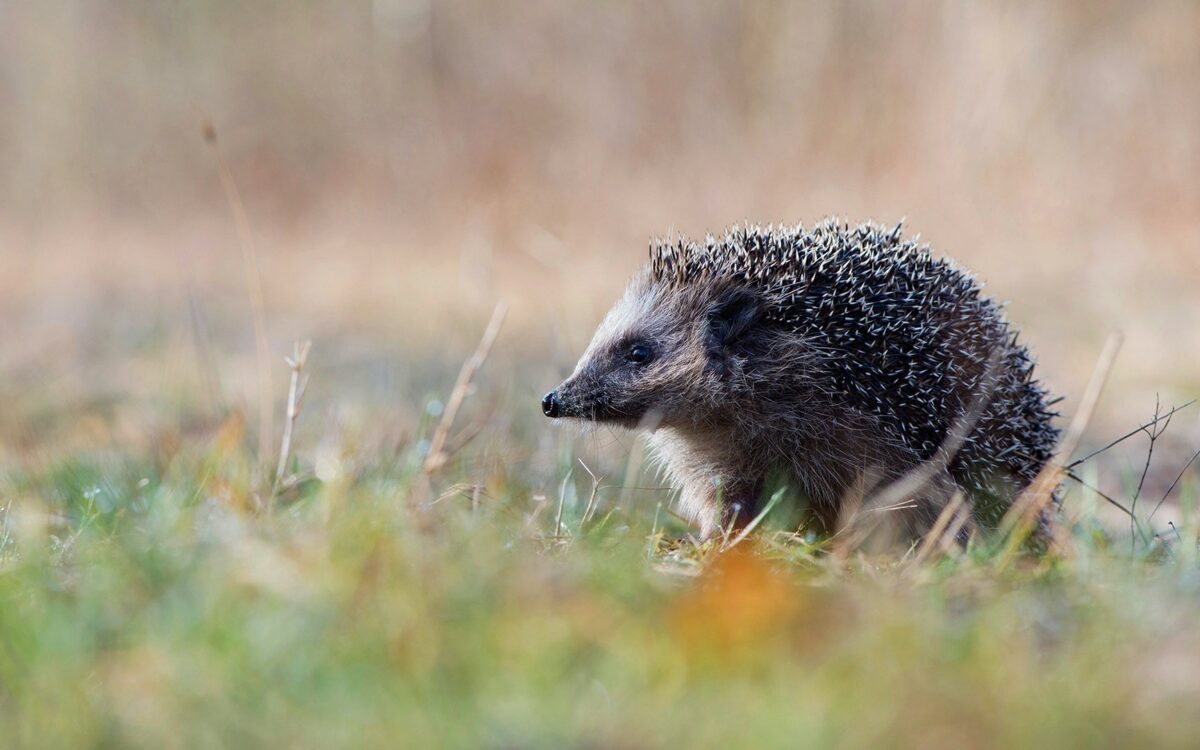
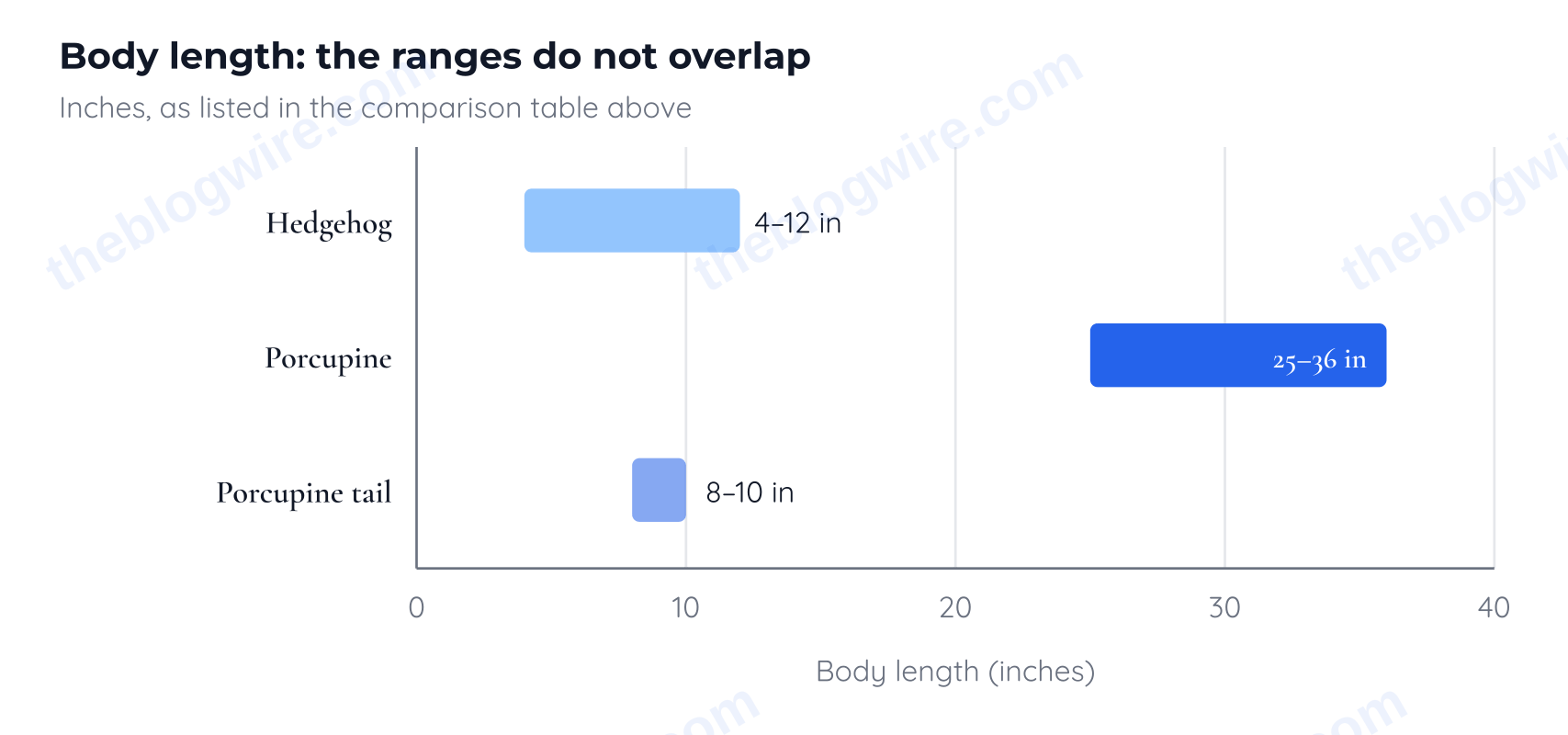
- Hedgehog: sharp pointed snout, body 4–12 inches, spines of even length at roughly 1 inch, and a short tail you would not comment on.
- Porcupine: blunt rounded nose, body 25–36 inches plus a quilled tail of 8–10 inches, quills of mixed lengths from 2–3 inches up to around a foot in African crested porcupines.
A quilled tail is close to decisive on its own. Hedgehogs do not have one.
If all you have is a photo
Having just a photo isn’t helpful, but if you know the weight, hedgehogs are between 5 ounces and 3.5 pounds. Porcupines range from 12 to 35 pounds and crested porcupines can reach up to 27 kg. If you can’t identify the size of the animal from the photo, consider the body shape. A hedgehog’s spiny coat is most of its visible body, whereas a porcupine’s quills are on the top of a large, obviously heavy animal.
Also, movement can help. Hedgehogs move low to the ground and ball up when disturbed; porcupines move like the big rodents they are.
Hedgehog vs porcupine: the differences that actually matter
| Criterion | Hedgehog | Porcupine |
|---|---|---|
| Classification | Erinaceidae (not a rodent) | Rodentia — Hystricidae or Erethizontidae |
| Body length | 4–12 in | 25–36 in (60–90 cm) |
| Weight | 5 oz – 3.5 lb | 12–35 lb; crested to 27 kg |
| Snout | Sharp, pointed | Blunt, rounded |
| Tail | Short, unremarkable | 8–10 in, quilled and rattled |
| Spine count | ~5,000–6,000 | More than 30,000 |
| Spine length | ~1 in, even throughout | 2–3 in typical, to ~12–13 in (African crested) |
| Barbed? | No | Yes |
| Detachable? | No — firmly anchored | Yes — on contact, or shaken loose |
| Defence | Rolls into a ball | Turns its back, fans quills, reverses in |
| Diet | Omnivore, mostly insects | Herbivore — leaves, twigs, bark |
| Native range | Europe, Asia, Africa | Africa, southern Europe, Asia, the Americas |
| Lifespan | 2–4 yr (small species) to 4–7 yr wild; 8–10 yr captive | Up to ~27 yr wild; one captive animal, Cooper, passed 32 |
Three rows do most of the work. Size is the one you will notice first — there is no overlap at all between a 3.5-pound animal and a 12-pound one. Snout shape confirms it. And quill behaviour is what matters if the animal is close enough to touch you or your dog.
The lifespan row is worth a second look, too. Porcupines are the longest-living rodents, and a porcupine can outlive three generations of hedgehogs.
What is the difference between hedgehog spines and porcupine quills?
Porcupine quills and hedgehog spines are very similar. Both are modified hairs stiffened with keratin and both are hollow. Neither of the animals are venomous. Other than that they are very different.
Hedgehog spines are firmly attached to their skin; however, they are not barbed and do shed and regrow them one at a time. Porcupine quills are loosely attached by design. They come out upon contact or from a flick of the tail and sometimes just drop out when the animal shakes itself.
Can porcupines shoot their quills?
No. This is the single most persistent myth about the animal. A porcupine cannot launch or fire quills at range. They come out upon contact and sometimes just drop out — that is the whole mechanism. If a quill reaches you, something touched something.
Why the two spine types are built differently
This is the part the comparison pages skip and is the real answer. Vincent and Owers, writing in the Journal of Zoology in 1986, worked out the mechanics. Porcupine quills are designed to be as long as they can be without bending easily under load along their axis, and they are built to break at the tip. Hedgehog spines are designed to be as short as they can be and still bend. The design of a hedgehog spine delays local buckling, thus absorbing more mechanical energy.
A porcupine quill is a detachable weapon, and a hedgehog spine is a shock absorber. A hedgehog spine is meant to come back and be used again, and a porcupine quill is meant to stay with the attacker.
Are they dangerous to people or dogs?
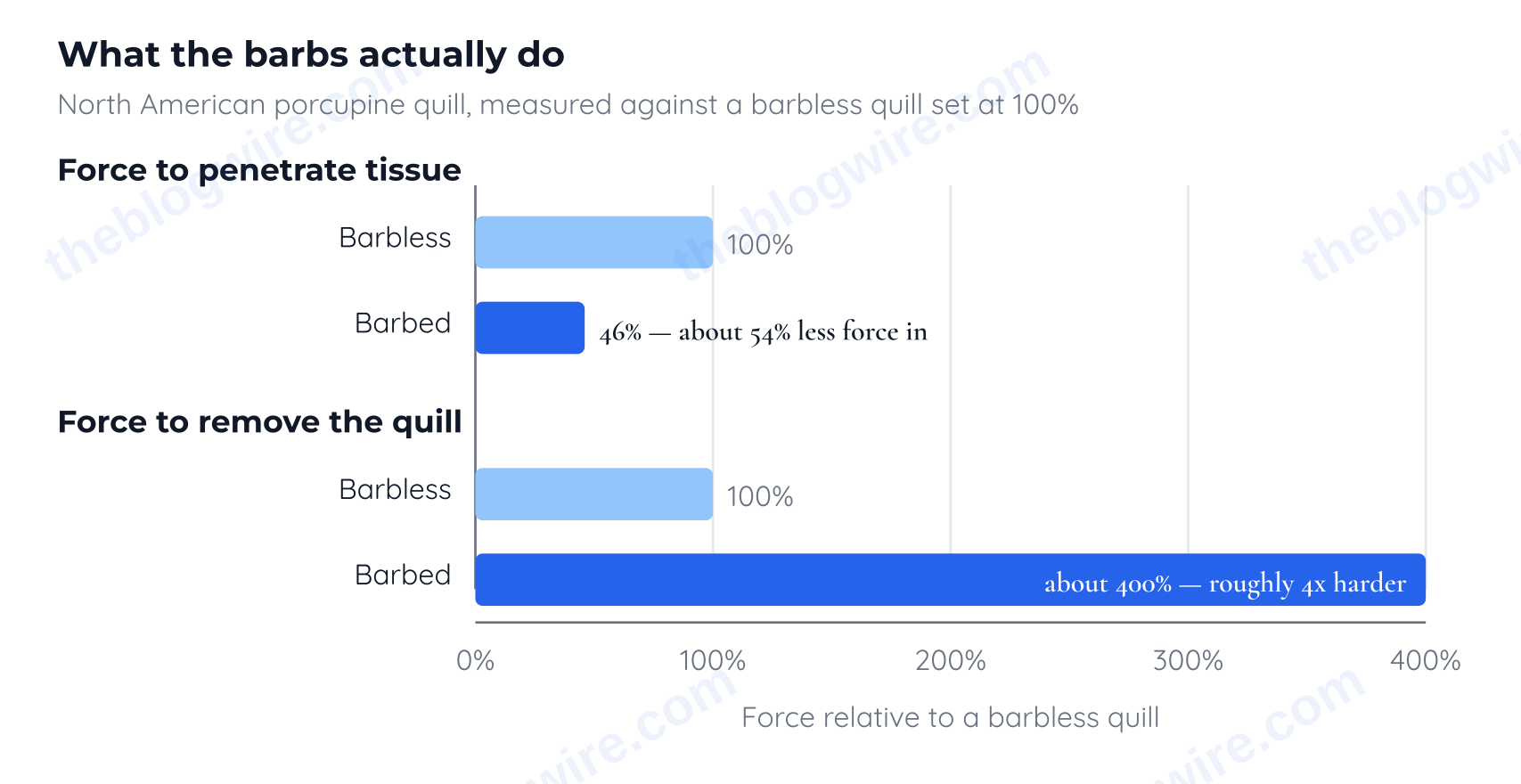
There are real numbers on this. Cho and colleagues, publishing in PNAS in 2012, measured what the microscopic barbs on a North American porcupine quill actually do. They measured what happens when you try to insert a porcupine quill into tissue and what happens when you try to remove it. They found that the barbs cut the force needed to penetrate tissue by about 54% compared with a barbless quill, while it takes roughly 4x more effort to remove the quill. The barbs actually concentrate the stress while going in. They also acted as anchors coming out.
A quill going in is not a big deal and is why dogs get quilled. When going out, it’s a different story — a porcupine quill slides in with little resistance and then fights you on the way out, which is why quilled dogs end up at the vet. A hedgehog spine stings, can draw blood if you press on it, and then stays on the hedgehog.
How does each animal defend itself?
Neither of them attack. They’re both built to make attacking them a bad idea.
Hedgehogs can roll into a tight ball, and can use their subcutaneous muscles to bring their legs, belly and head inside, to make the spines radiate outward in all direction. The ball is completely closed, and is an entirely passive defence. They also self-anoint, working irritant or toxic substances into their spines.
A hedgehog does face you. An angry porcupine doesn’t. It turns its back, raises and fans the quills, rattles the hollow quills in its tail, stomps its feet and reverses into the threat. Here’s why: a hedgehog is small enough to armour itself completely, but a porcupine is far too large to curl up. So a porcupine presents a loaded, mobile surface instead.
If you meet either one: leave a hedgehog balled up — it will uncurl on its own time. Back away from a porcupine with its tail rattling. It’s warning you, and that is a genuine warning rather than a bluff. It will not chase you.
Where do they live, and do their ranges overlap?
Most comparison pages give a clean split of ranges. Porcupines in the Americas; hedgehogs elsewhere. That is incorrect for about 1/3 of porcupine species.
Hedgehogs are in parts of Europe, Asia and Africa. No hedgehogs are native to the Americas or Australia, and they live in New Zealand only because they were introduced. Porcupines, though, come in two families. Old World porcupines (Hystricidae) are in Africa, southern Europe and Asia. The New World porcupines (Erethizontidae) cover the Americas, and many of them climb trees.
The two genuinely overlap in parts of Africa, southern Europe and parts of Asia. A Southern African hedgehog and a Cape porcupine share the same countries. If you are there, range tells you nothing — go back to the snout and the tail. Range settles a hedgehog vs porcupine question reliably only in the Americas, where any spiny mammal is a porcupine, because no hedgehog is native at all.
Where they overlap, habitat still differs. Porcupines tend to favor forest and grassland habitats, along with rocky hillsides, while hedgehogs tend to favor hedgerows, gardens, farmland and woodland edges. Deserts are common porcupine habitats. One more bit of context worth carrying: UK hedgehog populations have fallen somewhere between 30% and 75% since 2000, which makes the hedgehog a conservation story in a way the porcupine generally is not.
What do they eat, and can you keep either one?
Hedgehogs tend to be insectivorous omnivores — insects, snails, slugs, frogs and toads, snakes, bird eggs, carrion, mushrooms, grass roots, berries and melons. A hedgehog in a garden is a welcome visitor for most, as it tends to eat slugs, snails and other garden pests. Porcupines are fairly herbivorous: leaves, herbs, twigs and green plants such as clover, leaving bark for the winter. That is why foresters, not gardeners, treat them as a nuisance.
Diet also explains the teeth. A porcupine has to have incisors that never stop growing in order to strip bark off trees. An insect-eater needs canines and a lot of small teeth.
On pets: owning African pygmy hedgehogs — Atelerix albiventris, the four-toed hedgehog — is restricted in different ways. As of 2019, they were illegal in Hawaii, Georgia, Pennsylvania, California, New York City, and Washington D.C., and in some Canadian municipalities. Check your local laws, don’t assume. The rules differ jurisdictionally and change.
While a pet porcupine is not possible for numerous reasons — a dog-sized body, a lifespan past 25 years, a browsing herbivore’s diet and more than 30,000 barbed quills — both animals are nocturnal and solitary, which is probably why they are confused with each other in a dark garden.
What about echidnas — the third spiny lookalike?
The searches that start “hedgehog vs porcupine” often turn out to be about the third spiny lookalike, the echidna. An egg-laying monotreme native to Australia and New Guinea, the echidna comes from a lineage that split off from placental mammals long before either of the other two existed. Per Natural Habitat Adventures, echidnas range from 14 to 30 inches long and 5.5 to 22 pounds with up to 5 inch spines.
Echidnas are easily recognizable. They have no teeth at all, a long, tube-shaped snout, a tongue up to 6 inches long, and heavy digging claws and backward-pointing hind feet.
The three-way rule is short. Pointed snout and teeth, hedgehog. Blunt nose, big body, quilled tail, porcupine. Tube snout, no teeth, reversed hind feet, echidna. And if the picture was taken in Australia, it is an echidna; the other two are not native there.
So which is it?
There is one fact that helps to definitively answer this: porcupines are rodents and hedgehogs are not. So differences in body size, quill design, type of food eaten, and what the defence is are all variables that are solved two different ways in two unrelated animals.
This taxonomy is not often needed. Note which continent you are on and pay attention to the snout and the tail. If you need to identify which species it is, read up on the one that is most likely: the European hedgehog, the North American porcupine, or the short-beaked echidna.
As a rule of thumb, a pointed snout means hedgehog, a quilled tail means porcupine, and no teeth at all means you are looking at an echidna. You’ll find more guides like this across The Blog Wire.