You are comparing two trips. One has you in Rio in a numbered seat to see twelve samba schools parade in front of you. The other has you in Salvador for six hours standing, shoulder to shoulder inside a roped-off bloco behind a sound truck the size of a bus. Both are Brazil Carnival, and most people do not tell you the differences before you book.
This guide covers the ins and outs of Brazil Carnival: what the festival actually is, why its date moves, where it came from, each of the four big city Carnivals, the costs for 2027, and which of the Carnivals is for you. Brazil Carnival is a five-day pre-Lenten festival held nationwide, running from the Friday before Ash Wednesday through Fat Tuesday. Its date shifts each year with the Christian calendar. In 2027 it falls 5–9 February, centred on Rio’s Sambadrome parades, Salvador’s trios elétricos, and the free street blocos of Recife and Olinda.
What is Brazil Carnival, and why does the country celebrate it?
It is a time to party before the fast. Carnival is the sanctioned time of excess before the 40 days of Lent, ending on Fat Tuesday (Terça-feira Gorda), the night before Ash Wednesday. Royal Caribbean’s festival guide describes it as a five-day celebration starting on the Friday before Ash Wednesday and ending on Fat Tuesday.
The pre-Lenten calendar in one paragraph
You do not need to be Catholic to follow this. Lent is the period of abstinence in the Christian calendar during which meat, alcohol and rich food are traditionally given up. The release valve built into the system is Carnival. The scale of the festival comes from that build-up, released all at once at the last possible moment. The Brazilian tourism board’s official Carnival overview is right to treat Carnival as Brazil’s most important and significant cultural festivity rather than as a single scheduled event.
A festival of many cities, not one event
Newcomers usually get this wrong. Carnival is not a single parade. Most of it is not ticketed. A variety of street parties dominate the celebrations. Rio, Salvador, Recife, Olinda, São Paulo, Florianópolis and Ouro Preto each run their own version, and the music, access rules and crowds differ between the cities. Free carnival street events and parties — blocos de rua — are the main popular expression of Brazilian Carnival, while paid parties are comparatively minor.
The scale is easier to grasp in numbers. Rio brings around two million people into the streets daily. Salvador has a Guinness World Record for the largest street party on Earth. Recife’s Galo da Madrugada is the biggest carnival parade in the world, according to the Guinness Book of World Records, pulling in a crowd of more than 2,500,000 at its 2013 outing. There are three different records, held by three different cities, and people get them confused all the time.
When is Carnival in Brazil in 2027 — and why does the date move every year?
Friday 5 February to Tuesday 9 February 2027, with Ash Wednesday on 10 February. Now, the rule behind it that almost no guide bothers to give you.
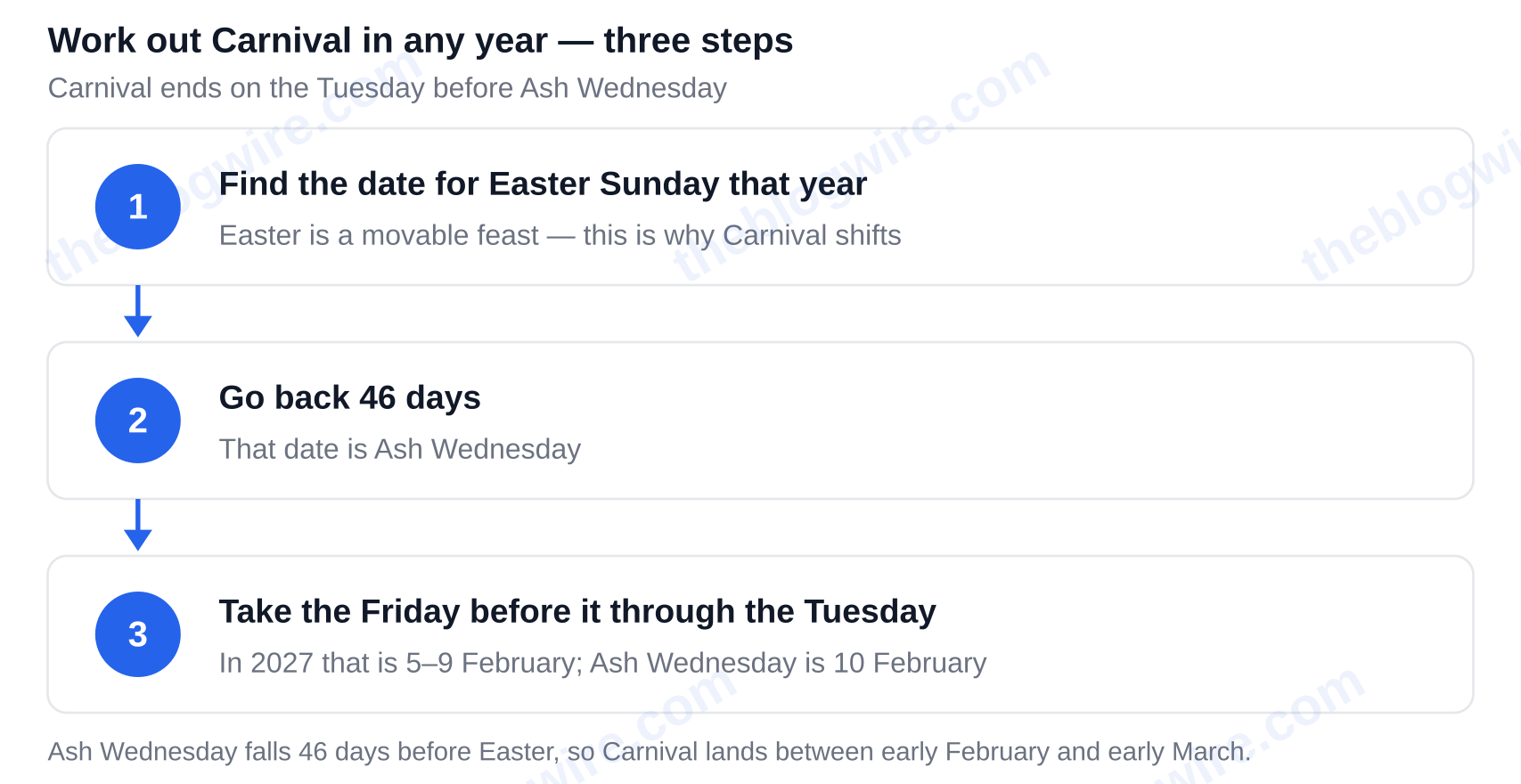
Carnival ends on the Tuesday before Ash Wednesday. Ash Wednesday is 46 days before Easter. Since Easter is a movable feast, Carnival changes between early February and early March, year to year. “February or March” is the symptom, not the answer.
To figure out any future year yourself, follow these three steps:
- Find the date for Easter Sunday for that year.
- Go back 46 days — that is Ash Wednesday.
- The five-day core is the Friday before it through the Tuesday.
How long Carnival lasts
Traditionally the national core is five days, but cities extend it. Salvador runs from the afternoon of Thursday 4 February 2027 until midday of Wednesday 10 February 2027 — a week on its feet. Recife’s Galo da Madrugada always parades on the first Saturday, which in 2027 is 6 February. Rio adds a Champions’ Parade afterwards.
This is effectively a de facto national holiday period, so plan for the disruption: transport, hotels and many businesses reorganise themselves around these dates, and the Monday and Tuesday are effectively shut.
Rio Carnival 2027: night-by-night schedule
Rio Times Online’s schedule for 2027 has the Sambadrome separated into two tiers:
- Friday 5 and Saturday 6 February — Série Ouro (Group A) schools parade.
- Sunday 7 to Tuesday 9 February — the 12 Grupo Especial (Special Group) schools, the main event.
- Saturday 13 February — the Champions’ Parade, where the top-placed schools run it again.
If you only have one night, take Sunday, Monday or Tuesday. The Special Group schools are a must, but the Série Ouro nights feature strong schools too, and cost less.
Where did Brazilian Carnival come from?
It arrived as a Portuguese import and became something else entirely.
From entrudo to the first Rio Carnival in 1723
One of the great traditions brought by the Portuguese to Brazil was entrudo, a rowdy pre-Lent street fight where participants threw flour, water and food at each other. The first Carnival festival in Rio de Janeiro took place in 1723. Through the 19th century there was a distinction between the wealthy and the poor. The upper class withdrew from the chaos of entrudo to European-style organized masked balls and processions, a spectacle from where the origins of Carnival as a produced show began to be established.
How samba and the samba schools took over
The most important aspect is the part that was added last. Samba and batucada rhythms, which have their roots in the traditions of enslaved Africans and their descendants, began being performed during Carnival in the 1920s by the early carnival blocks. Through the 1920s and 1930s the blocks formalized into samba schools, and by 1930 there were seven active schools in Rio. The formalization and institutionalization of the schools produced the competitive parade format the world now watches on television.
The spectacle itself is a Black Brazilian cultural creation built on a European religious calendar. The music is regional as well. In Pernambuco the music is frevo and maracatu, and axé arrived in Bahia later. For these reasons, the four Carnivals are not just visually distinct — they sound nothing like each other. Musical forms carry their own structures, and repetition is a subject in its own right, as with strophic form in music.
Rio, Salvador, Recife or Olinda — which Brazilian Carnival should you actually go to?
This comparison is rarely laid out in one place. Dates are on one site, prices are on another, and access models are hardly explained in English at all. The access model, not the city’s reputation, is what decides whether you have a good time. Here they are, side by side, for 2027.
The 2027 city-by-city comparison
| City | 2027 dates | Music | What you actually do | Access model | Real cost |
|---|---|---|---|---|---|
| Rio de Janeiro | Sambadrome 7–9 Feb (Série Ouro 5–6 Feb; Champions’ Parade 13 Feb) | Samba | Sit in a stand and watch a judged production; free street blocos citywide alongside | Ticketed seat, bought months ahead | Grandstand from about R$250 (~US$50) a night; frisas R$1,835–R$10,200; camarotes well above US$1,150 |
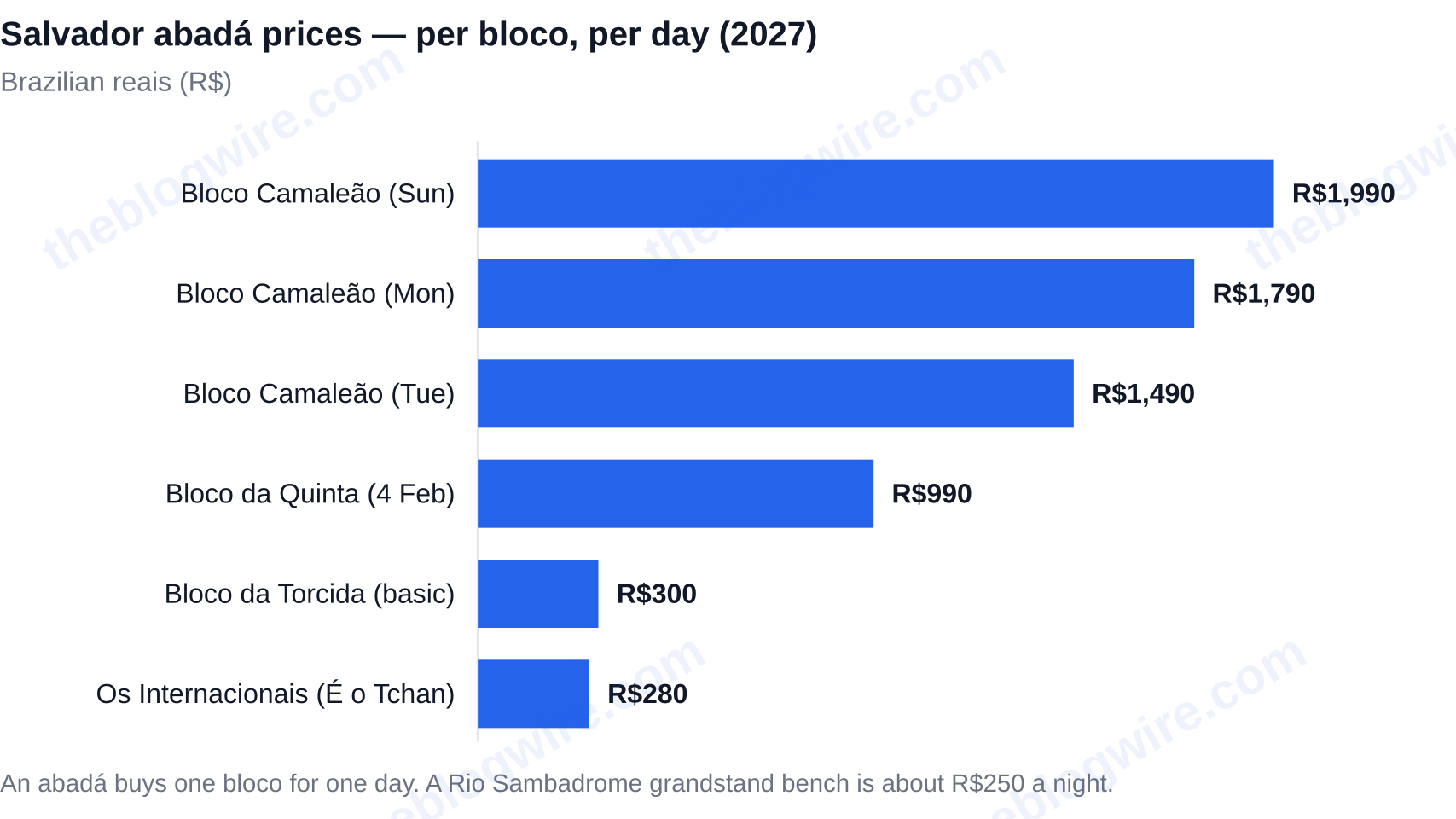
| Salvador | Afternoon of 4 Feb to midday 10 Feb | Axé | Walk and dance for about six hours inside a roped bloco behind a trio elétrico, on the Barra–Ondina or Campo Grande circuits | Paid abadá, per bloco per day | Bloco Camaleão with Bell Marques R$1,990 (Sun), R$1,790 (Mon), R$1,490 (Tue); Bloco da Quinta R$990 (4 Feb); Os Internacionais with É o Tchan on Campo Grande R$280; Bloco da Torcida basic abadá R$300 |
| Recife | Galo da Madrugada Sat 6 Feb, from 9 AM | Frevo, maracatu | Join the world’s largest carnival parade — 30 trios elétricos, six allegorical floats, a 6.5 km route from Praça Sérgio Loreto | Free, just turn up | Nothing to enter; food, drink and a bed are the only costs |
| Olinda | Alongside Recife, 5–9 Feb | Frevo, maracatu | Walk steep cobblestone hills among giant puppets; no stage, no stand, no barrier | Free, entirely on foot | Nothing at all |
Recife’s 2027 Galo parade will feature the theme Ao Canto do Galo, a Espora é a Lança, honouring the caboclo de lança and rural maracatu, and is expected to draw over 2.5 million people.
Which one is right for you — a simple decision rule
- Want to see a world-class production? Go to Rio.
- Want to be in the party rather than watching it? Go to Salvador.
- Want the largest free crowd on the planet? Go to Recife.
- Want charm and hills and no money spent? Go to Olinda.
- Short on time and money? Don’t go to Rio.
Who should not go to Rio
The default advice is to go to Rio and buy a Sambadrome ticket. That advice is wrong for three identifiable types of travelers.
First, the budget traveler. Hostel dorm beds often cost US$80–100 or more a night during Carnival and that’s before you buy a ticket to the parade which may already be sold out. Olinda gives you a full Carnival for the price of your food.
Second, anyone who wants to dance. The Sambadrome is a seated event. If your mental image of Carnival is you moving through a crowd, you’re buying the wrong product. Carnival in Salvador happens entirely in the streets.
Third, anyone who thinks street Carnival is universally free. Two things are true at once here. Blocos de rua are generally free. The headline blocos in Salvador are paid. Blocos in Recife and Olinda cost nothing. A R$1,990 abadá is not a street party in the same sense.
Other things worth mentioning for a second trip include Ouro Preto’s student-republic Carnival in the colonial hills, Florianópolis, and São Paulo’s Anhembi parades.
How much does Carnival cost, and when do tickets actually go on sale?
“Expensive” and “book early” are not plans. Here is what Brazil Carnival actually costs, with a deadline.
Sambadrome ticket types and 2027 prices
Learn the four seat types, or the ticket pages will be unreadable: arquibancada (open grandstand bench), cadeira (numbered chair), frisa (a box at runway level), camarote (covered VIP box with hospitality).
| Seat type | What it is | 2027 price a night |
|---|---|---|
| Arquibancada (special sectors) | Open grandstand bench | About R$250 (~US$50); half price R$125 |
| Frisa (six people) | Box at runway level | R$1,835–R$10,200 (~US$366–US$2,032) |
| Camarote | Covered VIP box with hospitality | Well above US$1,150 |
| Sectors 12 and 13 | The most popular grandstand sectors | Not yet announced |
To plan ahead, per Carnavalrio.eu’s Sambadrome ticket guide, grandstand tickets for the Sambadrome for 2027 went on sale in August 2026. They sold out shortly afterwards, so about six months prior to the parade is your planning window.
Buy from the source. LIESA, the league of samba schools that runs the parade, sells Sambadrome seats online through Ticketmaster Brasil as its official 2027 seller. Check who you are actually paying — resellers add a markup.
Abadás in Salvador — the other pricing model
Salvador bills differently. You purchase an abadá per bloco per day, so if you wanted to go with Bloco Camaleão for example, for three headline days, you’re looking at approx. R$1,990, R$1,790 and R$1,490 respectively. That’s a few times more than a single Sambadrome grandstand seat. You can find cheaper options at the same Carnival, like R$280 for Os Internacionais with É o Tchan on Campo Grande, or R$300 for a basic Bloco da Torcida abadá. Mix tiers rather than assuming one price.
Do you have to pay to attend Carnival at all?
No. Aside from the blocos being free, street food and beer remain cheap, and Recife and Olinda can be done on almost nothing. The real budget shock is a bed: surge pricing hits all four cities, dorms run US$80–100+ a night, and minimum-stay requirements are common. Book lodging before anything else.
What should you know before you go — safety, clothing and the parade itself?
Weather, and specifically the heat, will affect every single decision you make at Brazil Carnival. February is peak Brazilian summer: hot, humid, relentless. Plan for the heat and especially for sun, shade and serious hydration before you plan anything else.
Heat, clothing and footwear
For footwear, wear closed shoes you can stand in for eight hours. Sandals will not survive Olinda’s cobblestone hills, or any day that runs from a 9 AM parade start into the night. Take light clothing, costumes and masks, nothing precious you would mind losing.
Staying safe in Carnival crowds
While violent crime is relatively low during Carnival, pickpocketing in dense crowds is still common. The best way to avoid this is to carry minimal cash, leave jewellery at the hotel, and put nothing in a back pocket. You also want to make sure your phone is secured on you at all times. Lastly, drink only what is made in front of you or something that comes in a sealed can, never accept an open drink, and stay with the people you arrived with.
You also want to plan ahead and book flights, accommodation and any Sambadrome ticket months out. Internal Brazilian flights around Carnival sell out and spike hard.
How to read a samba school parade
In the Sambadrome each Special Group school gets a certain time window on the runway. Each school is judged on ten criteria, including enredo (the theme), samba-enredo (the theme song) and harmony. Watch for four things. Look for the carnavalesco, who designs the entire production. Listen for the bateria, the drum section that drives it. Look for the allegorical floats. Lastly, look for whether every single person in the parade is genuinely singing along to the samba-enredo with the lead singer. That is harmony, being judged in front of you.
One small change: learn the chorus of the samba-enredo before you arrive. Singing along makes a bystander into a participant.
Three things to take away
First, the date. Brazil Carnival in 2027 runs 5–9 February, and the rule behind it is Tuesday-before-Ash-Wednesday, 46 days before Easter. You can work out any other year from that rule.
Second, the choice. For the Sambadrome spectacle, Rio. If you want to dance behind a trio elétrico, come to Salvador. Recife and Olinda are the biggest free street Carnival on Earth.
Third, the booking order. Decide on your city from the table above first. Then book accommodation before anything else, because lodging sells out and surges harder than tickets — and if Rio is the pick, Ticketmaster Brasil’s on-sale date lands roughly six months ahead.