Most owners see yellow on the floor and assume it’s vomit from poisoning. False. If you find yourself wondering “why is my dog throwing up yellow?”, it’s most likely bile — a fat-digesting fluid made in the liver and stored in the gallbladder. A long time between meals causes the bile to build up, and then when an empty stomach is irritated by the bile, it is then thrown up. Bile is not caused by an illness.
This article provides the whole picture. It answers what bile is and why the color yellow is only a category. It helps answer when you should monitor and when you should go to an emergency veterinarian clinic. It provides first steps to take and what the consequences are if the first steps do not help. Finally, it answers the one clear sign that takes precedence over the color. It also answers a contradiction on the most read articles about the symptom. The withholding of food is the worst thing to do if bile is the most likely cause.
What is the yellow stuff my dog threw up?
It is bile. The liver makes it, the gallbladder stores it, and it gets released into the small intestine to break down fats. That is the whole job.
In the absence of food moving downstream, bile can flow back across the pylorus and into the stomach. Once there, it can cause damage. As described in the clinical literature for bilious vomiting syndrome, bile salts interfere with the gastric mucosal barrier — the lining’s own protection — which lets stomach acid irritate the tissue underneath. This injury is termed gastritis, and can lead to the vomiting of bile.
An empty stomach is the common denominator of most cases, and accounts for the appearance of the vomitus, i.e. thin and yellow, or yellow foam, instead of vomitus that contains food. GreatPetCare notes that yellow foam specifically is often a blend of gastric fluid, mucus and bile, which is what you get when there is almost nothing left in the stomach to bring up.
Does yellow vomit always mean bile?
No, and this is where the vast majority of published information on this subject subtly contradicts itself.
Yellow is a category, not a diagnosis. It covers bile, gastric mucus, chewed plants and grass, yellow treats and kibble, dye from a chewed toy, and in some cases chemicals or toxins. GreatPetCare touch on this one, all-inclusive, reference point, and state a dog may have vomited yellow food or a toy, or yellow plants and grass, and then abandon the thought.
So read what is actually in front of you. Thin yellow liquid and yellow foam point to an empty stomach. Yellow-green with grass fragments shows what your dog was chewing in the garden. Unnaturally bright or Neon yellow can be food coloring, a chewed up object, or a chemical. That one deserves a same-day call rather than a morning of watching.
Noticing this signal is important. In the section of the Merck Veterinary Manual that is targeted to the owner regarding vomiting in dogs, they do not organize the problem based on color at all. Furthermore, they do not single out bile or bilious vomiting as a category. The most general and authoritative reference regarding canine vomiting does organize by cause — digestive disease, kidney or liver failure, pancreatitis, nervous system disorders, ingestion of irritants and poisons — not by what landed on the carpet. That, in effect, tells you how important the color of the vomitus is. The color indicates an empty stomach, and not much else. Diagnosing the problem lies more in your dog’s behavior and when and how often it is vomiting.
Vomiting vs. regurgitation — and why the difference matters
Check this before anything else. Vomiting is active: abdominal heaving, usually preceded by drooling, lip-licking or restlessness. Regurgitation is passive — undigested material simply comes back up with no effort, which Merck describes as motion that does not require abdominal muscle contraction.
If it’s regurgitation, you want to look at the oesophagus instead of the stomach. The whole diagnostic direction changes, and it’s something you should know before you tell your vet. It’s also important to know some of the broader reasons a dog throws up, so you can ask your vet about the right course of action in the right situation.
So why is my dog throwing up yellow in the morning but acting totally fine?
The medical name for this condition is bilious vomiting syndrome, duodenal-gastric reflux, or reflux gastritis syndrome. This is the most common reason for yellow vomiting in an otherwise healthy dog.
A classical presentation means the case is often easy to recognize. Your dog throws up yellow liquid or foam, usually in the early morning hours or during the night after having a long fast. They then eat their breakfast enthusiastically. The rest of the day, they act completely normally. They don’t show any signs of lethargy or pain. They don’t have diarrhea. The only sign that something is wrong is their one early morning (or night) vomiting episode.
In this case, Joii Pet Care says the contributing factors for this syndrome include too long of a gap between meals, gastric acid irritating an empty stomach, backflow of bile, slower-than-normal stomach emptying and altered intestinal motility. Two of those are motility problems. Meal timing is the most effective way to manage this, but if that doesn’t help, then it may be related to other motility issues that might require more aggressive treatment.
One thing that’s often not mentioned is that bilious vomiting syndrome is a diagnosis of exclusion. It is confirmed once everything else has been ruled out and the dog is overall healthy. So, “acting fine” is part of the picture — not a reason to avoid the vet indefinitely. Plenty of owners “normalize” a weekly morning bile vomit for a few months before they bring it up at a routine appointment.
The two things nobody tells you: fasting can make it worse, and colour is the least useful clue
Read the highest ranking pages for this symptom side by side and you will find an inconsistency that no one points out.
When fasting is right — and when it is the wrong move
All pages that rank highest for why is my dog throwing up yellow say bilious vomiting syndrome, explain that it is caused by an empty stomach and say to not give food after vomiting. On petMD’s page on dogs throwing up yellow bile, bilious vomiting syndrome is the first of six causes listed and they explain that an evening meal will remedy the syndrome, all on the same page as advising 12 to 24 hours of fasting after vomiting. GreatPetCare tells readers to withhold food and water for 12 hours, and then says an earlier breakfast and a late night snack will shorten the fasting time.
Combine all of this advice with a classic case of morning bile dog and you’ve extended the empty stomach time which caused the vomiting.
So state the rule plainly. Fasting is for a dog with suspected gastritis or dietary indiscretion that is still actively vomiting. Keep in mind that fasting is not the correct treatment for a bright, otherwise normal, morning-only bile vomiter. In that case, the overnight gap should be shortened.
Many of the home-care numbers also vary. petMD states that a 12 to 24-hour fasting period, with water in small amounts after three to four hours, is the recommended treatment. GreatPetCare, however, states that 12 hours of withholding both food and water is recommended, and then a small meal of a bland diet is given. That disagreement is itself the argument for deciding by clinical picture rather than by the clock.
The sign that outranks the colour: unproductive retching and a hard belly
The yellow-vomit pages list “bloating” as a bulleted point among a series of red-flag bullets for yellow vomiting. They do not explain the most important aspect, and it is counterintuitive: the alarming sign is the absence of vomit.
GDV is a veterinary emergency and has a rapid time frame. In the case of suspected GDV, surgery is required to correct. BluePearl Pet Hospital describes unproductive retching as the hallmark of gastric dilatation and volvulus — the dog acts as though trying to vomit but nothing, or almost nothing, comes up, typically alongside a tight, distended belly. GDV can quickly become fatal in as little as four to six hours. Every suspected case is an emergency.
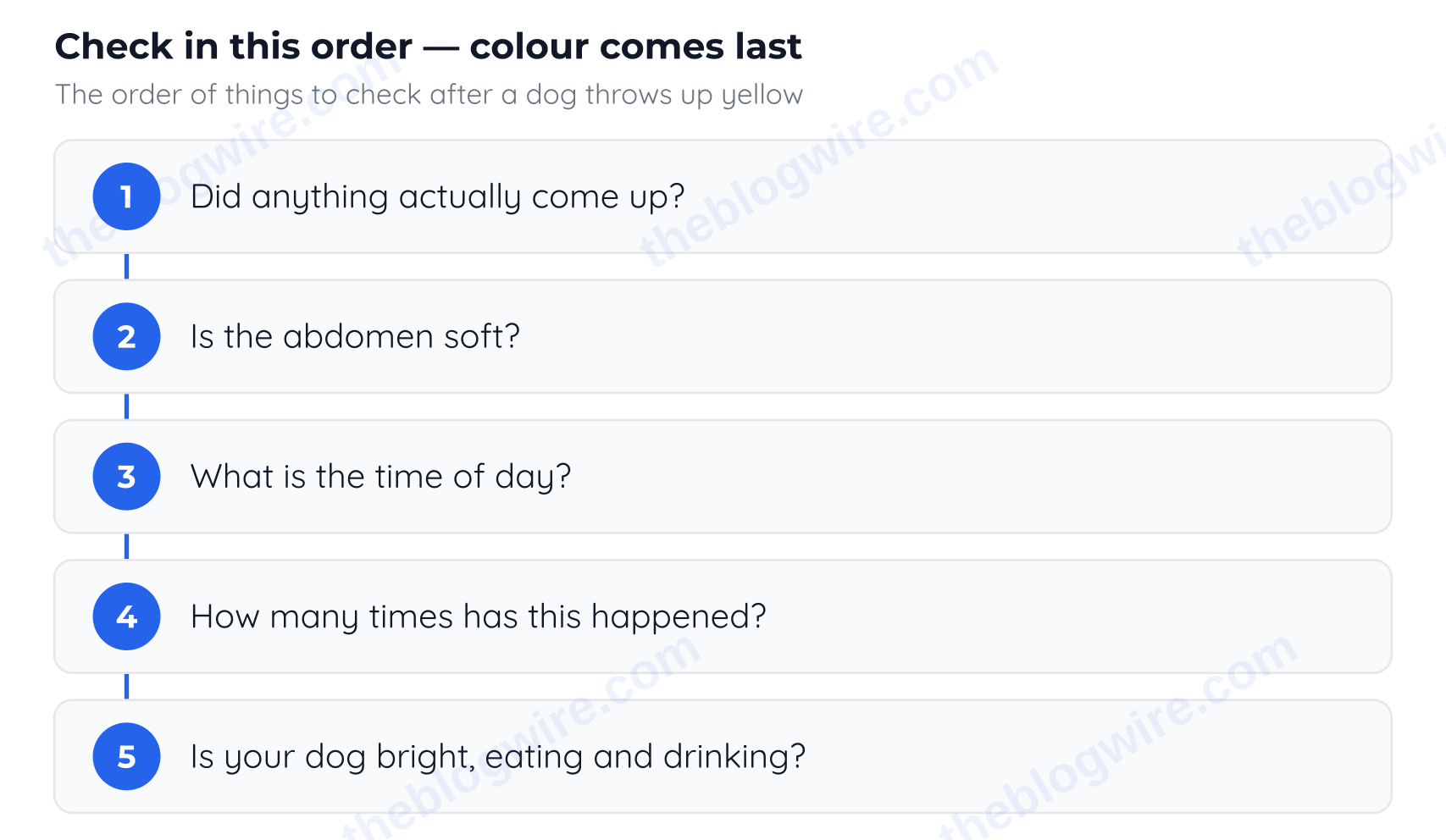
This gives you the discriminator that none of the yellow-vomit pages hands over. A dog that has succeeded in bringing up yellow and has a soft abdomen is a different clinical picture to one that is retching unproductively with a firm/swollen abdomen. So the order of things to check is, did anything come up, is the abdomen soft, what is the time of day, how many times has this happened and is your dog bright, eating and drinking?
What else causes a dog to vomit yellow?
Bilious vomiting syndrome is the most likely explanation, not the only one. Here are some of the important causes, drawn from the petMD and Merck’s resources:
- Gastritis and dietary indiscretion — from scavenging, bin raiding, sudden change in diet, eating rich and fatty food.
- Pancreatitis — petMD says it can occur as early as 24 hours and typically three to five days after the fatty meal, and is usually seen with abdominal pain, lethargy and repeated vomiting.
- Intestinal blockage or a gastrointestinal foreign body — from chewing on or swallowing a toy, bone or fabric. Usually seen with repeated vomiting, absence of defecation, and a painful abdomen.
- Other gastrointestinal disease — inflammatory disease, ulcers, infections and parasites and, in older dogs, cancer.
- Food allergy or intolerance — petMD reports that most pets develop food allergies between one and five years of age, and diagnosis requires a strict 12-week diet trial.
- Systemic disease — liver and gallbladder disease, kidney failure and Addison’s disease (hypoadrenocorticism), where vomiting is just one of the signs.
- Toxin or irritant ingestion — especially with very bright yellow, or unsupervised access to chemicals or plants.
One pattern separates all of these from bilious vomiting syndrome: they produce vomiting at any time of day rather than only on an empty stomach, usually more than once, and almost always with something else wrong alongside it.
Is a dog throwing up yellow an emergency?
Not usually. Normally, yellow vomit is not an emergency, especially if the dog is bright, alert, eating, drinking, passing stool and acting normally. That dog can reasonably be monitored at home.
Monitor at home, same-day vet, or ER now
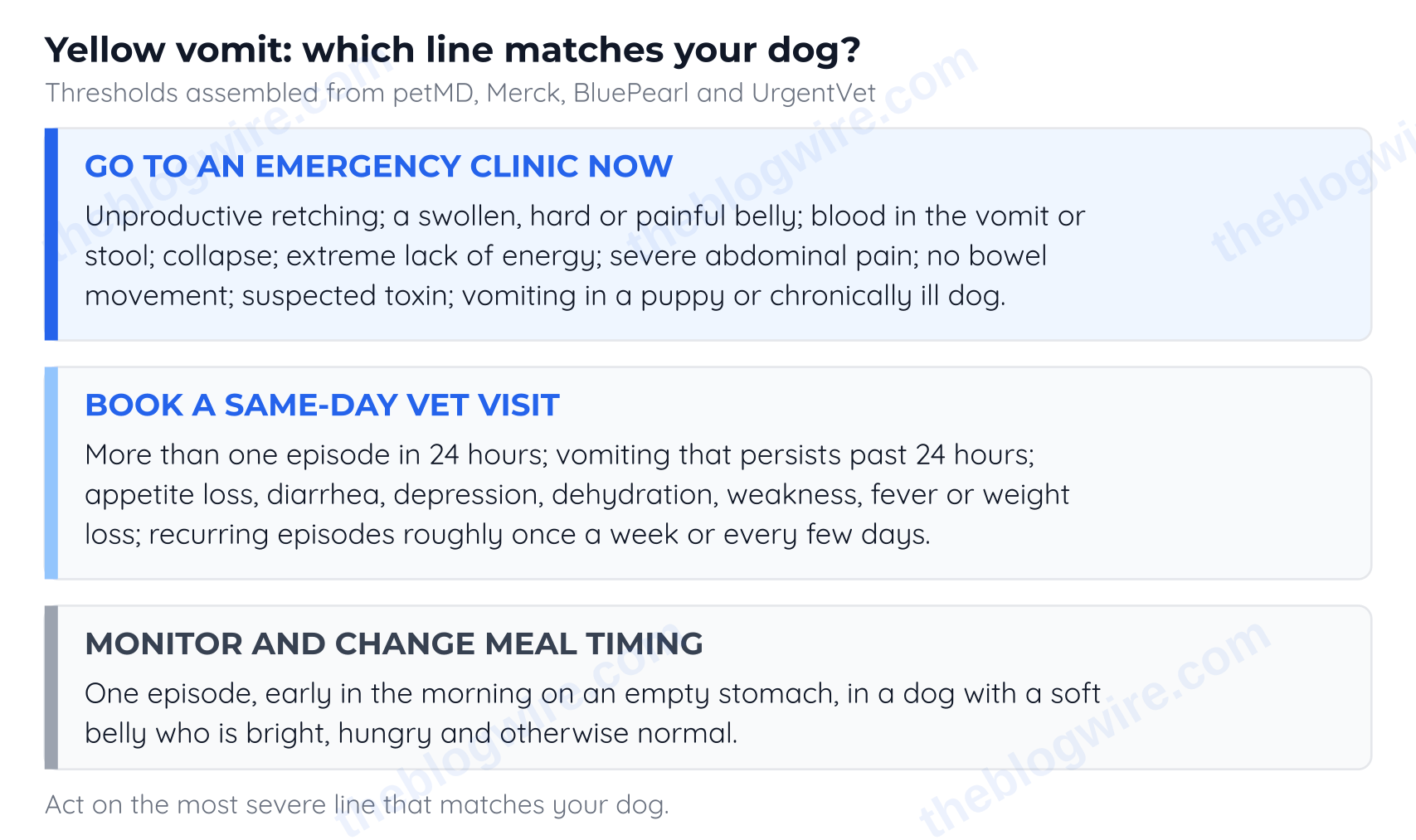
The thresholds exist as three separate numbers on three separate sources and nowhere as one rule. Assembled, they look like this — act on the most severe line that matches your dog.
- Go to an emergency clinic now: unproductive retching; a swollen, hard or painful belly; blood in the vomit or stool; collapse; extreme lack of energy; severe abdominal pain; no bowel movement; suspected toxin ingestion; or vomiting in a puppy or a dog with a known chronic illness. petMD flags extreme lethargy and severe abdominal pain as immediate-care signs; BluePearl’s four-to-six-hour GDV window is why unproductive retching allows no waiting.
- Book a same-day vet visit: more than one episode in 24 hours (petMD’s threshold), if vomiting persists past 24 hours, or if vomiting is accompanied by appetite loss, diarrhea, depression, dehydration, weakness, fever or weight loss — the accompanying signs Merck says warrant detailed examination, along with vomiting more often than once or twice daily.
- Monitor and change meal timing: one episode, early in the morning on an empty stomach, in a dog with a soft belly who is bright, hungry and otherwise normal.
One threshold most pages miss entirely: UrgentVet also mentions that recurring episodes of yellow bile — roughly once a week, or every few days — should warrant a vet visit, even if the individual episodes are mild. If you have a dog that is throwing up yellow every Tuesday morning for example, and is otherwise normal, that frequency is the finding. Mention it.
What should I do at home right after my dog throws up yellow?
Based on the three observations provided — what came up, how the belly feels, and how the dog is acting — determine which situation you are in, and then read the scenarios below to see if anything is applicable.
For a bright dog that is still actively vomiting or had a clear scavenging episode: give the GI tract a short food rest for around 12 hours, and no longer without veterinary guidance, then offer small amounts of water after a few hours rather than a full bowl. Food can be reintroduced as a small, bland, easily digestible meal. Merck describes teaspoon-sized portions of easily digested food; plain boiled chicken and rice or a vet-recommended gastrointestinal diet both work. Food can be gradually returned to normal over the course of two to three days.
What about the dog that only vomits in the morning? For this case, fasting is not required and the overnight food gap should be shortened instead. Joii Pet Care’s recommendation is to provide a small, high-protein, dry food, late-evening snack to help occupy the dog’s stomach overnight, paired with an earlier breakfast.
A few hard lines. Do not withhold water from a dog that has vomited repeatedly. Never fast a puppy, a very small dog, a diabetic dog or a lethargic dog, call your vet instead. Do not use human antacids or anti-sickness medications. Do not try to induce vomiting unless instructed to do so by your vet or a poison control center. Always write down when, the appearance and number of times your dog vomits as well as what your dog may have eaten. That note is what shortens the appointment.
What if the late-night snack doesn’t fix it?
This is the question that the ranking pages don’t answer. They give you the late-night snack and stop there.
Try a structured approach to see if the changes in meal-timing help: give the late-evening snack and an earlier breakfast a defined trial of about one to two weeks, and see if there’s any improvement. Keep track of which mornings produced vomit. If morning vomiting persists through that trial, that persistence may be an indication that something else is causing the problem, and is the signal to have other causes excluded rather than something to continue adjusting the meal timing by another half hour.
What your vet will check
Your vet will likely perform a physical examination and palpate your dog’s abdomen to see if there is anything abnormal. They will also likely take some blood, urine, and feces samples, as well as take abdominal radiographs to check for potential blockages and organ disease. That is the work that turns bilious vomiting syndrome from a guess into a genuine diagnosis of exclusion.
Treatment options when meal timing isn’t enough
If the meal timings don’t help, there are other medications your vet may prescribe. Prokinetic drugs may help to speed up the emptying of the stomach and reduce the flow of bile. H2 blockers reduce acid. Antiemetics control the vomiting itself. In addition to the timing of the meals, some dogs may also need medication, and the reason for this is mechanical, i.e. a dog’s stomach may be emptying too slowly, or the motility of the intestines may not be normal, and meal timing is unable to fix that on its own.
In the long term, the management of your dog’s vomiting is unglamorous but effective and includes the following: consistently sticking to your dog’s meal timing, keeping the overnight gap short, gradually transitioning your dog to a new food if a change is made, controlling your dog’s parasites, and ensuring your dog has no access to bins (or places where they can scavenge).
The short version, and what to watch next
Yellow usually means an empty stomach and bile. For a dog that’s bright, and hungry, and only vomits in the early morning, the solution isn’t fasting, which will only feed the exact cause; the solution is to reduce the gap overnight, which is the real issue. The color of the vomit is the least important thing to be looked at. The important things are whether anything came up, whether the belly is soft, how often it is happening, and how your dog is behaving.
So, check the demeanor and the belly. If the abdomen is soft and your dog is bright after a single episode, give a small snack at the end of the night, bring breakfast forward tomorrow, and log every episode. You should contact the vet if yellow vomiting continues past a two-week trial, if it happens more than once in 24 hours, if it recurs weekly, or if it comes with retching that produces nothing.
What is changing in this area is the framing itself. Veterinary references already sort canine vomiting by cause and clinical picture rather than by color, and the pages that owners look at the most still lead with what the stain looks like. Expect better owner-facing information to change in line with the references — moving toward timing, frequency, abdominal feel and demeanor as the things worth writing down, with the color demoted to a footnote. Start writing that down now and you will be ahead of it.
People Also Ask
How soon after my dog vomits yellow can I give water?
If your dog vomited once and is otherwise bright, give water in several small amounts rather than a full bowl — petMD’s guidance is water in small amounts within three to four hours of the episode. Small and frequent beats a big drink, which can trigger another round of vomiting. Never withhold water from a dog that has vomited repeatedly, because dehydration becomes the bigger risk. If your dog can’t keep even small sips down, that is a same-day vet call.
What’s the difference between a dog vomiting yellow bile and yellow foam?
Not much, clinically. Thin yellow liquid is largely bile. Yellow foam, as GreatPetCare describes it, is a mixture of gastric fluid, mucus and bile, appearing when very little food remains in the stomach. Both of these mean that the stomach is empty. From a practical perspective, the difference between vomiting bile and foam changes nothing about what you do next; other factors come into play when determining next steps, such as timing, how frequent the vomiting is, how the abdomen feels, and how your dog is behaving.
Can stress or anxiety make a dog throw up yellow bile?
Stress can certainly upset a dog’s stomach and disturb their appetite, which in turn affects how long the stomach sits empty — and an empty stomach is the mechanism behind bile vomiting. Merck’s list of causes of vomiting in dogs mentions nervous system disorders alongside digestive disease, pancreatitis, and kidney or liver failure, so behavioural and neurological factors are not irrelevant. In practice, treat stress as a possible contributor rather than a diagnosis, and if the vomiting is recurring, have other causes excluded first.
Why is my dog throwing up yellow and eating grass at the same time?
There are a few things that could be occurring. Grass and plant matter can themselves make vomit look yellow or yellow-green, so some of what you are seeing may not be bile at all. Dogs also often eat grass when their stomach feels uncomfortable, including the acid-and-bile irritation behind bilious vomiting syndrome. If your dog is bright, eating well and only doing it in the early morning, shorten the overnight gap and log it. However, if grass eating comes with repeated vomiting, lethargy or appetite loss, then you may want to book a vet visit.