

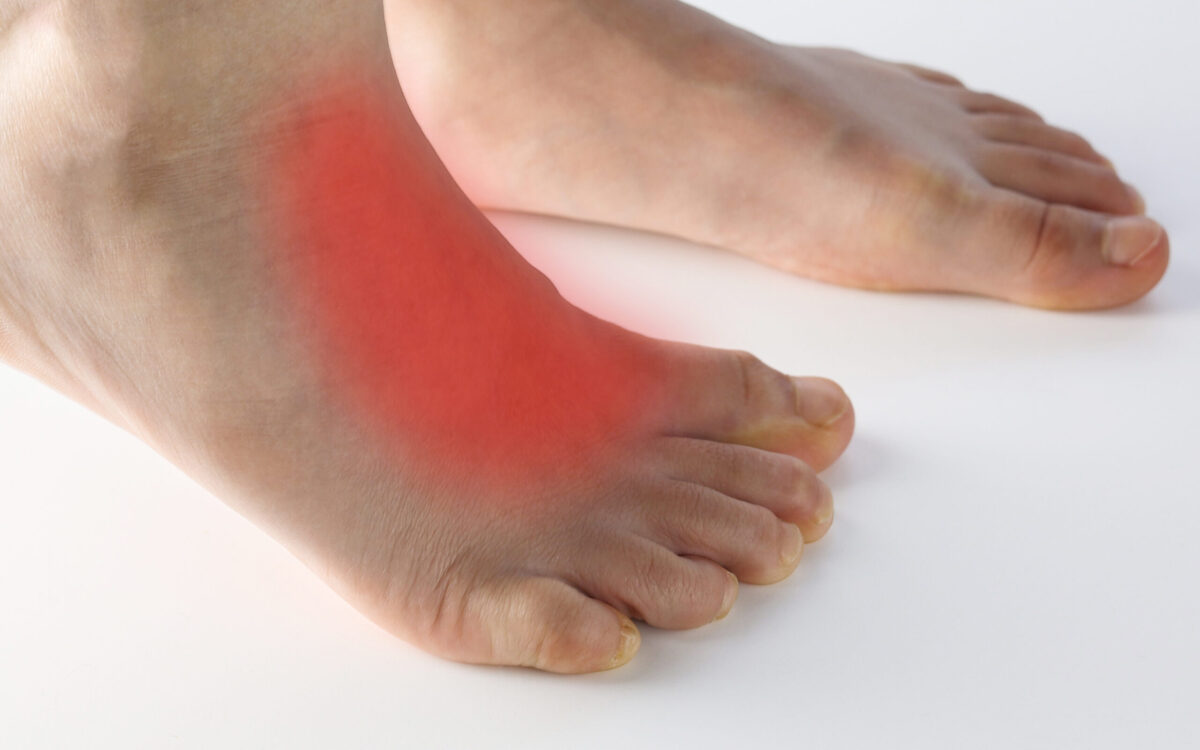
This article covers all the most common reasons for big toe pain, how to differentiate them in about thirty seconds, and which ones require urgent vs. non-urgent evaluation. So, why does my big toe hurt? The most common reasons are: hallux rigidus (arthritis) of the big toe joint, gout, bunions, sesamoiditis, “turf toe” and big toe fractures. Quickly differentiating the reason for your pain can be determined by where it’s located, and how quickly the pain developed.
Start with the number that reframes the whole page. A population-based radiographic study published in October 2025 in Osteoarthritis and Cartilage Open found hallux rigidus in 23.5% of participants (25.1% of men and 22.8% of women). Nearly a quarter. The consumer pages that rank for this question quote a figure roughly ten times smaller, and that’s why most of the time, people rule out arthritis before they even consider pressing on the joint.
Where Does It Hurt, and How Fast Did It Start?
Two questions are better at sifting through the causes of your symptoms: where exactly it’s hurting, and how quickly the pain developed.
Every ranking page simply lists the same seven causes in the same order and expects you to figure out which one pertains to you. Here is the matrix instead.
The 30-Second Location-and-Onset Table
| Where it hurts | How fast it started | Most likely cause |
|---|---|---|
| Top of the joint, worse as you bend the toe upward | Gradual, months to years | Hallux rigidus (big toe arthritis) |
| Directly underneath the joint, worse on push-off | Gradual, weeks to months | Sesamoiditis |
| The whole joint, sometimes bruising underneath | One forced upward bend of the toe | Turf toe |
| Bony bump on the inner edge of the foot, toe drifting toward the second toe | Gradual, years | Bunion (hallux valgus) |
| Whole joint red, hot and swollen, no injury | Hours — often overnight | Gout |
| The nail edge, red and tender to touch | Days | Ingrown toenail (onychocryptosis) |
| Burning, tingling or numbness rather than joint pain | Gradual | Peripheral neuropathy |
How to Press on Your Own Toe Properly
The table is based on a documented exam finding. The dorsal (top) surface of the first metatarsophalangeal (MTP) joint is the tender spot in hallux rigidus. The plantar surface underneath is tender in sesamoid problems. Clinicians use that split to separate the two and you can use it yourself.
Using only one fingertip, press on the dorsal surface of the joint, and then press on the plantar surface of the joint directly below it. Repeat these two presses on your other foot for comparison. Also, note which spot hurt more, and note if the pain has been building up for one day or a year.
It should be noted, however, that this only narrows the field. It does not rule out the need for an X-ray or joint fluid analysis.
Is It Really “Too Young for Arthritis”? What the Newest Data Says
The majority of people questioning if one can get big toe arthritis at a younger age assume that big toe arthritis is a condition of old age. While the pages that rank may be quiet on this topic, in clinical practice this is the assumption that leads to a delay in diagnosis the most.
The 1-in-40 Figure Everyone Quotes
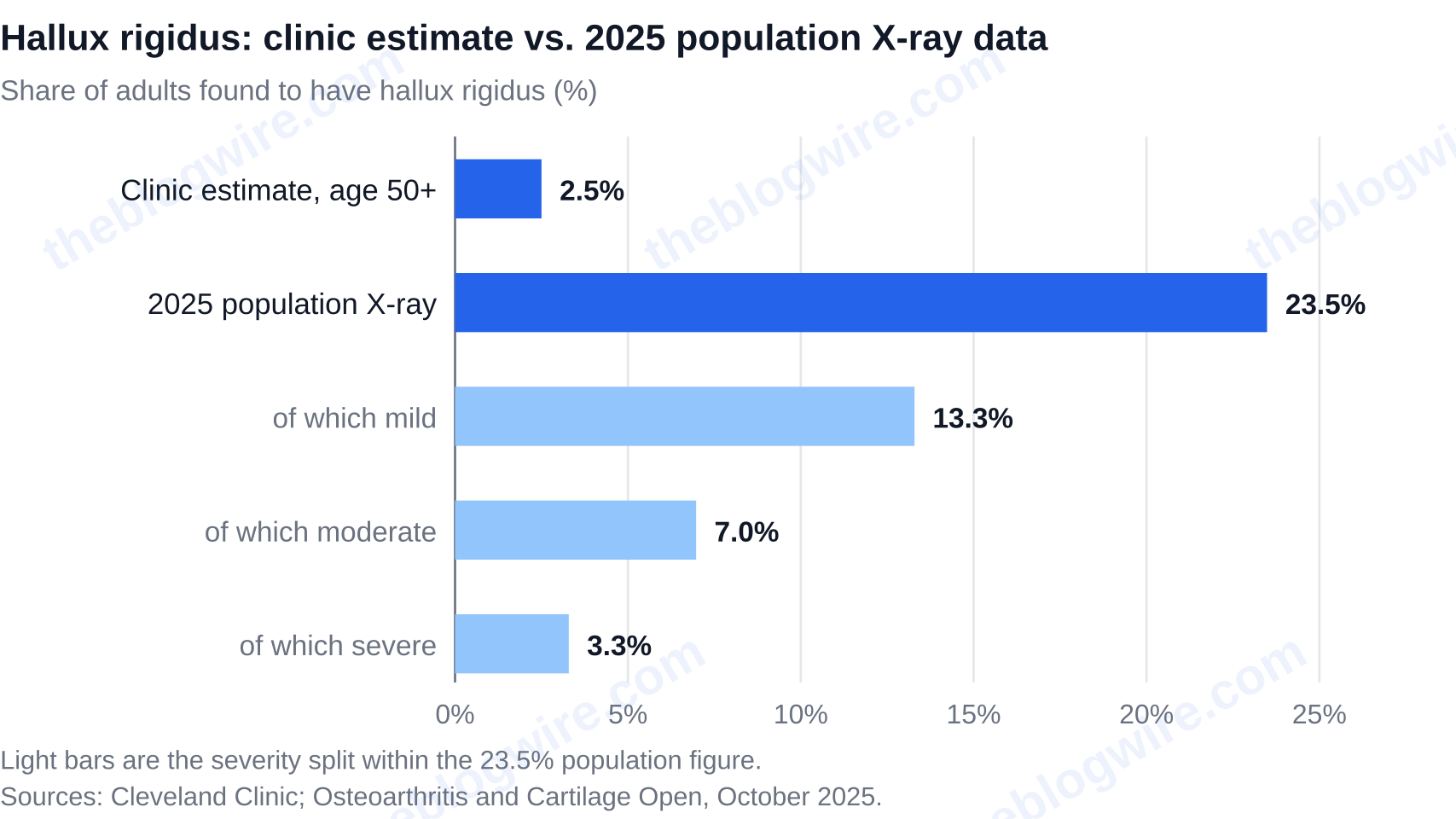
Cleveland Clinic, the source most consumer explainers lean on, estimates that about 1 in 40 adults older than 50 have hallux rigidus (about 2.5% of that population). It is most common between ages 30 and 60. This figure is repeated in almost all articles on this topic.
The 23.5% Figure Almost Nobody Does
October 2025’s cohort analyzed something different and found a much higher rate of 23.5% overall (with little to no difference between males and females). Mild 13.3% cases, moderate 7.0% cases and severe 3.3% cases were found. It was found to affect one foot in 6.6% of the cases and both feet in 17.0% of the cases. Older age, gout and knee osteoarthritis were independently associated with it.
Both numbers are correct and reflect different things. The 1-in-40 figure reflects cases diagnosed at a clinic, and the 23.5% figure reflects cases found in the general population where x-rays show findings of bony changes, most of which are mild. Either way, the point is the same, and that is, “it can’t be arthritis at my age” is a much weaker assumption than the top results show, and that, in fact, hallux rigidus should be placed at the top of the differential diagnosis rather than at the bottom.
For reference, clinicians grade it 0 to 4 by lost movement, with 0 reflecting 10 to 20% reduced mobility and 4 reflecting 75 to 100% loss of movement with severe pain.
Why Would My Big Toe Suddenly Turn Red, Hot and Swollen Overnight?
That is a classic presentation of gout — it is gout until proven otherwise. The pain comes on rapidly, often over the course of a few hours, and can be so severe as to wake you from sleep. Often the sheet feels too heavy to bear on the affected area.
The Gout Pattern in Plain Terms
Gout affects this specific joint. Podagra (the first MTP joint) makes up approximately 50% of the first gout attacks, and nearly 90% of people with gout develop podagra at some point. Hyperuricemia promotes the formation of monosodium urate crystals in joints. Gout is becoming more and more prevalent. NHANES 2017–2018 reported approximately 5.1% of adults in the US (about 12.1 million people) have gout, up from roughly 3.9% about 10 years prior.
Why Gout Is a Same-Day Call, Not a Two-Week One
Here is where the standard advice inverts. Almost every resource on big toe pain says that you should see a doctor if you don’t get better after approximately 2 weeks. For gout (the fastest onset of the list), that threshold is completely wrong.
According to the 2020 American College of Rheumatology guideline, NSAIDs, glucocorticoids, and colchicine should all be considered co-equal first-line flare therapy, with treatment as soon as symptoms begin (ideally within the first 24 hours) recommended. For equal efficacy with fewer side effects, low-dose colchicine is preferred: 1.2 mg at the first sign, then 0.6 mg an hour later.
Therefore, the rule is split, not single. Gradual joint stiffness can definitely wait 2 weeks. A joint that is red, hot and swollen, that came on suddenly overnight with no injury, is a call that needs to be made today.
When Is a Hot, Swollen Big Toe an Emergency?
None of the resources ranking for this question name the thing that looks exactly like gout on day 1.
Gout vs. Joint Infection: The Fever Test
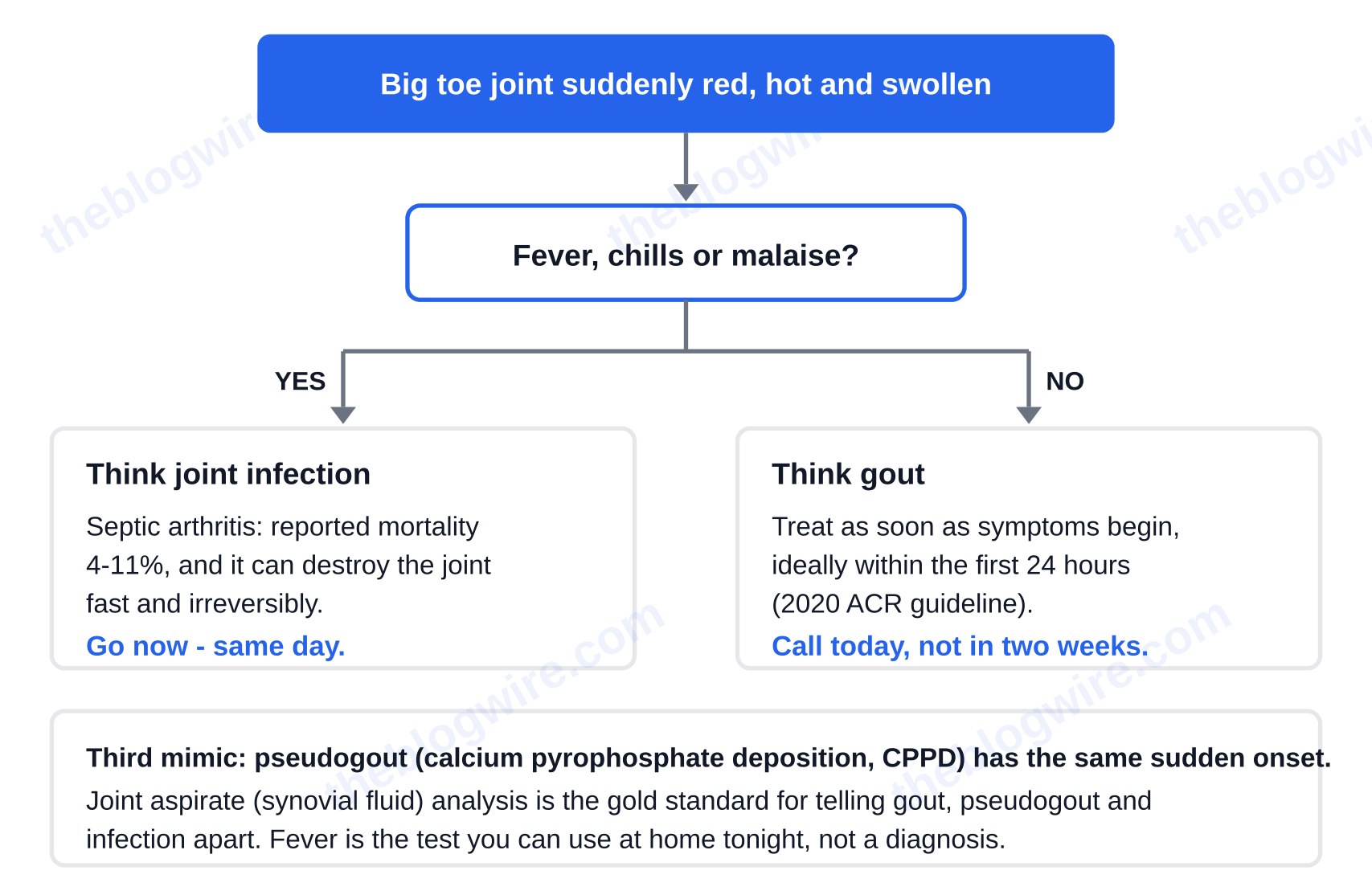
Septic arthritis, a bacterial joint infection, can quickly cause joint swelling, warmth and intense pain. It is a rheumatologic emergency with reported mortality of 4–11% and if not treated quickly it can also destroy the joint fast and irreversibly.
Tonight, you can use fever to differentiate. With fever and systemic symptoms (chills and malaise) and joint pain, think infection. Without, think gout. Pseudogout — calcium pyrophosphate deposition (CPPD) — is a third mimic with the same sudden onset of sharp joint pain and swelling. Clinicians use analysis of joint aspirate (synovial fluid) to differentiate all three, and that is the gold standard.
Red Flags That Mean Go Now
- A hot, swollen joint with fever, chills or malaise
- An injury you can’t put any weight on
- Obvious toe deformity
- Redness spreading up the foot
- New numbness in the toe or foot
- Any foot problem at all if you have diabetes — neuropathy and diabetes-related foot risk change the stakes completely
The hot, swollen toe with fever is not an ice and wait situation.
What Causes Big Toe Pain With No Injury at All?
Big toe pain with no injury is common. Specialists at Nebraska Medicine say arthritis, bunions and gout are the three most common causes, and that arthritis at the big toe (knuckle) presents itself as pain, stiffness and a pinching sensation on top when the toe bends.
The Mechanical Causes
Hallux rigidus is when the big toe joint is stiff with the gradual development of pain on top of the joint as the toe bends upward. With time, the joint can form a visible bony overgrowth — a dorsal osteophyte — which can get caught in shoes. Hallux limitus is the earlier, less restricted form of the same problem.
A bunion is a bony prominence on the inside of the foot at the big toe joint, with the toe drifting toward the second toe. The pain usually comes from constant irritation from shoes rubbing the bump rather than from inside the joint.
Sesamoiditis is gradual, well-localized pain in the ball of the foot under the big toe over the sesamoid bones. It is often worse when pushing off the foot. It is more common in dancers and runners.
Ingrown toenails often occur when a nail is cut too short or too curved which causes the edge to dig into the toe. It is very painful, red and swollen at the nail edge. A corn or callus is a pressure area which can be painful and formed from shoes rubbing or not fitting correctly.
The Inflammatory and Nerve Causes
Psoriatic arthritis, rheumatoid arthritis, lupus and Raynaud’s phenomenon can all affect the big toe. The clue to making the diagnosis is a pattern of joint pain in other areas of the body. These are the cases where a rheumatologist is the right specialist rather than a foot surgeon.
Peripheral neuropathy is different again. It produces a burning, tingling or numb sensation rather than mechanical joint pain, and pressing on the joint usually does not reproduce it.
Could an Injury Be Behind It — Even One You Don’t Remember?
A sprain of the first MTP joint and the plantar plate beneath it from a single forced upward bending of the toe is known as turf toe. The term “turf toe” is related to the sports injury classically occurring on hard playing surfaces. Pain spans the whole joint and bruising can occur beneath the joint.
Fracture of the big toe can occur from a stub or crush injury and is associated with bruising, swelling and difficulty bearing weight. Sprains and dislocations of the big toe joint occur from obvious traumatic events.
Stress fractures are the injuries that patients truly do not remember. There is no single incident — just pain that builds with load over weeks and eases with rest. If your pain tracks your mileage rather than any event, say so to the doctor.
The practical test: pain that stops you putting weight through the toe at all, or any visible deformity, is an imaging question, not a home-care question. A missed fracture treated as a sprain is the common and costly error here.
How Do I Stop My Big Toe From Hurting Tonight?
For most causes, the first 48 hours are the same. Rest and elevate the foot, ice for about 20 minutes every 2–3 hours, use light compression, and switch to wide, soft, stiff-soled shoes.
What to Do in the First 48 Hours
Shoes and insoles with rigid or rocker-bottom soles stop the joint from bending at the point where it hurts and are therefore good in hallux rigidus and sesamoiditis. Pain in these conditions comes from movement and not inflammation alone.
For medication, over the counter NSAIDs like ibuprofen are good, and acetaminophen is an alternative if you can’t take NSAIDs. With movement, find a happy medium with range-of-motion exercises to ease stiffness and full offloading for an injured joint or to give relief to a very inflamed joint.
At night, keep the foot elevated, and don’t let your bed sheet touch the joint. Should your toe suddenly start hurting at night, assume it’s the gout pattern until proven otherwise.
When Ibuprofen Is the Wrong Choice
There is an exception no top-ranking page addresses. If your kidney function is impaired, ibuprofen is definitely not the drug you want to reach for first. NSAIDs are best avoided at a creatinine clearance of 30 mL/min or below, or on hemodialysis. Colchicine is generally avoided in end-stage kidney disease, and it is not recommended for a flare-up in someone who is already using it as prophylaxis. Injection of glucocorticoids directly into the joint is preferred instead.
The exception, unfortunately, applies to a good portion of people reading this. People with gout and chronic kidney disease overlap a lot, meaning that a good portion of people reading this with a ‘hot’ big toe is exactly the people who should not reach for the ibuprofen every article recommends.
What Will a Doctor Do — and Which One Should I See?
The diagnostic sequence is predictable. History taking (how quickly did it start? Was there any injury? Have you had attacks before?) — then a physical exam with targeted pressing on the top versus the underside of the joint. Then X-rays to look for joint space, spurs and fractures, then blood tests, and joint fluid aspiration where crystal disease or infection is suspected.
Why a Normal Uric Acid Test Doesn’t Clear You
This is the trap that sends people home, reassured and in pain. As many as 42% of patients can have a normal serum urate level during an acute gout flare. Urate may fall temporarily during an attack. A value less than 6 mg/dL while your joint is red, swollen and painfully inflamed does not rule out gout.
If your uric acid level comes back “normal” and the joint still looks like gout, you should ask about joint aspiration to look for intracellular monosodium urate (MSU) crystals alongside polymorphonuclear leukocytes. That is the reference standard, not the blood test.
Beyond diagnosis, treatment escalates through prescription anti-inflammatories, a corticosteroid injection, custom orthotics, a protective boot for fractures, and physical therapy. When conservative care fails in hallux rigidus, surgery options run from cheilectomy — shaving the dorsal bone spur — through osteotomy, arthroplasty and arthrodesis. A symptomatic bunion is addressed with a bunionectomy.
Which Specialist for Which Pattern
- Podiatrist — most mechanical problems, nail issues, footwear and orthotics, and first-line foot care generally
- Orthopedic foot and ankle surgeon — fractures, more severe hallux rigidus, and bunions that require surgery
- Rheumatologist — suspected gout, recurrent flares, or inflammatory arthritis
On timing: a sudden red hot joint, or any fever with swelling, is the same day. An injury you cannot weight-bear on is the same day. Joint stiffness that does not improve after two weeks of honest home care warrants an appointment to book.
How Do I Keep It From Coming Back?
Footwear is the single biggest lever you control. To prevent further issues with your feet, try to wear footwear with a stiff sole if the joint is arthritic and a toe box that is wide and deep enough to accommodate your toes so that they do not rub on a bony bump. Toenails should be trimmed straight across and not too short to prevent recurrent ingrown nails.
In sport, be careful when ramping up mileage and push-off volume, and respect the symptoms of early soreness under the joint instead of training through it. Weight management reduces load through the first MTP joint and lowers gout risk at the same time.
If gout has been confirmed, long-term urate-lowering treatment and trigger awareness matter far more than how well you manage each individual flare. And keep a short log — onset speed, location, how long it lasted. That history is what makes the next diagnosis fast.
The baseline itself changes next, and for 2025, we have our first large-population radiographic hallux rigidus measurement — the first most consumer sources have had to reckon with. As that number works its way into clinical guidance and patient-facing pages, expect the default first diagnostic guess in a gradually stiffening joint to be hallux rigidus rather than an unusual diagnosis. Until then, the two details you already have — figuring out when it started and where it hurts — still outperform anything else you can do at home.
Most cases of big toe pain fall into a limited number of named conditions. Gradual joint stiffness, especially at the top of the joint, points in one direction and can wait. Swelling, especially if it’s hot and red and appeared overnight, points another, and should not. Your next best step is to press one fingertip on the top of the joint, then directly underneath it, and see which is more painful. Note how long the pain has been building, and take those two answers to a podiatrist — or, if there is any fever with the swelling, to urgent care today.
Frequently Asked Questions
Can big toe pain go away on its own, and how long should it take?
Often, it can. Mild pain from pressure from your shoe, an ingrown nail caught early, or a minor sprain usually settles on its own within a few days to about two weeks of rest, icing and wearing wider shoes. A flare of gout, however, should not be wait-and-seen. The 2020 American College of Rheumatology guideline recommends starting treatment within 24 hours of first symptoms, so a big toe that is all of a sudden very red, hot and swollen should not be given two weeks. Hallux rigidus and bunions do not go away on their own either — they are structural, and they tend to progress slowly rather than disappear, though the pain can be managed well.
Why does my big toe joint feel like it needs to crack or pop?
That nagging urge to pop the joint usually means that movement is being restricted rather than that something is loose. In hallux rigidus, the joint space narrows and a bony spur can form on top, so when you attempt to bend the toe upward it hits a hard stop and the joint feels jammed. As the Cleveland Clinic explains, they grade the condition by exactly that loss of movement, from 10–20% reduced mobility at the earliest grade to 75–100% loss with severe pain at the most advanced. If the stiffness came on gradually and the top of the joint is the tender spot when you press it, big toe arthritis is the likely explanation — not a joint that needs cracking.
Does big toe pain mean I have gout if I don’t drink alcohol?
Alcohol is not a prerequisite for gout — it is one trigger among several, and gout is still possible and common. NHANES 2017–2018 reported a gout prevalence of 5.1% of US adults, roughly 12.1 million people. The main driver is monosodium urate (MSU) crystals forming in the joint as a result of hyperuricemia. The big toe joint accounts for roughly 50% of first attacks. Be careful with blood tests here too: as many as 42% of people can show a normal serum urate level during an acute flare, so a normal result while the joint is red and severely painful does not rule gout out. Joint fluid analysis showing urate crystals is the reference standard.





1 comment