98.5 F to C works out to 36.94 °C, normally written as 36.9 °C. The arithmetic is (98.5 − 32) × 5/9 = 66.5 × 5/9 ≈ 36.94. As a body temperature, 36.94 °C sits inside the normal range and stays 1.9 °F below the 100.4 °F (38 °C) fever threshold, so it is not a fever.
An example: showing 98.5 °F on a thermometer will show 36.9 °C on the Celsius scale. Same temperature, different scale. What that number means depends on many things that most conversion sites do not tell you: the age of the person using the thermometer, which thermometer was used, and the time of day it was used.
What is 98.5 F to C?
98.5 degrees Fahrenheit is 36.94 degrees Celsius. You’ll see it rounded to 36.9 °C on a chart, and sometimes flattened to 37 °C in casual conversation.
The formula applied to 98.5 °F
The conversion is (°F − 32) × 5/9. With this value substituted in:
- Subtract 32 from 98.5 → 66.5
- Multiply 66.5 by 5/9 (0.5556) → 36.944
You have to do it in this order. Because the two scales have different degrees and different zero points, you’ll have to line up the zeros first, and then rescale. Doing it in the opposite order results in a number that is wrong by about 18 °C.
There is a mental shortcut — subtract 30 and halve it — but it fails here. (98.5 − 30) ÷ 2 = 34.25 °C, roughly 2.7 °C below the true figure. That is close enough for guessing at the weather and useless for a thermometer reading, where a tenth of a degree is the whole point.
Should you write 36.94 °C, 36.9 °C or 37 °C?
36.94 is the most accurate, and 36.9 is for everything related to the medical field, because clinical thermometers and health records work to one decimal place. 37 is used when people just want to round up — and that quietly drags your reading up toward the old 98.6 °F benchmark, which is the single biggest reason people misread this number.
Two asides worth knowing. Celsius and centigrade are the same scale, so an app or a nurse asking for either wants 36.9. And in Kelvin, 98.5 °F is 310.09 K — add 273.15 to the Celsius figure. Run it backwards and you land where you started: (36.94 × 9/5) + 32 = 98.5 °F. The two familiar scales agree on only one number, −40°.
Is 98.5 °F (36.94 °C) a fever?
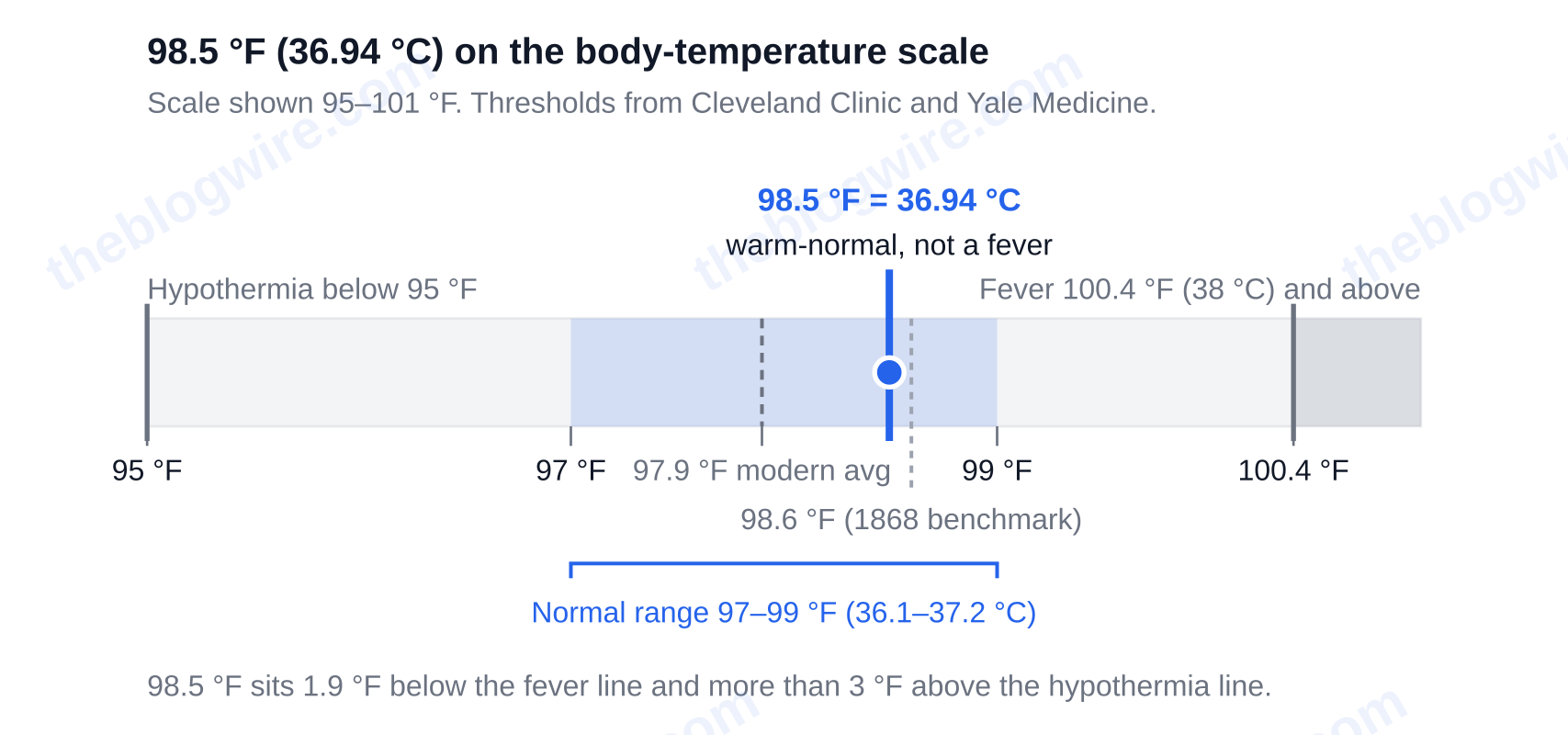
No. Cleveland Clinic puts the fever line at 100.4 °F (38 °C), which leaves 98.5 °F about 1.9 °F short of it. Additionally, the same source states that the general normal band is 97 to 99 °F (roughly 36.1 to 37.2 °C), and 36.94 °C sits in the upper half of that, well within this band.
What is the difference between 100.4 °F and the fever line? The fever line does not represent the boundary between normal and abnormal. It is the level at which it makes medical sense to begin treating the patient, call about the patient, or monitor the patient for a second day.
Where the 98.6 °F benchmark came from
Most people read 98.5 °F as slightly cool, and that is entirely the fault of one Victorian study. 1868 was the year that German physician Carl Reinhold August Wunderlich settled on the benchmark of 98.6 °F after taking more than a million temperature readings from 25,000 people, as Yale Medicine recounts. In 2026, that number is 158 years old, and modern data shows the adult average is actually lower. Based on today’s data, 98.5 °F is a normal-warm reading, not a cool one.
When a reading is actually too low
The useful range has a floor as well as a ceiling. Below 95 °F is classified as hypothermia by Yale Medicine, which classes it as a medical emergency. At 36.94 °C you are nowhere near it — 98.5 °F is more than 3 °F above that line.
Why 98.5 °F sits at the top of normal, not just under it
This is where almost every conversion page of 98.5 F to C gets it the wrong way around. Grade the reading against 98.6 °F and it looks slightly low. Grade it against the current data and it is on the warm side of what is considered typical.
What the modern average actually is
Stanford Medicine’s 2023 analysis of 618,306 oral temperature measurements taken at Stanford Health Care between 2008 and 2017 found an average adult oral temperature of 97.9 °F, with most individuals’ normal falling between 97.3 °F and 98.2 °F.
Put 98.5 °F against that, and it is at or just above the top of the normal range of the typical individual, which is about 0.6 °F above the population average, not 0.1 °F below some universal standard. Dr. Julie Parsonnet, one of the study authors, explains it like this: “Most people, including many doctors, still think that everyone’s normal temperature is 98.6 F. In fact what’s normal depends on the person and the situation, and it’s rarely as high as 98.6 F.”
Additional reasons one population average is a poor yardstick for one person’s reading include Stanford’s findings that temperature falls with age and height, rises with weight, and runs lower in men than women.
How to establish your own baseline
The flat fever rule doesn’t work for everyone. In particular, if your normal is on the low end, the flat fever rule does not work for you. For someone whose normal is around 97.3 degrees Fahrenheit, a reading of 98.5 degrees is only around 1.2 degrees above their normal and is far from 100.4 degrees. Dr. Catherine Ley of the same Stanford team says, “We’ve used an average value to create a false dichotomy of what’s normal and what’s not.”
In the end, you really can’t grade a single number without a baseline. Take two or three readings at the same time of day on days you feel well, and write them down. Then, look at the deviation from that figure, rather than looking at how far it is from the fever line.
Does 98.5 °F mean the same thing on every thermometer?
Not at all. Where you took the temperature changes the verdict. The same number can be mid-normal on one thermometer and near threshold on another. According to Kaiser Permanente, a rectal temperature runs 0.5 °F (0.3 °C) to 1 °F (0.6 °C) higher than oral, and a forehead or temporal scanner usually runs 0.3 °C (0.5 °F) to 0.6 °C (1 °F) lower than oral.
In light of this information, an oral 98.5 °F corresponds to roughly 99.0–99.5 °F (37.2–37.5 °C) taken rectally. And a forehead scanner showing 98.5 °F corresponds to roughly 99.0–99.5 °F oral-equivalent, which pushes it to the edge of normal.
Oral, rectal, armpit, ear and forehead compared
| Measurement site | How it compares with oral | A displayed 98.5 °F equals (oral-equivalent) | What that means here |
|---|---|---|---|
| Oral (mouth) | The baseline most ranges are written for | 98.5 °F (36.94 °C) | Upper half of normal. Not a fever. |
| Rectal | 0.5 °F (0.3 °C) to 1 °F (0.6 °C) higher | About 97.5–98.0 °F (36.4–36.7 °C) | Cooler than it looks. Solidly normal. |
| Forehead (temporal) | 0.5 °F (0.3 °C) to 1 °F (0.6 °C) lower | About 99.0–99.5 °F (37.2–37.5 °C) | Warmer than it looks. Near the top edge of normal. |
| Armpit (axillary) | Lower than oral, per Cleveland Clinic | Above 98.5 °F; no published offset to pin it down | Treat as a warm reading and confirm orally. |
| Ear (tympanic) | Runs warmer than oral; placement and earwax skew it | Below 98.5 °F if the seal was good | Re-take before you trust it. |
Which site to use for a reading you plan to report
Stick to one site and one device for your readings so you can compare readings to each other rather than to a general range. Be specific when reporting numbers to clinicians. The clinician needs to know where that number came from. “98.5 on the forehead” and “98.5 under the tongue” are different pieces of information.
What is a normal body temperature range in Celsius — and does 98.5 °F fit yours?
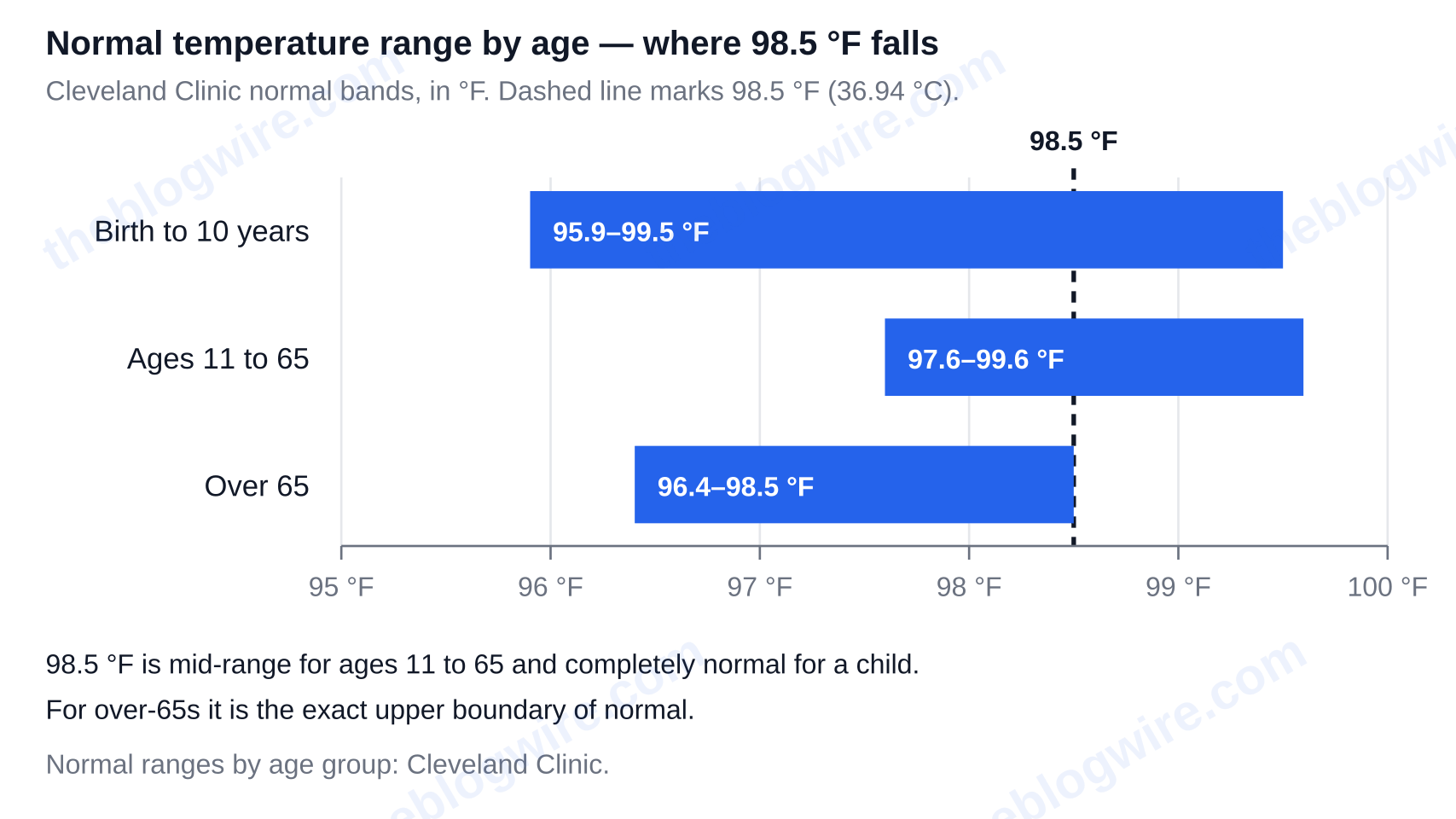
The general band is 97 to 99 °F, about 36.1 to 37.2 °C. However, the Cleveland Clinic publishes it by age, and this reading lands in a different place in each band.
Normal range by age group
- Birth to 10 years — 95.9 to 99.5 °F. 98.5 °F is completely normal for a child. Infants and young children are typically running warmer than adults.
- Ages 11 to 65–97.6 to 99.6 °F. 98.5 °F is a completely normal mid-range temp for a working-age adult.
- Over 65–96.4 to 98.5 °F. 98.5 °F is the highest acceptable normal body temp — the exact upper boundary. This is the one group whose reading should not be waved off, and the one most likely to have it dismissed.
Time of day matters more than any of this. Stanford found it was the single largest source of variation, with temperature being lowest in the early morning and highest at around 4 p.m. So a temperature of 98.5 °F at 6 a.m. is a high reading for that person, and at 4 p.m. is just their daily peak. If you are going to do anything, record the clock time with the number and take the temperature again at the same hour before you conclude anything has changed. The menstrual cycle shifts baseline temperature too, and a hot drink, a warm room, heavy clothing or recent exercise will each nudge a reading up.
97 °F to 99.9 °F conversion table
| Fahrenheit | Celsius | Note |
|---|---|---|
| 97.0 °F | 36.11 °C | Low end of the general normal range |
| 97.3 °F | 36.28 °C | Bottom of Stanford’s individual range |
| 97.5 °F | 36.39 °C | |
| 97.9 °F | 36.61 °C | Modern adult average (Stanford Medicine) |
| 98.0 °F | 36.67 °C | |
| 98.2 °F | 36.78 °C | Top of Stanford’s individual range |
| 98.5 °F | 36.94 °C | This reading — warm-normal |
| 98.6 °F | 37.00 °C | The 1868 benchmark |
| 99.0 °F | 37.22 °C | Top of the general normal range |
| 99.5 °F | 37.50 °C | |
| 99.9 °F | 37.72 °C | Just under the fever line |
| 100.4 °F | 38.00 °C | Fever threshold |
When a reading is worth a phone call
A temperature reading of 100.4 °F (38 °C) or above is a cause for a phone call, and so is a fever that runs past two days. Anything below 95 °F should be reported as well, since it is a hypothermia emergency. A single 98.5 °F reading with no other symptoms needs nothing at all.
So 98.5 °F is 36.94 °C, 36.9 °C for charting, and a normal body temperature on the warmer side of the range rather than a fever or a low reading. Always record the time and the thermometer site along with the reading, then take two or three more readings at that same hour on days you feel well. These readings will help you define your personal normal, and that will tell you more about your next reading than 98.6 °F ever did. You’ll find more guides like this across The Blog Wire.
Frequently Asked Questions
What is 98.5 °F in Kelvin?
98.5 °F is equal to 310.09 K. The starting point is to convert to Celsius — (98.5 − 32) × 5/9 = 36.94 °C — then we just need to add 273.15, since a Kelvin and a Celsius degree are the same size and only the zero point moves.
At what temperature is Celsius and Fahrenheit the same?
At −40° (C and F). That is the one number where the two scales agree: −40 °F and −40 °C are the same temperature. Everywhere else you need the formula, because the scales have different zero points and different degree sizes.
Can you be sick with a normal temperature of 98.5 °F?
Yes. A fever is just one way for the body to respond to infection or illness — it is not a requirement for it, and many infections and conditions don’t cause a fever at all. There is also the baseline issue. Stanford Medicine found individual normals as low as 97.3 °F, so for that person a reading of 98.5 °F is about 1.2 °F above their own normal while staying well short of the 100.4 °F fever line. Each person is different and needs to judge the number against their own baseline and their symptoms, not against a population average.
Why does my temperature read 98.5 °F in the evening but lower in the morning?
Because that is how body temperature normally behaves. Stanford Medicine’s analysis of 618,306 readings found time of day was the single largest source of variation — you are coolest in the early morning and warmest around 4 p.m. So a 98.5 °F reading late in the day is likely your daily peak, while the same number at 6 a.m. is comparatively high for you. Record the time alongside the reading and compare at the same hour.