If you are asking why does it hurt to poop, the anal canal has several layers of tough, muscle-like tissue, and painful conditions occur when these layers are torn, inflamed, or clenched. There are the usual suspects: hard stool from constipation, anal fissures, and hemorrhoids. A relaxed and functioning pelvic floor is not always the case. In cases of fissures and pelvic floor dysfunction, the pain comes from a sphincter muscle spasm, not from hard stool.
The point of this list is to break away from the usual suspects that are hard to see, feel, or guess at, and talk about what is causing the pain at the tissue level. This list is also in order of what is causing the pain signal, as this determines whether fiber helps you or wastes your next three months. There are seven causes and treatments, and each includes specific details that are usually left out of the generics of this list.
1. What Does It Mean When It Hurts to Poop?
Pain while pooping is a symptom, not a condition. It means something is wrong with the anal canal or the rectum. There are 3 things that can be wrong: there is damaged or inflamed tissue, or muscles are tight. When any of these things occur, pooping becomes hard or painful. Normal defecation is effortless and painless. Pain every time you poop is not normal, even if it has been your normal for a long time.
Readers notice four patterns, and the pattern tends to be more helpful than the intensity:
- Sharp and tearing at the moment of passing
- Burning that lingers for minutes to hours after
- Deep cramping before and during
- Raw soreness at the opening all day
The three questions that recur when reading descriptions are, when does it hurt? Is there a lump? Is there blood? The answers to these questions typically triage almost every case on this list.
Why does it hurt to poop but there’s no blood?
In the absence of blood, it does not mean something else is not the case. A fissure can clot and stop streaking. Sphincter spasm and pelvic floor dyssynergia never bleed at all, because nothing is cut. Even if you see a clean sheet of toilet paper, it does not mean something is not wrong — it just removes one clue.
Is it normal for pooping to hurt every time?
No, it should not be painful to poop. Occasional discomfort after an unusually hard stool is ordinary. Pain on a frequent or regular basis can mean there is an injury, and something is not relaxing and needs further evaluation, and both have specific treatments.
2. The Assumption Everyone Gets Wrong: It’s the Muscle, Not the Stool
Softening the stool explains the first painful bowel movement. It does not explain the next fifty. The standard logic — hard stool scrapes a too-small opening, so soften the stool — is why so many people do everything right for months and stay in pain.
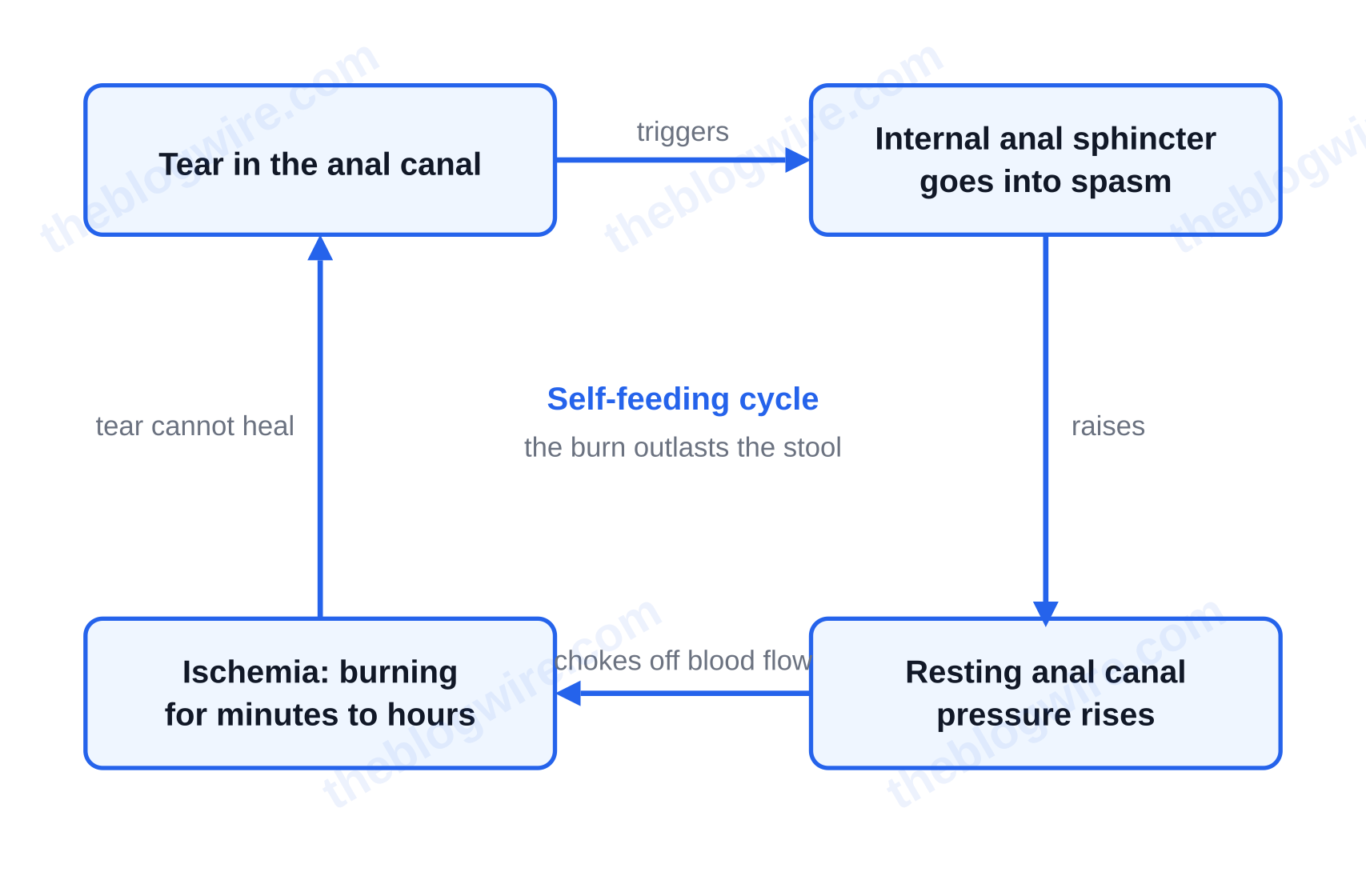
In StatPearls’ review of anal fissures, it notes that the initial tear leads to spasm of the internal anal sphincter. Spasm increases the resting pressure of the anal canal. Increased pressure chokes off blood flow to the anal mucosa, resulting in ischemia. Ischemia creates the burning sensation, and also stops the tear from healing — a self-feeding cycle of pain, spasm, and ischemia. Without adequate blood flow, the tear will not heal.
The anatomy explains the location of anal fissures. Fissures occur overwhelmingly at the posterior midline, where blood flow is less than half that of other regions of the anal canal and is inversely related to resting anal pressure. This is the region that, due to low blood flow, is most susceptible to ischemia. While it may suggest fissures are caused by trauma from hard or impacted stool, perfusion is the more probable cause — not by which way the stool happened to scrape.
This reframes the timeline you have been living with. When the burning lasts beyond the bowel movement by twenty minutes or two hours, the stool is long gone and cannot be the cause. This is the concept that confuses people when describing this to a medical professional. The truth is the bowel movement itself is survivable, and the half hour afterward is the part that ruins the day. That is muscle and blood supply, not stool.
The practical consequence is blunt. If the pain is spasm-driven, fiber and barrier creams are treating the wrong variable. The treatment goal is to break the spasm so blood reaches the wound — and therefore, topical nitroglycerin and calcium channel blockers like nifedipine and diltiazem exist as fissure drugs in the first place.
The same failure happens in pelvic floor dyssynergia as well: the puborectalis and the external sphincter contract instead of relaxing, and narrow the anorectal angle. You are pushing against a closed door.
3. Is It a Fissure, a Hemorrhoid, Constipation, or Your Pelvic Floor?
This four-way table does not exist in one piece anywhere else. It is based on just the three things you can answer without an exam.
| Cause | When it hurts | Lump? | Blood? |
|---|---|---|---|
| Anal fissure | Sharp tearing during and after; burning or spasm for minutes to hours; symptoms essentially only at stool time | No | Often a small streak of bright red |
| Hemorrhoids | Itching, fullness, swelling; discomfort persists through the day | Yes — hard and tender if thrombosed, soft and protruding if prolapsed | Bright red, often painless |
| Constipation / hard stool | Tracks exactly with how hard that stool was; heavy straining | No | Usually none |
| Pelvic floor dyssynergia | Long unproductive straining; feeling of incomplete evacuation; anal pain | No — nothing visible on exam | None |
In the Pelvic Health & Rehabilitation publication, they say pain during a bowel movement with no lump points to a fissure. A hard lump points to an external hemorrhoid. WebMD says nearly 3 out of 4 people get hemorrhoids at some point. Thus, by default, people usually assume hemorrhoids.
Be honest about overlap. Constipation is the upstream driver that cuts fissures and aggravates hemorrhoids, so having 2 of these things at the same time is the rule, and not the exception. Also, the single most diagnostic thing you can self-report is the lingering burn. This is discomfort that continues for an hour after you go, and strongly points to fissure plus sphincter spasm rather than hemorrhoids.
4. Why Hard Stool Starts the Whole Problem
Constipation is the ignition, even when it is not the thing still burning. Healthline defines constipation as having fewer than three bowel movements a week, with hard, dry, large-caliber stool that stretches the anal canal past what it tolerates. According to Hartford HealthCare, patients describe fissure-grade pain as passing shards of glass. If that is the phrase in your head, you are not exaggerating.
The chronic part comes from fear. One oversized stool tears you; you then fear the next one, and withhold; the rectum then reabsorbs water from stool left sitting, and the next one becomes larger and drier, which begins the cycle again. That loop — not the original injury — is why painful pooping stops being a one-off.
WebMD puts recommended fiber intake at 20 to 35 grams a day. Gradually build up the amount of fiber in your diet, and ensure you are also consuming adequate fluid, as bulk without water hardens rather than softens. Use of stool softeners and osmotic agents are also suggested. Softening stool is a reasonable long-term habit; stimulating the bowel is not a long-term plan.
5. When Your Pelvic Floor Is the Reason It Hurts to Poop
This is the cause the big listicles omit entirely — and it is not rare. This condition is referred to as dyssynergic defecation or anismus, in which the pelvic floor muscles and nerves fail to coordinate, and thus, contract instead of relaxing during a bowel movement.
Cleveland Clinic states 15% to 25% of chronic constipation cases are caused by this. It’s about twice as common in women as in men and more common after age 65. Symptoms include: fewer than three bowel movements per week, excessive straining, and hard, painful stools, with anal pain — no tear and no lump to point at.
Stress and guarding genuinely feed this. The pelvic floor is voluntary muscle and can be clenched similar to other voluntary muscles — a clenched one behaves exactly like a clenched jaw. Pain in a muscle that is not visible may result in people dismissing it, similar to how a person may spend months guessing at the cause of an aching big toe before anyone names the actual structure involved.
The diagnosis involves objective testing including anorectal manometry, the balloon expulsion test, and defecography. Two or more of these tests must be positive for the diagnosis to be made.
Why more fiber hasn’t fixed your pain
Because adding bulk gives uncoordinated muscles more to push against. It does not teach them to relax. This is the stated exception no top-ranking page gives you.
Cleveland Clinic states that biofeedback therapy is the treatment that matches the mechanism and the most effective option so far, at up to 80%, and is more effective than laxatives in both the short and long term, with 67% of patients stopping use of laxatives afterward. Botox injection helps about 50% of the time.
6. What Else Causes Painful Bowel Movements?
Any pain beyond bowel movements = tell. Work this list if your pain is not isolated to the bathroom, rather than the one above.
- Proctitis — inflammation of the lining of the rectum causes rectal pain, urgency, and the feeling that you need to go constantly. It can be from an infection, medication, radiation, or ulcerative colitis.
- Inflammatory bowel disease — urgency and painful bowel movements with cramping, often with diarrhea that can contain blood and mucus. This can be from Crohn’s disease or ulcerative colitis.
- Diarrhea — Healthline says this is three or more thin, watery bowel movements daily. The pain is cramping plus genuine skin breakdown from frequent passing and wiping.
- Anorectal STIs — chlamydia, syphilis, herpes, and HPV/anal warts can all present as anorectal pain, and they are routinely missed because people don’t connect the two.
- Endometriosis — this can cause pain with bowel movements that tracks with your menstrual cycle. Flag the pattern; it changes which specialist you need.
- Skin and irritants — contact dermatitis, pruritus ani, fragranced wipes, and capsaicin from spicy food can cause a burning feeling with nothing wrong inside the canal.
- Anal and colorectal cancer — rare as a cause of painful pooping, but real. WebMD states that colorectal cancer screening starts at age 45.
7. What Can You Do Tonight to Make Pooping Less Painful?
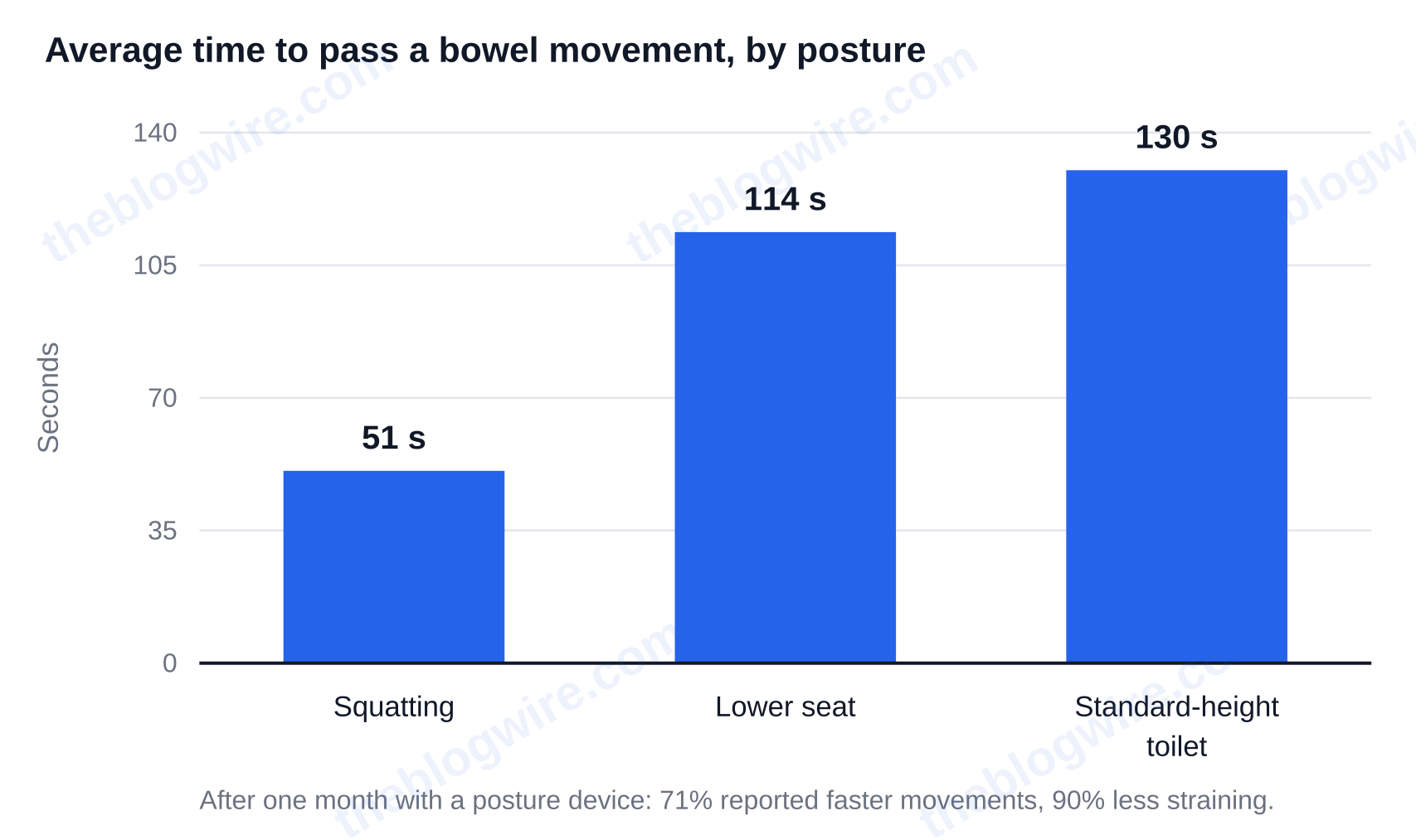
Start with your feet, not your diet. No top-ranking page for this question mentions toilet posture, and it is the cheapest change available. In the study indexed on PubMed Central, bowel movements averaged about 51 seconds squatting, compared to roughly 130 seconds on a standard-height toilet and 114 seconds on a lower seat. After using a defecation posture modification device for one month, 71% of the subjects reported faster bowel movements, and 90% reported less straining, with the main reason being a wider recto-anal angle requiring less push. Most of it can be reproduced by using a stack of books under your feet.
Then, in order:
- Use a warm sitz bath for 10 to 15 minutes after each bowel movement. It relaxes the internal anal sphincter and helps with the spasm, not with the wound.
- Use psyllium or another bulk-forming fiber, with a real increase in fluid — if your predominant symptom is straining, and you’re not seeing anything, skip to section 5.
- Don’t strain, and stop the long phone sit. Extended toilet sitting engorges hemorrhoidal tissue.
- Go when the urge arrives, and breathe out rather than bear down — exhaling keeps the pelvic floor from bracing.
- Use plain water or unfragranced cleansing and pat, rather than rub, to clean.
Honest expectations: WebMD notes an acute fissure usually heals within a few weeks, and is called chronic beyond eight weeks; Healthline frames home treatment as aimed at the first 6 weeks.
8. When Should You See a Doctor About Painful Pooping?
Don’t delay. See a doctor as soon as possible for heavy bleeding, dark or tarry blood, fever, severe pain, unexplained weight loss, a persistent change in stool caliber, or a new lump that is hard and acutely tender. On timing: pain lasting a few weeks warrants a visit, per Healthline, and anything still present past 6 weeks of honest home care needs a clinician.
The exam will not be as bad as you expect. The doctor will ask you questions about your history, look at the area, do a gentle digital exam, and do an anoscopy if you can tolerate it, with referral for manometry or colonoscopy where indicated. The biggest reason people wait years to see a doctor is dread of the exam.
For fissures, the 2023 ASCRS clinical practice guideline sets the order: the first course of treatment should be conservative therapy, followed by topical agents, and finally surgery. It reports that topical calcium channel blockers heal chronic fissures about as well as topical nitroglycerin but with fewer side effects such as headache, and can be used first-line — with healing around 90% for topical nifedipine and 76% for oral. Lateral internal sphincterotomy is the surgical option when nothing heals, and it works by permanently reducing sphincter pressure. The same logic as every step before it.
Match the specialist to the cause. For hemorrhoids and fissures, you should see a colorectal surgeon. Proctitis and IBD should be seen by a GI doctor. For pelvic floor dyssynergia, you should see a pelvic floor physical therapist. For cycle-linked pain, you should see a gynecologist.
The One Pick for Most Readers
I would say the footstool and the post-movement sitz bath are the two things most worth taking off the list. They both work to decrease sphincter pressure, which is what is generating the pain in the two most common cases. Hard stools may have been the initial injury, but spasm and an uncoordinated pelvic floor are what keeps it going.
For the next week, the plan is to use the footstool, no straining, take warm sitz baths after each bowel movement, and track when the pain occurs. Is it during, after, or both? Still there after two weeks, or any red flag appears? Then you need to book the appointment and bring that timing detail with you. Timing of when the pain occurs is the single most useful thing you can hand a clinician. And it is where this field is moving: fissure guidance updated on both sides of the Atlantic in 2023, and the direction of travel is away from treating the stool and toward relaxing the muscle.
Frequently Asked Questions
How long does an anal fissure take to heal on its own?
WebMD notes an acute anal fissure usually heals within a few weeks, and Healthline frames home treatment as aimed at the first 6 weeks. Past the eight-week mark it is considered to be chronic and needs medical treatment — usually a topical agent that lowers sphincter pressure, because by then it is the pain-spasm-ischemia cycle blocking healing, not the stool.
Can I use over-the-counter hemorrhoid cream on an anal fissure?
It may dull the surface soreness, but it has no effect on the mechanism that keeps a fissure open. A fissure stays open because internal anal sphincter spasm raises resting pressure and cuts blood flow to the wound. The 2023 ASCRS guideline points to topical calcium channel blockers or nitroglycerin for that reason — they relax the muscle. A barrier cream is not of much help in that case.
Why does it hurt to poop when I’m on my period?
Two possibilities worth separating. First, there could be cycle-linked constipation that can harden stool for a few days each month, which aggravates an existing fissure or hemorrhoid. But pain with bowel movements that reliably tracks your cycle can also be endometriosis, which changes who you should see — gynecology rather than colorectal. Track it across two or three cycles and bring the pattern to the appointment.
Does it hurt to poop after you have been holding it in for days?
Yes, and the reason is mechanical. The rectum reabsorbs water from stool left sitting, so what you eventually pass is drier and larger than it would have been. Healthline defines constipation as fewer than three bowel movements a week. Withholding is also how a single painful bowel movement turns into a chronic problem — you dread the next one, delay it, and make it worse.
Can a fissure or hemorrhoid heal if I keep having painful bowel movements every day?
A fissure largely cannot heal with constant re-injury. Per StatPearls, each pass re-injures the tear and re-triggers the sphincter spasm that is already starving the wound of blood. Breaking the daily re-injury — softer stool, a footstool, no straining, sitz baths — is the precondition for healing, not an optional extra. If the painful movements continue past 6 weeks, you need a prescription topical agent.
Why does it only hurt to poop sometimes and not every time?
That pattern is more dependent on stool consistency than on a fixed injury — pain that tracks exactly with how hard a given stool was. Intermittent pain fits constipation and early fissures. Pain on every single movement, or a burning sensation that lingers for an hour afterward, points instead at established sphincter spasm or a pelvic floor that is not relaxing, which is a different fix.