

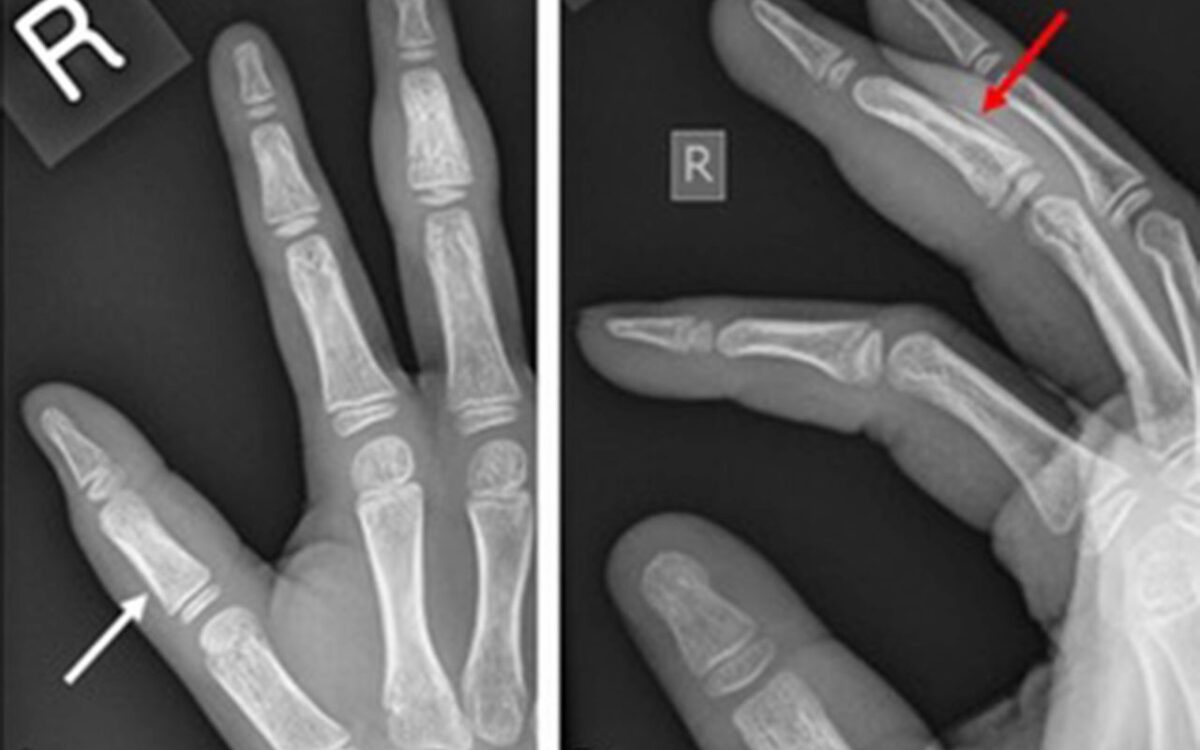
Your primary care doctor just said the word “rheumatologist,” and your knuckles have been swollen for 3 weeks and your fingers stiff for an hour every morning. What is a rheumatologist? A rheumatologist is a subspecialist with additional training beyond pediatrics or internal medicine focused on the 100 or more rheumatic conditions affecting the joints, muscles, bones and other organ systems of the body. After training, they devote their career to the diagnosis and management of conditions such as lupus, rheumatoid arthritis and gout. They do not perform surgery.
One example: a 34-year-old with swelling of both wrists and hands, and 1 knee, as well as morning stiffness and fatigue, is a textbook case for a rheumatology referral. Rheumatoid conditions often affect the same joints on both sides of the body, and rheumatoid conditions are often systemic, meaning they can affect multiple joints and multiple organ systems. A rheumatologist is an expert in determining the cause of the systemic inflammation, and often treats the condition with long-term medication.
What does a rheumatologist do?
A rheumatologist is a board-certified physician, either in internal or pediatric medicine, with additional training to diagnose and manage conditions that affect the joints, muscles and bones. The American College of Rheumatology says that rheumatic conditions occur when the body’s immune system becomes overactive and causes inflammation in areas where it is not needed, and this can affect various organ systems of the body — the joints, muscles and bones, but also the eyes, skin, nervous system and internal organs.
There are three main parts of the work. The first is differentiating vague multi-system symptoms and arriving at a diagnosis. The second is prescription and management of long-term medication, including DMARDs and biologics. The third is management of disease activity and side effects of the drug, for a long period of time — often for decades.
Rheumatologists are medical specialists and not surgeons. Therefore, they cannot perform joint replacements. They will refer patients to orthopedic surgeons for joint replacements.
Why a joint specialist asks about your skin, eyes, and fatigue
Rheumatology is concerned with connective tissues and the autoimmune system, not just joints. Therefore, a rheumatologist has the right to ask for other tests including renal function tests, scans of the chest, eye tests and others. Joint pain may be the most prominent symptom of a condition, but not the only symptom.
Pediatric rheumatology: the same specialty for children
Pediatric rheumatology is the same specialty for children. There are two main ways to enter this specialty. One is through the adult specialty track (i.e. from Internal Medicine). The other is from the pediatric specialty track (i.e. Pediatrics). This special track of medicine is for children with conditions like Juvenile Idiopathic Arthritis.
Where does the word “rheumatologist” come from?
What is in a name? The name of this specialty is derived from an outdated theory in medicine. This is the reason why the description of this specialty bears no semblance to the name.
The term rheumatology was first used to describe this branch of medicine in 1949, but the roots of the word extend back many centuries. The term is derived from the Greek word rheuma, which means a flow, or discharge, from rhein, “to flow” (PIE root *sreu-), and is a reference to the humoral theory of illness. This theory suggests that some illnesses are caused by an imbalance in the body’s humors and can be cured by realigning them to their proper balance. Hippocrates attributed achy muscle illnesses to abnormal flow of body humors, and this theory continued to be articulated by others through the centuries, including Galen of Pergamum who is believed to have coined the term rheumatismos near the start of the 2nd century CE.
The French physician Guillaume de Baillou (1538–1616) used the term “rheumatism” to describe illnesses involving joints and was therefore considered the father of rheumatology. This suggests that the literal translation of the word rheumatology is the study of flows or discharges. However, the specialty involves understanding when the body’s immune system attacks the body’s own tissue, and the label is about 2,000 years older than the understanding behind it. For this reason, “rheumatism” survives as a lay person’s term for aches and pains, but “rheumatic disease” is a precise clinical category.
What conditions do rheumatologists treat?
More than 100 different types of arthritis and musculoskeletal conditions. In this field, we tend to call things by their names. So, grouped, the named ones are navigable:
- Autoimmune and inflammatory: rheumatoid arthritis, systemic lupus erythematosus (SLE), psoriatic arthritis, ankylosing spondylitis and other forms of spondyloarthritis, scleroderma, Sjögren’s syndrome, vasculitis, myositis and polymyositis, polymyalgia rheumatica
- Crystal-driven and metabolic: gout
- Degenerative, soft-tissue, and bone: osteoarthritis, tendinitis, osteoporosis
- Pediatric: juvenile idiopathic arthritis
- Pain amplification: fibromyalgia
Osteoarthritis, Tendinitis and Osteoporosis are not Autoimmune conditions, but are still musculoskeletal conditions and are in this field because of where the pain is located. That mismatch is a common source of confusion — the specialty is defined by the body systems it covers, not by one disease mechanism.
When should you see a rheumatologist?
You should seek a rheumatology evaluation if you have joint, muscle or bone pain and swelling lasting more than a few days, repeated episodes of joint pain (especially if accompanied by fever or a skin rash), and/or joint pain in several locations at the same time. The onset of your symptoms could be important. For example, if your symptoms developed quickly, particularly if they are getting progressively worse, that could also be important. Similarly, symptoms and conditions that run in the family (especially autoimmune conditions) are worth mentioning.
Laboratory abnormalities are also reasons to seek a rheumatology evaluation. For example, if your primary care physician (PCP) found a raised erythrocyte sedimentation rate (ESR), a positive rheumatoid factor (RF) or antinuclear antibody (ANA), or other abnormalities on laboratory evaluations, that would warrant further evaluation by a rheumatologist. Specific combinations are worth naming out loud: joint pain with dry eyes and/or dry mouth, unexplained skin rashes, morning stiffness that lasts more than an hour, and persistent unexplained fatigue.
Do you need a referral to see a rheumatologist?
Typically, yes. Many insurance plans require primary care referrals, so be sure to check your plan before booking. In that same primary care visit, ask for both the referral and interim management. Your primary care team can order initial testing, imaging, and manage your pain, among other things, which will make the wait time for the referral to the rheumatologist more productive.
Rheumatologist vs. orthopedist vs. primary care: which one should you book?
The organizing principle is that an orthopedist is a surgical specialist who alleviates joint pain due to structure, and a rheumatologist is a medical specialist who lessens joint pain due to inflammation and immune processes. Primary care is the first point of contact for both.
| Doctor | What they handle | Symptoms that point there | What treatment looks like |
|---|---|---|---|
| Orthopedist | Injury, cartilage damage, wear-and-tear arthritis, mechanical and bone problems | One joint, often after a specific event or injury; locking, instability, or structural pain | Injections, bracing, physical therapy, and surgery including joint replacement |
| Rheumatologist | Autoimmune disease, gout, systemic inflammation, connective tissue disease | Several joints at once, symmetrical swelling, or joint pain with rash, fever, dry eyes, or fatigue | Long-term medication (DMARDs, biologics), injections, and ongoing monitoring — no surgery |
| Primary care | New or undifferentiated pain | Anything you can’t yet categorise | Initial labs and imaging, pain control, and the referral itself |
When you need both
There are a lot of patients who do in fact see both specialists, and the two often co-manage. For example, a rheumatologist can control inflammation, and an orthopedist can address damage to the joint that has already happened. Other specialties who may also be involved are physical/occupational therapy, dermatology (for psoriasis and lupus rashes), nephrology (for lupus kidney involvement) and ophthalmology (for eye inflammation).
How many rheumatologists are there — and how long is the wait?
There may not be a rheumatologist nearby, and that first appointment can be several months out. Plan for that from the beginning.
The numbers tell the story. Medscape reports ACR workforce projections showing approximately 5,595 full-time adult rheumatologists in active US practice, with a projected shortage of approximately 2,500 by 2025, and a demand/supply gap of 4,729 adult rheumatologists by 2030. The ACR’s 2015 workforce study predicted a 25% decrease in rheumatology provider supply — physicians, NPs, and PAs — between 2015 and 2030. A few thousand providers for a condition group that affects tens of millions of Americans explains the gates and the lengthy wait times to see a rheumatologist.
The wait times have been measured. Results from the ACR national patient survey of 1,517 US adults with rheumatic disease, conducted online in June 2019, showed that 63.68% of respondents waited longer than 30 days for their first available rheumatology appointment, with 39.58% of respondents waiting between 31 to 60 days.
The rural access gap
What works for most doesn’t work for some. A 2026 microsimulation study by Silvestre et al. in Arthritis Care & Research (doi:10.1002/acr.80092) used the Health Workforce Simulation Model to project workforce adequacy from 2025–2037. The study projects 97.3% metropolitan workforce adequacy (supply 7,600 vs. demand 7,810 full-time rheumatologists), but only 18.5% adequacy in non-metropolitan areas (supply 210 vs. demand 1,190, P < .001). Regional adequacy varies from 73.4% in the South to 128% in the Northeast, and state lows are Idaho (14.3%), West Virginia (33.3%), Nevada (44.4%), and Arizona (45.8%). The authors state that distribution, not total supply, is the biggest problem.
What to do while you wait
Ask to be added to the practice’s cancellation list at the moment of referral — not when you show up for the appointment months later. If you are in a rural area or a low-adequacy state, the route that actually works is an academic medical center in the nearest metro, a telerheumatology visit, or interim management by your PCP. A local referral to a specialist who is not there costs you weeks.

What happens at your first rheumatology appointment?
Expect a lengthy history visit. The diagnosis is usually a synthesis of your symptoms over time, not a single test result.
The history consists of your symptom timeline, which joints hurt and in what order, the duration of your morning stiffness, rashes, fevers, eye and mouth dryness, fatigue, family history of autoimmune disease, and all medications you are on. The examination consists of a joint examination for swelling, warmth and range of motion, as well as skin, eye and relevant organ system exams.
Some of the tests that may be ordered include, but are not limited to, ANA, rheumatoid factor, ESR, other labs, x-rays, ultrasound, CT, MRI, bone density scans, biopsies, EMGs, and organ function tests. Bring your prior labs and imaging, a written symptom timeline with dates, photographs of rashes or swelling, and a full list of medications and supplements with you to your visit.
Treatment options may include medicinal management (i.e. use of DMARDs and biologics) as well as the use of joint and soft-tissue injections, referrals to physical or occupational therapy, and scheduled long-term monitoring. Surgery is not included. And be prepared for a confirmed diagnosis to take more than one visit. Labs alone usually don’t “settle” it.
How do you become a rheumatologist?
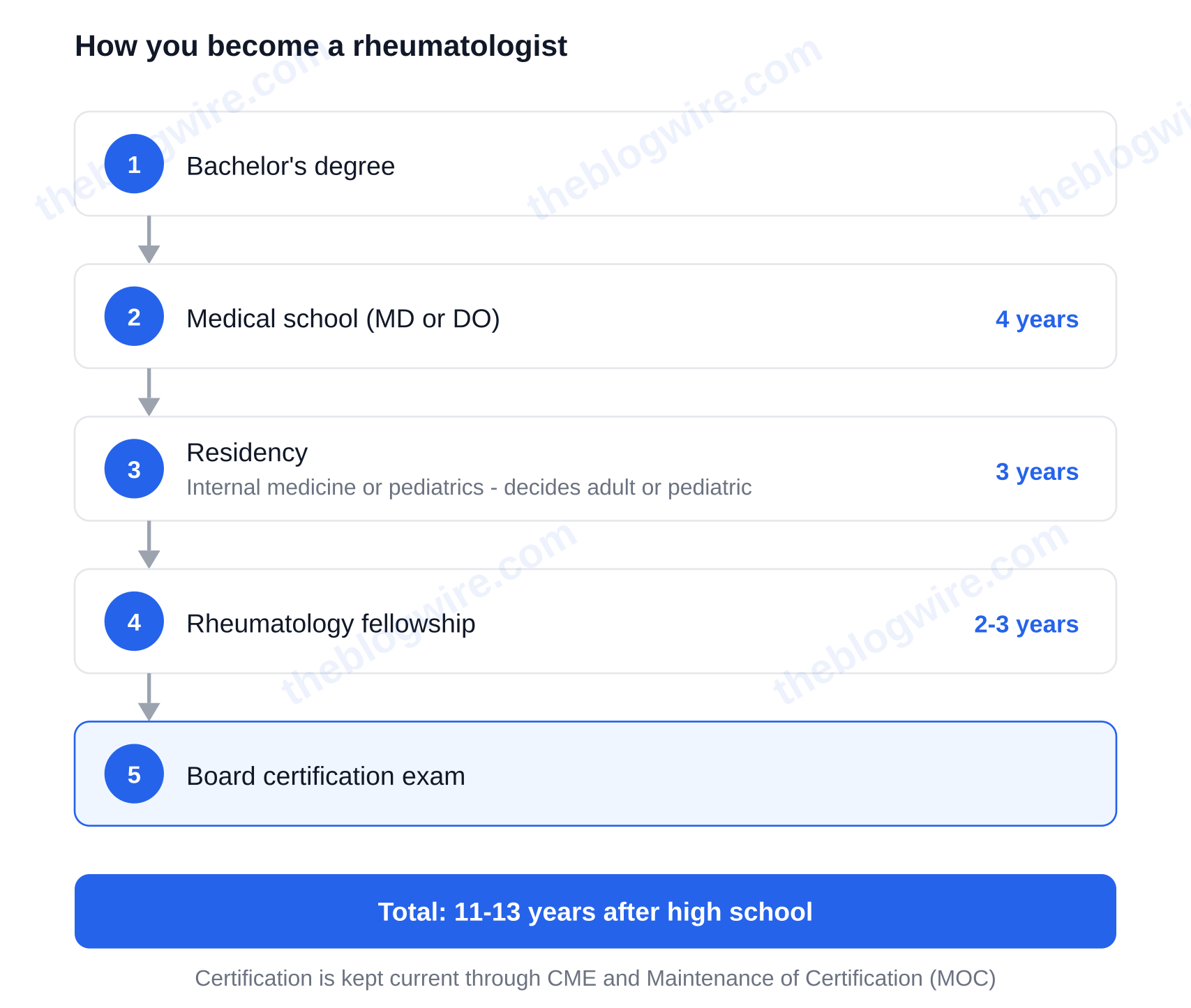
According to Cleveland Clinic, the path is as follows:
- Bachelor’s degree
- 4 years of medical school (MD or DO)
- 3 years of residency in internal medicine or pediatrics
- 2–3 years of rheumatology fellowship
- Board certification exam
This path totals 11–13 years after high school. Certification is maintained through continuing medical education and Maintenance of Certification (MOC), so the credential is ongoing rather than one-time. The residency choice (internal medicine or pediatrics) is the fork that determines if the rheumatologist will be adult or pediatric.
The reader’s payoff is that a foundation in internal medicine allows a rheumatologist to read and evaluate results from other systems of the body (i.e. lung, kidney, blood, etc.) and joint exams and synthesize them as one large, holistic problem. If you want to check a specific doctor, look up their board certification status and ACR membership.
The three things to take away
A rheumatologist is the medical specialist in the diagnosis of immune activity and inflammation in joints, muscles, bones, and connective tissues. The rheumatologist is the one who diagnoses rheumatoid arthritis, lupus and gout and manages them for the long haul — this is long-term medical management, not surgery.
If your joint pain lasts more than a few days, affects several joints at once, or comes with a rash, fever, or fatigue for which you can’t find an explanation, the next step is a referral discussion with your primary care doctor.
At that same visit, you should also ask for three things: the rheumatology referral, your name on the practice’s cancellation list, and assistance with management of your symptoms while you wait. For other pieces in this vein, see The Blog Wire.
Frequently Asked Questions
Do rheumatologists perform surgery?
No. Rheumatologists are medical specialists, not surgeons. They treat rheumatic disease with medication — including DMARDs and biologics — along with joint and soft-tissue injections, therapy referrals, and long-term monitoring. The group of medications that can be injected into a joint, for example, can help address an arthritic condition of a joint. If a joint is damaged enough to need repair or replacement, the rheumatologist will refer you to an orthopedic surgeon to manage that joint replacement, and the two often co-manage your care from there.
Can a rheumatologist diagnose fibromyalgia?
Yes. Fibromyalgia is a pain-amplification condition that is managed within rheumatology, even though it isn’t autoimmune and won’t show up on an inflammation blood test. It often presents with fatigue, widespread muscle pain, and tenderness. Rheumatologists are the specialists best placed to diagnose it because doing so requires ruling out inflammatory and autoimmune causes of widespread pain and fatigue first — which is exactly the work their training prepares them for.
What are the first signs of an autoimmune or rheumatic disease?
Joint, muscle, and/or bone pain and/or swelling that lasts more than a few days, morning stiffness that lasts more than 1 hour, pain in several joints at once, and repeated episodes of joint pain, especially if accompanied by a fever and/or rash, are some signs. So are dry eyes and/or dry mouth, an unexplained rash, and persistent, unexplained fatigue alongside joint symptoms. The inflammation brought on by the immune system can affect the skin, eyes, nerves, and organs — not just joints. This is why, along with joint symptoms, fatigue and a rash can also point toward rheumatic disease.
Should you keep seeing your primary care doctor after a rheumatology referral?
Yes, and it is more important than many realise. An ACR (American College of Rheumatology) national patient survey of 1,517 US adults with rheumatic disease, conducted online in June 2019, found 63.68% waited more than 30 days for their first rheumatology appointment. Your primary care doctor can order the initial labs and imaging, manage your pain in the meantime, and continue coordinating your general care afterward while the rheumatologist handles the rheumatic disease itself.





1 comment