Pick up a full glass of water and the surface ripples. Hold your hand out to sign a receipt and your hand wavers. If you’re wondering, “Why are my hands shaking?”, you’re seeing a tremor — an involuntary, rhythmic muscle movement. Everyone has a very faint version. Caffeine, stress, hunger, fatigue, and even being cold can make them visible. Persistent shaking, however, is more often essential tremor than it is Parkinson’s disease, and when the hand shakes help to narrow the cause the fastest.
Why are my hands shaking? What is actually happening in the muscles
Tremors are characterized by an involuntary, rhythmic, oscillating contraction of muscles that pull alternately on either side of a joint. The rhythm is the defining feature.
Tremor vs. twitch vs. spasm — why the difference matters
- Tremor: back and forth, repeating, and roughly regular. Both sides of a joint take turns pulling.
- Twitch: not rhythmic and not oscillating. It is a single muscle or small group of muscles that contracts once — an eyelid, a thumb pad.
- Spasm or cramp: a sustained contraction that holds and hurts, and does not oscillate.
- Weakness: the hand fails to do the job at all, rather than doing it shakily.
Getting this right is crucial because these categories take you down completely different diagnostic paths. The National Institute of Neurological Disorders and Stroke tremor overview is the place worth bookmarking for how the types are classified.
The physiologic tremor everyone already has
We all have a tremor right now. It is called physiologic tremor, it runs all of the time, and it is normally too small and too fast to see. So we don’t usually ask, “do I have a tremor?” The question is “why is my tremor visible?”
There are two axes that divide every cause listed below.
- Timing: does it shake at rest? Or, does it only happen when you are moving?
- Trigger: is there something reversible driving it? Or is it constant?
The categories you are looking at are: enhanced physiologic tremor, essential tremor, parkinsonian rest tremor, cerebellar or intention tremor, and tremor secondary to medications, metabolism, or withdrawal.
One assurance before the details. It is normally benign to have a tremor that occurs with a trigger — shaking after the third cup of coffee, or shaking after skipping lunch, four hours of sleep, a hard meeting — and it goes when the trigger goes.
When do your hands shake? The timing test that sorts the causes
The most useful thing you can observe at home — and it almost never gets mentioned — is not what the shaking looks like. It is when it occurs. Run this test before you look at any of the causes.
Three positions to test in ten seconds
- Rest. Sit with both hands in your lap, palms down, fully supported and completely relaxed for ten seconds.
- Posture. Extend both arms straight out in front of you. Or hold a full glass and try to keep it level.
- Reach. Move slowly towards a target — touch a finger to the tip of your nose, or pick up a cup.
The medical definitions associated with those positions? A “rest” tremor occurs when the body part is completely supported against gravity and is not voluntarily activated. “Action” tremors occur from the voluntary activation of the muscles. “Postural” tremors occur while holding a position and a “kinetic” or “intention” tremor occurs while moving to a target.
Timing-to-cause decision table
| What you observe | Likely category | Typical frequency | What it does with movement |
|---|---|---|---|
| Shakes at rest, hands supported in your lap | Parkinsonian rest tremor | 4–6 Hz | Often eases when you start to move |
| Shakes while holding a posture or lifting a glass | Action tremor — essential tremor or enhanced physiologic tremor | 4–12 Hz (essential tremor) | Settles when the hand is fully supported |
| Shakes and overshoots as the hand closes on a target | Cerebellar or intention tremor | Under 5 Hz | Worsens at the end of the reach |
Those frequency ranges and the rest-versus-action split come from a clinical review of tremor published in American Family Physician. The authors of the review note history and physical examination remain the most important diagnostic tools available.
What this test can’t tell you
It sorts direction, not diagnosis. The categories overlap. One person may have more than one type of tremor. A ten-second test in your kitchen cannot replace an examination. If you run it and are still asking “why are my hands shaking?”, that is the expected result — the test narrows the field, it does not close it.
In the interim, write down the following: which hand is affected, whether both hands are affected, how long it has been happening, and what makes it worse or better. The gist of what you’re writing is exactly what a neurologist would want to know. Bringing those notes to the neurology appointment can save you a round of follow-up.
Why the Parkinson’s assumption is usually the wrong first guess
The majority of people Googling “why are my hands shaking” are quietly self-diagnosing for Parkinson’s disease. The honest answer is statistical, not just soothing.
Essential tremor affects roughly 10 million Americans — about eight times the number living with Parkinson’s disease, according to Baptist Health. For a persistent hand tremor, essential tremor is much more common.
More numbers worth noting from Cleveland Clinic and American Family Physician:
- About 1% of the world population is affected by essential tremor, and about 5% of the population aged 60 years and older.
- The prevalence rate is between 4.1 to 39.2 cases per 1,000 people. It may reach 50.5 cases per 1,000 of the population older than 60 years.
- Essential tremor has a bimodal age of onset, approximately between the ages of 10 to 19 years and 50 to 59 years. Medical News Today places the second window of onset between the ages of 40 to 50 years. Either way, shaky hands in your twenties are neither automatically alarming nor automatically benign.
- About 50% of cases are inherited. If a parent carries the gene, there is roughly a 50% chance of passing it on. Therefore, ask about family history before reaching a conclusion.
Essential tremor vs. Parkinson’s disease, side by side
| Feature | Essential tremor | Parkinson’s disease |
|---|---|---|
| When it shakes | In action — holding, reaching, lifting | At rest, hand supported |
| What calms it | Resting the hand | Starting to move |
| Body parts | Hands, sometimes head and voice | Typically one hand first |
| Symmetry | Usually both sides | Usually starts one-sided |
| Progression | Often slow, over years | Faster, with new motor signs |
| Family history | Common — about half of cases | Less often the deciding clue |
| Other signs | Tremor largely on its own | Slowness, stiffness, shuffling gait, balance change |
The signs that actually point to Parkinson’s
Tremor is not the test. Medical News Today points out that up to 75% of individuals with Parkinson’s disease experience tremor. However, tremor alone, in the absence of other cardinal features (bradykinesia, rigidity, and gait or balance abnormalities), is weak evidence for it.
It is possible to have both essential tremor and Parkinson’s disease, which is why the statement “it’s probably just essential tremor” deserves more scrutiny than it usually gets.
What else makes hands shake — from caffeine to thyroid to medication
The reversible everyday triggers
For most people asking “why are my hands shaking?”, the answer sits in this category rather than anywhere in neurology. Enhanced physiologic tremor is the ordinary, fixable group — the hand tremors caused by the conditions or situations you can usually control: caffeine, nicotine, acute anxiety and stress, fatigue and poor quality sleep, low blood sugar from a skipped meal, cold hands, and the shake that occurs after strenuous exercise. UPMC’s 2025 hand tremor guidance mentions exactly these — lack of sleep, nutritional deficiency, medication side effects, skipped meals, stress, excess caffeine, substance withdrawal — ahead of true neurologic conditions.
This also addresses the question people have when they feel calm but are still shaking. Adrenaline, stimulants, and metabolic stress act on the same pathways anxiety does, without producing the feeling of anxiety.
Metabolic and hormonal causes
- Hypoglycemia. Cleveland Clinic defines low blood sugar as generally below 70 mg/dL (3.9 mmol/L). If your blood sugar gets too low the body responds by releasing adrenaline and other stress hormones, and that surge is what makes the hands tremble. Treat with the 15-15 rule: 15 grams of fast-acting carbohydrate, wait 15 minutes, recheck. If this happens a lot then further testing is warranted, not just snacking.
- Hyperthyroidism. An overactive thyroid produces a fine, fast action tremor and is also commonly associated with weight loss, heat intolerance, a racing heart and anxiety. If you have these symptoms a blood test settles it.
Medications that cause tremor — and how fast it resolves
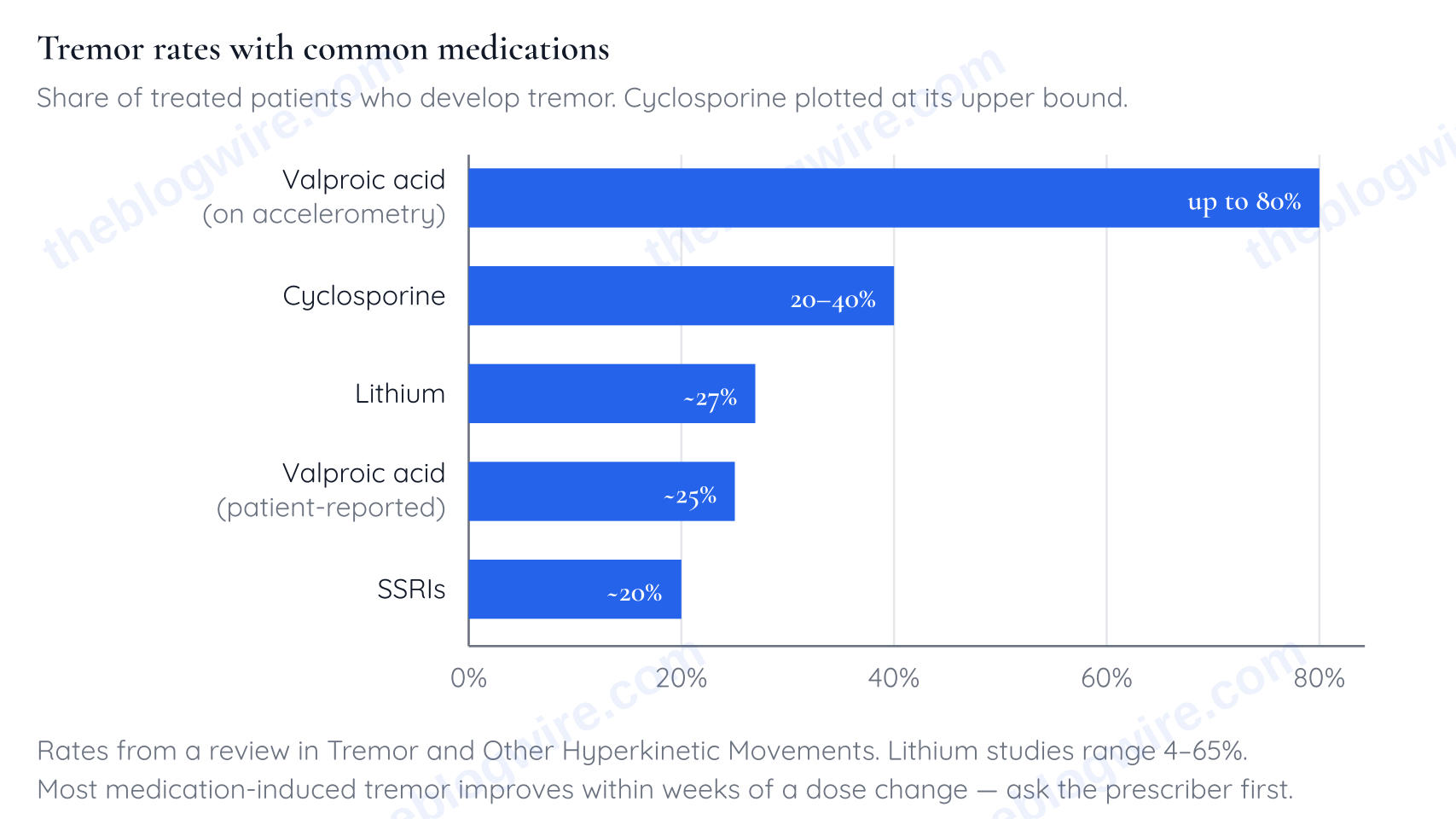
Most summaries say “some medications can cause tremor” and stop. The review in Tremor and Other Hyperkinetic Movements gives the actual rates:
- SSRIs: about 20% of patients develop tremor with no prior history of it.
- Lithium: about 27% of treated patients, with individual studies ranging from 4% to 65%.
- Valproic acid: up to 80% of patients demonstrate tremor on accelerometry, with only around 25% of patients reporting tremor symptomatically.
- Cyclosporine: 20–40% of patients.
- Also implicated: asthma inhalers and other beta-agonists, steroids, and other anti-seizure drugs.
Now the reassuring side of the data, which matters most if you are taking one of these: the vast majority of medication-induced tremors improve with either a reduction in dose, or stopping the medication, with the improvement usually occurring within several weeks. Never discontinue a prescription on your own. Take the timeline to the person who wrote the prescription.
Withdrawal, deficiency and systemic illness
- Alcohol and benzodiazepine withdrawal. Tremor that is worst in the morning, and settles after a drink, is specific and urgent — not a quirk. Say it out loud to a doctor.
- Nutrient deficiency. Most particularly vitamin B12 deficiency, which is what people are reaching for when they ask which vitamin causes shaky hands; magnesium and calcium also matter.
- Other neurological causes. Multiple sclerosis, stroke, traumatic brain injury, dystonia (where tremor comes with abnormal posturing), and cerebellar disease producing intention tremor.
- Systemic causes that get missed. Liver failure and kidney failure, where the tremor is simply a sign of a much wider metabolic problem.
How doctors diagnose a tremor — and why the first label is often wrong
What happens at the appointment
Tremor diagnosis relies heavily on the history and physical examination. Expect detailed questions about timing, when it started, family history, alcohol use, and every medication and supplement you take. Be prepared for your physician to test your posture and ask you to perform various actions and movements (reaching, handwriting, spiral drawing and gait testing).
Tests rule out rather than rule in. Cleveland Clinic is blunt about it: there is no blood test, scan or genetic test that confirms essential tremor. Other tests may include thyroid, metabolic, and liver function tests; B12 levels; and various types of imaging (CT, MRI, PET, DaTscan) to exclude other conditions.
The 37% misdiagnosis problem
This number rarely makes it into general health articles. Jain, Lo and Louis (Archives of Neurology, 2006) state that 37% of tremor patients carrying an essential tremor label were misdiagnosed. True diagnoses included Parkinson’s disease (15%), dystonia (8%), Parkinson’s disease with essential tremor (7%) and other disorders (6%).
That is the concrete reason to ask for a movement disorder specialist rather than accepting a first-visit label.
The 2018 criteria that changed what counts as essential tremor
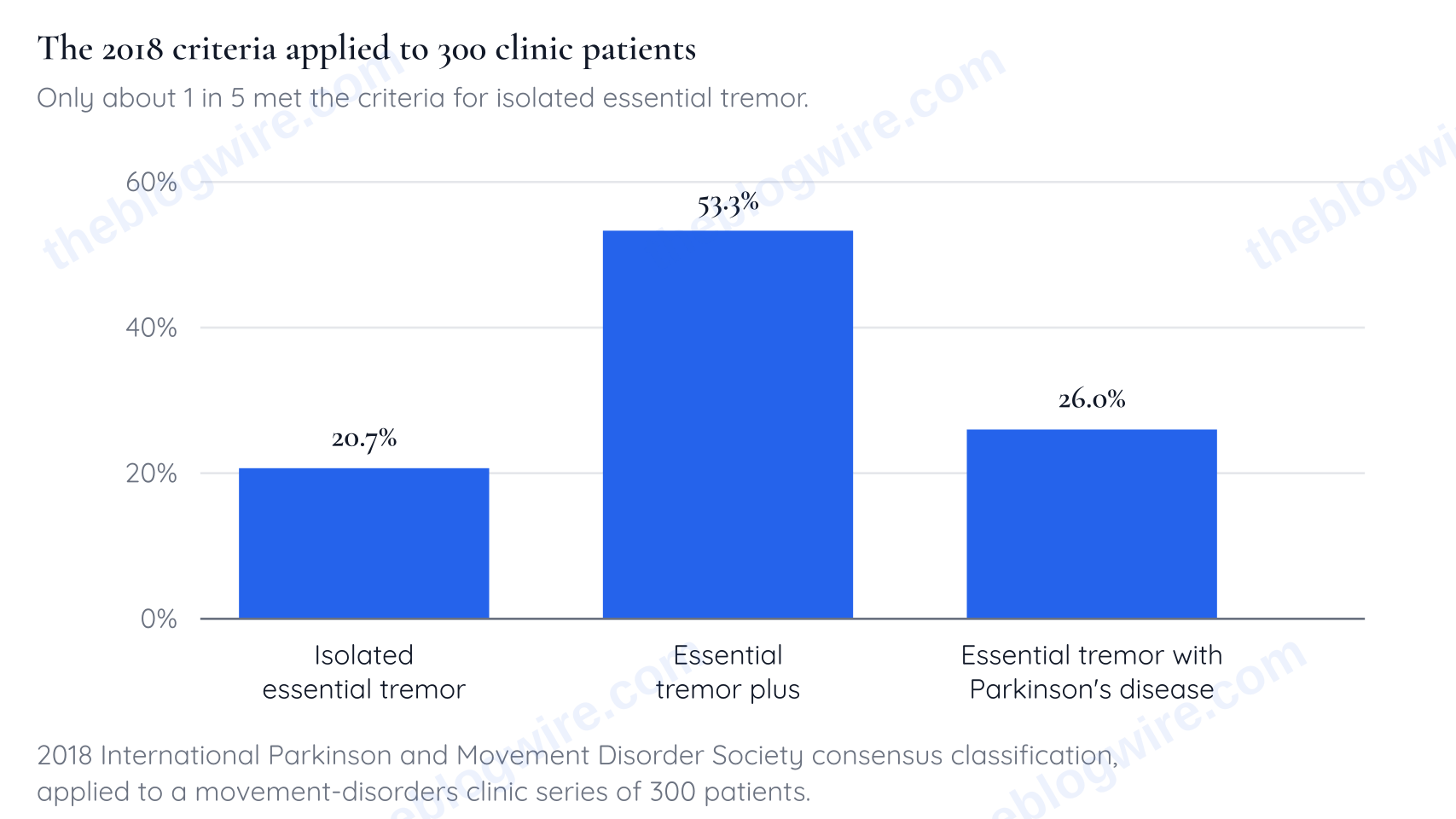
The definition tightened, and most health pages still use the old loose one. The 2018 International Parkinson and Movement Disorder Society consensus classification defines essential tremor narrowly: an isolated bilateral upper-limb action tremor of at least three years’ duration, with no dystonia, ataxia or parkinsonism. The consensus also created the term “essential tremor plus” to describe the same tremor accompanied by unclear neurologic soft signs of uncertain significance (for example, impaired tandem gait or questionable dystonic posturing).
There are two consequences for your appointment. A tremor of six months can’t officially be diagnosed as essential tremor yet. And the neatly isolated category is in the minority. Using these criteria on a movement-disorders clinic series of 300 patients, only 20.7% met isolated essential tremor criteria, while 53.3% were essential tremor plus and 26.0% had essential tremor with Parkinson’s disease.
So ask the question directly: does my tremor meet the criteria for isolated essential tremor, or does it fall in the “plus” category?
When should you see a doctor, and what can be done about it?
Red flags that mean call now
UPMC gives us a usable threshold. Call your doctor if hand tremors last more than two weeks, or if they come with something else that worries you. Move sooner for:
- Sudden onset
- Tremor present at rest
- Tremor on one side only
- Rapid worsening
- Tremor that interferes with eating, writing, dressing or work
- Tremor with other neurological symptoms — weakness, numbness, slurred speech, balance loss, stiffness or slowed movement
Can shaky hands go away on their own? Trigger-linked enhanced physiologic tremor usually does, once the trigger is gone. Essential tremor does not go away — but it can be treated, and it often progresses slowly.
What you can change yourself
- Cut or stage caffeine, and watch alcohol.
- Stabilize your blood sugar by eating on a schedule.
- Protect sleep — short nights amplify every tremor.
- Manage your total stress load rather than just the moment.
- Warm cold hands before doing something that requires fine hand movement.
- Use weighted utensils, wide-grip pens, and two hands for anything you carry full.
Medications, therapy and procedures
Generally, the first line of treatment for essential tremor is a beta blocker like propranolol, or the anti-seizure drug primidone. If you have a head or voice tremor, or selected hand tremor, botulinum toxin injections can be beneficial. You can also benefit from occupational and physical therapy, which build function and adaptive technique — the part people underrate.
If the medication is not working, two procedures are on the table. The first is called deep brain stimulation (DBS) and the second is MRI-guided focused ultrasound, which has the additional benefit that it does not require an incision.
And here’s the more recent update that older articles miss. On December 20, 2022, the FDA approved an expanded indication for Insightec’s Exablate Neuro focused ultrasound platform to treat both sides of the body in essential tremor, with the second side treated at least nine months after the first. Tremor reduction on the second side was significant immediately after treatment and was sustained through at least six months of follow-up, consistent with first-side results. If you have tremor in both hands, that waiting interval is the detail to ask about.
For secondary causes, the treatment is targeting the underlying cause of the tremor: treat the thyroid, adjust the drug, correct the deficiency — and the tremor follows.
So what should you do with this?
If you came here asking “why are my hands shaking”, the likeliest answer is caffeine, lack of sleep, low blood sugar, stress or a prescription rather than Parkinson’s disease — and when shaking hands do signal a tremor disorder, essential tremor is about eight times more common. Before you look for other symptoms, do the timing test: sit with your hands in your lap, hold them out in front of you, then reach slowly for a cup. Write down which position brings the shaking on, which hand it affects, and how long it has been happening.
Once you have this information, bring that single page of notes to your doctor. And if your tremor lasts for more than two weeks, appears at rest, affects only one side, or is accompanied by other symptoms like stiffness, slowness or balance trouble, ask for a referral to a movement disorder specialist rather than settling for a first-visit label. The diagnostic criteria became narrower in 2018 and the procedures keep expanding — the question you should be asking is no longer just what you have, but whether the label you are given still holds up to the current definition. For other pieces in this vein, see The Blog Wire.