

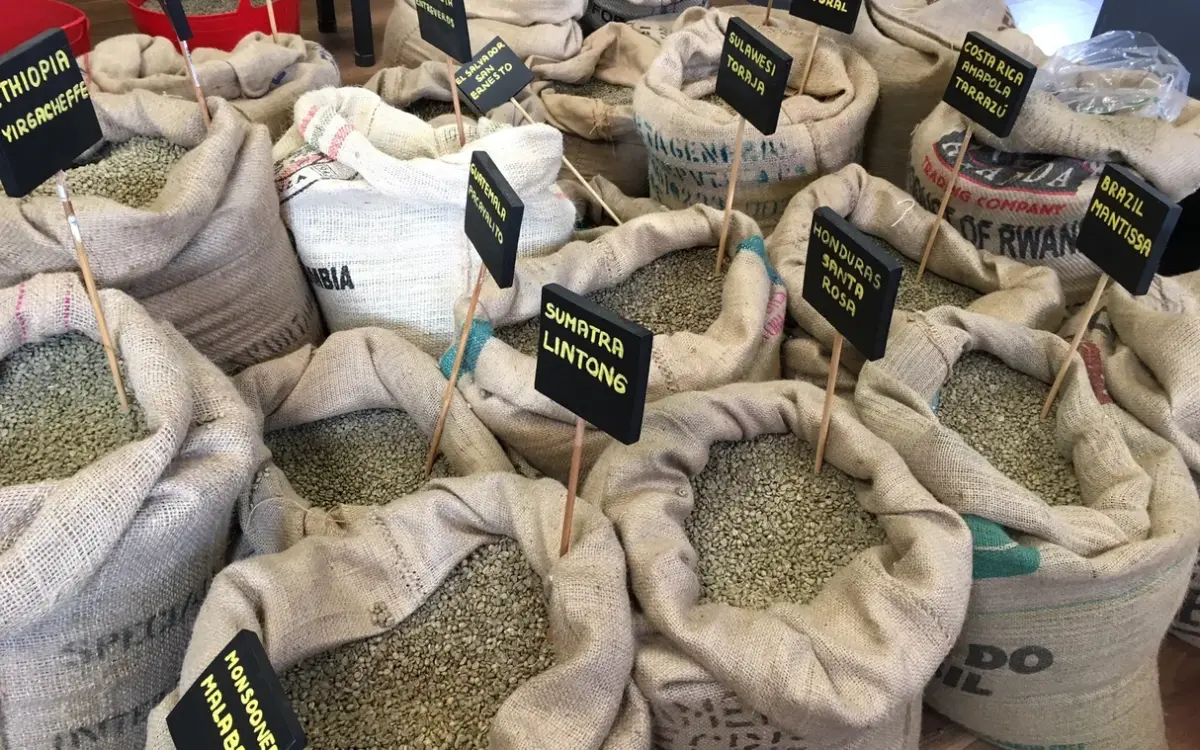
This guide covers the whole London robusta coffee market in one sitting: the exact contract specification, the two dates you must exit by, what can be delivered against it, how it differs from New York arabica, what is moving the price now, and where the EU Deforestation Regulation bites. London robusta coffee is the ICE Futures Europe Robusta Coffee futures contract — symbol RC, ten metric tonnes of Coffea canephora per lot, quoted in US dollars per metric tonne, settled by physical delivery. It is the world benchmark price for physical robusta.
One number frames everything that follows: $1 per tonne. That is the minimum price fluctuation on the contract, and because each lot is ten tonnes, one tick is worth $10. Dollars — not pounds. Hold that figure in mind, because a large share of the pages currently ranking for this phrase will tell you the tick is £1, and that single error mis-sizes every position you take.
What does “London robusta coffee” actually mean?
It is a futures contract, not a coffee style, a roaster, or a café in Shoreditch. Searchers land on the phrase looking for a market, and the market is the ICE Futures Europe Robusta Coffee contract.
The bean behind it is Coffea canephora — robusta. Per Investing.com’s London coffee market page, robusta is roughly 44% of world coffee production against arabica’s 56%, and it goes mainly into instant coffee, espresso blends and as filler in ground blends. That end-use profile is why this contract behaves differently from New York: robusta demand is industrial and price-sensitive, not specialty-driven. When a multinational blender re-specs a recipe to use more robusta, it shows up here.
Why it is nicknamed the London coffee market
The contract’s historical home was LIFFE — the London International Financial Futures and Options Exchange — which ICE acquired. The venue changed. The nickname did not. Traders still say “London coffee” the way they still say “the pit,” and data vendors still label the price page that way.
RC, RM, RC1! — one contract under several ticker symbols
This is the single most common point of confusion for a new reader, so take it slowly. There is one market. There are several labels for it:
- RC — the exchange symbol on ICE Futures Europe. This is the authoritative one.
- RM — the platform symbol on Barchart, where the contract is displayed as “Robusta Coffee 10-T”. Barchart’s own contract profile confirms the discrepancy.
- ICEEUR:RC1! — how TradingView renders the continuous front month.
- “London Coffee” — Investing.com’s page title for the same series.
Four tickers, one order book. Nothing about the RM symbol implies a different contract, a different size or a different settlement.
What the pages ranking for this keyword still get wrong
Here is the honest state of this search result, and it is the reason this page exists. The live-quote pages give you a number with no mechanics. The explainer pages give you mechanics that are a decade out of date. Neither is usable on its own, and in practice a reader who stitches two of them together ends up with a position sized in the wrong currency on an exchange that no longer runs the contract.
The GBP-versus-USD error, and why it matters to position sizing
MarketsWiki’s ICE Robusta Coffee page and several trader-education sites still state the contract is quoted in pounds sterling per metric tonne, with a £1 per tonne (£10) tick. ICE’s own product page for Robusta Coffee Futures specifies price quotation in US dollars per metric tonne and a minimum fluctuation of $1 per tonne ($10). Treat any GBP figure you meet elsewhere as a stale LIFFE-era artefact. The practical consequence is not academic: size a hedge off a sterling tick value and your risk per contract is wrong from the first fill, and your stop distance is wrong with it.
LIFFE is not the venue anymore
Pages still in the top results place the contract at “LIFFE, a subdivision of NYSE.” It lists on ICE Futures Europe, MIC code IFLX, symbol RC. Two further gaps run through the whole result set:
- The missing deadline. Quote pages show the price but never the date you must be out by, so a retail long can drift toward a physical delivery obligation without ever seeing a warning.
- The missing regulation. No page in this result set connects the EU Deforestation Regulation to the contract’s delivery and grading process, even though ICE circulars now impose subscription requirements on members involved in deliveries.
So the rule for reading anything about this market, including this page: verify every specification against ICE’s product page and the current ICE circulars. Not against a blog. Not against this article six months from now.
What is the full contract specification for London robusta coffee futures?
The complete current spec, in one table, taken from ICE’s product page rather than a third-party summary.
| Specification | Detail |
|---|---|
| Exchange | ICE Futures Europe (MIC: IFLX) |
| Symbol | RC (displayed as RM on Barchart) |
| Contract size | 10 metric tonnes |
| Price quotation | US dollars per metric tonne |
| Minimum price fluctuation | $1 per tonne — $10 per contract |
| Delivery months | January, March, May, July, September, November (ten delivery months available for trading) |
| Settlement | Physical delivery into an exchange-nominated warehouse in Europe or the USA |
| Trading hours | 09:00–17:30 London (04:00–12:30 New York, 17:00–01:30 Singapore) |
| Daily price limit | None |
| Also listed | Robusta Coffee options, plus 1-month and 2-month calendar spread options. |
Note the daily price limit line. There is no limit-up or limit-down circuit to halt an adverse move in this contract. Whatever the market does in a session, your position does with it.
How the front month rolls through the Jan–Nov cycle
The quote you see on Investing.com or Barchart is the nearest active delivery month, not a perpetual price. Liquidity rolls forward to the next month in the January/March/May/July/September/November cycle as expiry approaches. That matters for two reasons. First, a chart that looks continuous is actually stitched from successive contracts. Second, if you are holding and intend to stay exposed, the roll is a trade you have to make — it does not happen for you.
What can actually be delivered — and the two dates you must exit by
Deliverable quality is Class 1 Robusta Coffee at contract price. Other qualities are deliverable at set premiums and discounts fixed in the ICE Futures Europe contract rules for Robusta Coffee, Section GGGG. Coffee from any origin freely available for export to any destination qualifies, which is what makes this a true global benchmark rather than a Vietnam-only instrument. Delivery location is an exchange-nominated warehouse in Europe or the USA — and the stock sitting in those warehouses is the “ICE certified robusta stocks” figure traders watch.
Class 1 Robusta, premiums and discounts
If you are tendering physical coffee, the grade schedule is where your economics are decided. A cargo that grades below Class 1 still delivers — it delivers at a discount set by the rulebook, not by negotiation. Read Section GGGG before you assume a parcel is deliverable at the screen price.
First Notice Day vs. Last Trading Day — which one is your real deadline
Per ICE:
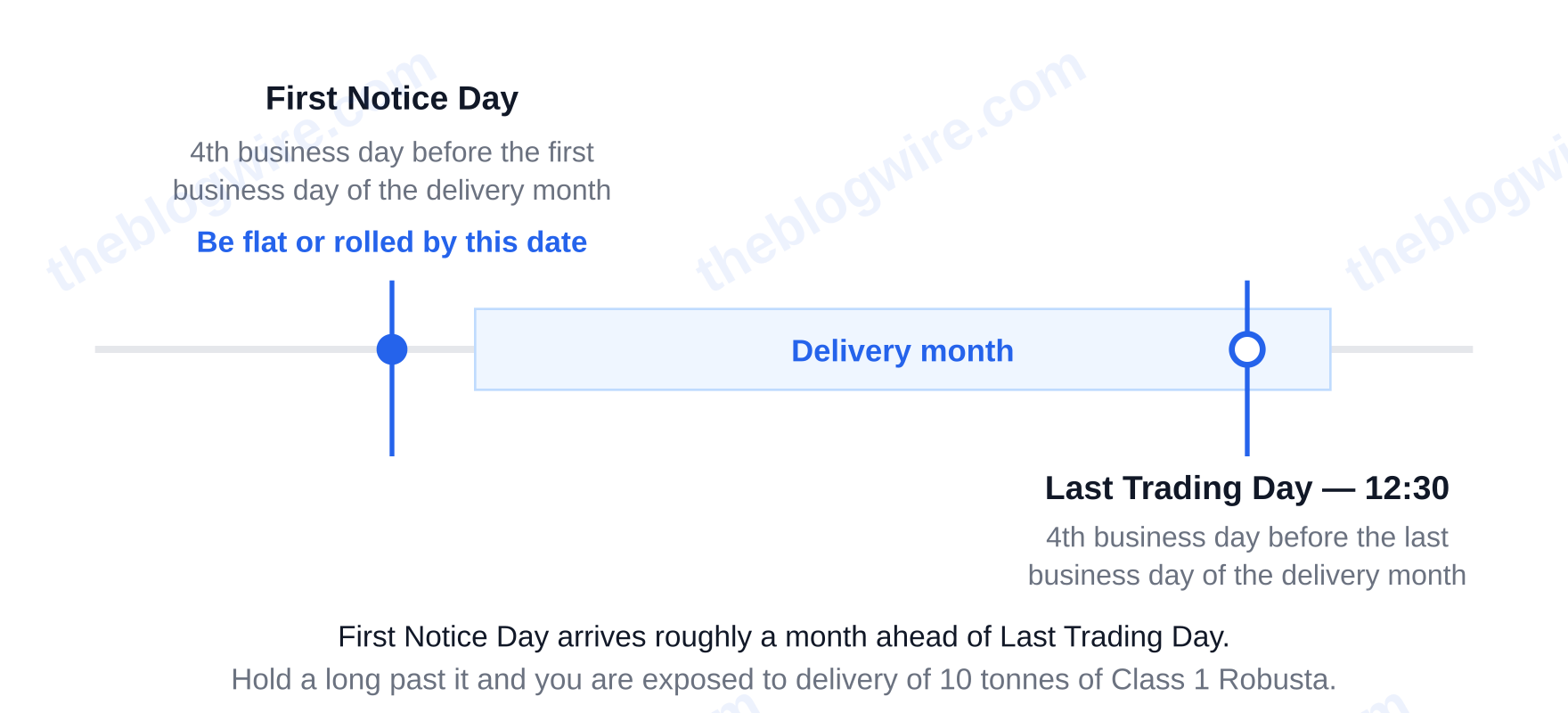
- First Notice Day: the fourth business day preceding the first business day of the delivery month.
- Last Trading Day: the fourth business day preceding the last business day of the delivery month, at 12:30.
Now the consequence nobody spells out. Hold a long past First Notice Day and you are exposed to taking physical delivery of ten tonnes of Class 1 Robusta into a warehouse in Europe or the USA. A speculator must be flat — or rolled — before that date, not before expiry. First Notice Day arrives roughly a month ahead of Last Trading Day, and it is the one that actually governs you.
The habit worth building: diary the First Notice Day for your front month on the day you open the position, and check it against the current ICE contract calendar rather than a remembered rule of thumb. Business-day counts shift around holidays.
London robusta vs. New York arabica: how do the two contracts differ?
These two markets are routinely confused, and their headline prices are not comparable without a conversion. One table, one screen.
| London robusta | New York arabica | |
|---|---|---|
| Exchange | ICE Futures Europe | ICE Futures US |
| Bean | Coffea canephora (robusta) | Arabica |
| Price unit | US dollars per metric tonne | US cents per pound |
| Contract size | 10 metric tonnes | The Coffee C lot |
| Delivery months | Jan / Mar / May / Jul / Sep / Nov | Coffee C cycle |
| End demand | Instant coffee, espresso blends, filler in ground blends | Roast-and-ground and specialty |
| Share of world production | ~44% | ~56% |
The unit row is the single biggest source of error when a reader compares two headlines. Dollars per tonne and cents per pound are different scales entirely; a robusta price of a few thousand and an arabica price of a few hundred are not telling you robusta costs more.
Why robusta trades below arabica
Yield per hectare, disease resistance and cup profile all point the same way: robusta is the cheaper, hardier been serving the price-sensitive end of the market. The discount is structural, not a market anomaly waiting to close.
Reading the arabica–robusta spread as a supply-stress signal
The trade reads the spread between the two contracts as a supply-stress indicator rather than merely a quality premium. A compressing spread signals arabica tightness pulling blenders toward robusta. A widening one signals the reverse. That read-across is exactly why London is watched alongside New York rather than in isolation — the two prices are not independent observations of “coffee.”
What moves the London robusta price?
Six forces, in rough order of how often they explain a day’s move.
- Vietnam. The world’s largest robusta producer at over 40% of global supply. Weather in the Central Highlands and the timing of the harvest are the dominant physical driver. Analyst surveys published in 2026 put the Vietnamese 2026/27 crop at an average of around 31 million bags.
- Brazil. Second-largest, growing robusta as conilon, largely in Espírito Santo, harvested roughly May to August. That is a second supply window which can offset — or compound — a Vietnamese shortfall.
- ICE certified robusta stocks. The visible buffer in exchange-nominated warehouses. Falling certified stocks tighten the deliverable supply the contract actually settles against, which is a different thing from world production.
- Fund positioning. In the week ending 3 November 2026, funds added 4,767 robusta shorts to reach a net short of 16,968 contracts — the largest in nearly four years, per Cocoaintel. A crowded short cuts both ways: it caps rallies until it does not.
- Cross-market read-across. Cocoaintel also reported ICE arabica certified stocks falling to a seven-week low of 220,379 bags in early November 2026, just above the 27-year low of 217,646 bags set on 15 September 2026. Arabica scarcity feeds back into robusta demand through the blend.
- The dollar, freight, and regulation. Because the contract is quoted in USD, dollar strength alone moves the effective price for every non-US buyer, with no change in the coffee balance at all.
Where the price stands now — and the forecast range
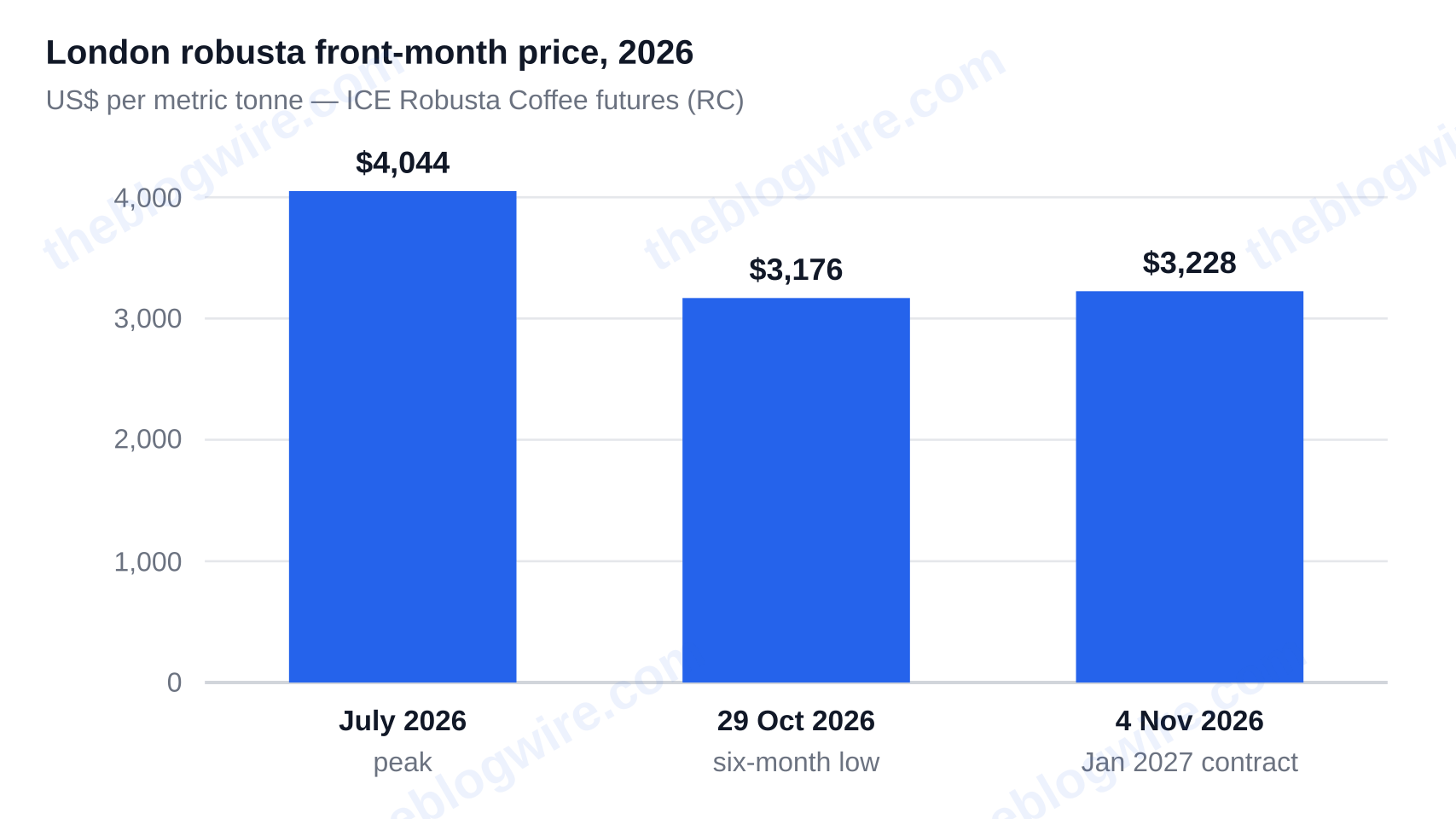
Kensington Coffee reported the January 2027 contract (RMF27) at $3,228 per tonne on 4 November 2026, up $18 (+0.56%) on the previous settlement. That sits well below the July 2026 peak near $4,044 and just off a six-month low of $3,176 set on 29 October 2026.
Forward views are wide. Analyst surveys published in 2026 by Comunicaffe show base cases of $3,200–3,800 per tonne against bearish calls nearer $2,500 for the May contract. Treat any single forecast as one scenario. The spread between them is the real information — it tells you the market has no consensus, which is itself a position-sizing input.
How does the EU Deforestation Regulation effect robusta delivered in London?
Coffee is in scope of the EU Deforestation Regulation, so compliance now sits inside the contract’s delivery and grading process rather than beside it. Two concrete requirements:
- ICE circulars covering the Robusta Coffee contract require Clearing Members involved in deliveries to subscribe to the exchange’s nominated Due Diligence Information System, ICE CoT.
- Members and customers who want robusta graded in the EU and UK for the delivery process must have subscribed to that system. That is a practical gate on staying deliverable, not a background formality.
Meanwhile, the regulatory calendar has moved on its own track. Per Latham & Watkins, EUDR’s main application date for large and medium-sized operators is now 30 December 2026, with 30 June 2027 for smaller operators.
The EUDR timetable has slipped — verify before you plan around it
The circular language and the EUDR timetable have shifted independently, and more than once. So check the live ICE circular and the current Commission position rather than any blog’s date — including this one. Exporters and physical traders tendering against the contract should care most, along with any EU or UK buyer whose differential contract quietly assumes the coffee behind it is deliverable.
How do you get exposure or hedge — and who actually uses this contract?
Users are producers, exporters, importers, roasters, instant-coffee manufacturers and investment firms: hedgers establishing a price floor or ceiling, and funds taking directional or spread positions. Most of the world’s robusta never touches a futures screen and is still priced off this market.
Hedging a physical position with a London-based differential
A Vietnamese or Brazilian cargo typically prices as the London futures price plus or minus an origin-and-quality differential. That is how the contract sets the reference even for parties who never open a futures account. If you buy physical robusta on a differential, you already have London exposure whether you track it or not.
Your instrument choices, in rising order of obligation:
- Fixed-differential physical contract. No account, no margin. You inherit the London price level via the differential.
- Robusta options, and the 1-month and 2-month calendar spread options listed by ICE. Defined risk, and spread options for anyone whose real exposure is about the roll rather than the level.
- CFDs. The small-account route, with the counterparty, financing, and spread costs that come with them.
- The outright futures contract. Full control, full obligation — including delivery if you misjudge First Notice Day.
When one contract is too big for your exposure
Here is the reality check no ranking page gives you. At roughly $3,200 per tonne, one ten-tonne lot is about $32,000 of coffee. A single-container buyer or a small roaster is therefore structurally over-hedged by one lot — the smallest position available is larger than the risk being hedged, which converts a hedge into a speculation. The honest answer for that reader is a fixed-differential physical contract priced off London, or options. Not an outright future.
Where to watch the live quote and historical series
Use Investing.com’s London Coffee page or Barchart’s RM quote for the live and historical front-month series in US dollars per tonne. Use ice.com for the binding specification. Keep those jobs separate: the quote vendors are good at prices and unreliable on mechanics, and the exchange is authoritative on mechanics and not where you watch a tick.
The short version
London robusta coffee is one contract with one authoritative specification: RC on ICE Futures Europe, ten tonnes, US dollars per metric tonne, $10 a tick, physical delivery, and a First Notice Day that arrives well before expiry. Everything else — the price level, the fund positioning, the EUDR timetable — moves week to week.
Next step: open ICE’s Robusta Coffee Futures product page, confirm the First Notice Day for the current front month, and write that date down before you size a position or sign a differential contract.
Rule of thumb: dollars per tonne, ten tonnes a lot, and out before First Notice Day — get those three right and nothing else about this market can surprise you expensively. You’ll find more guides like this across The Blog Wire.
Quick Answers
Is robusta coffee traded in London or New York?
Robusta trades in London — specifically as the Robusta Coffee futures contract (symbol RC) on ICE Futures Europe, in US dollars per metric tonne. New York’s ICE Futures US lists the arabica contract, quoted in US cents per pound. Both are ICE markets, but they are separate contracts on different beans, and their price units are not directly comparable.
What is the robusta coffee price today per tonne, and where do I check it?
Check Investing.com’s London Coffee page or Barchart’s RM quote for the live front-month price in US dollars per tonne. For a recent reference point, Kensington Coffee reported the January 2027 contract at $3,228 per tonne on 4 November 2026, up $18 (+0.56%) — against a July 2026 peak near $4,044 and a six-month low of $3,176 on 29 October 2026.
Who is the biggest robusta producer — Vietnam or Brazil?
Vietnam, at over 40% of global robusta supply. Brazil is second, where the bean is grown as conilon largely in Espírito Santo and harvested roughly May to August. That gives the market two separate supply windows: weather in Vietnam’s Central Highlands dominates, but the Brazilian conilon crop can either offset or compound a Vietnamese shortfall.

