
The death rattle describes the end-stage rattling or bubbling sounds made by a person who is unable to clear saliva or mucus from the throat and upper airway. It happens because the swallow and cough reflexes have faded — not because fluid is filling the lungs. Prevalence has been reported at 13% to 92% in the dying population, and usually it signifies the end is near.
That 13–92% spread comes from a systematic review in the Journal of Pain and Symptom Management, which settled on a weighted mean of 45% in prospective studies and 30% in retrospective ones. As such, it is a fairly common occurrence, but there are many people who die without making such a sound. Of the patients that you care for in the end of life process, roughly half will make the death rattle sound. The other half will not, and there is nothing to say about peace of that death based on the absence of the sound.
What is the death rattle, exactly?
It is a rattling, gurgling, crackling or bubbling noise heard on each breath in the final phase of life. The sound is caused by air passing over mucus and saliva that are obstructed in the oropharynx and upper airway. This is why the sound is made with each breath.
There are several names for the death rattle sound; these include terminal respiratory secretions, noisy upper airway secretions, and audible upper airway secretions. A nurse or doctor may not use the phrase “death rattle” at all. They all describe the sound you are hearing. The secretions, mucus, and saliva typically clear by means of the cough and swallow reflex, but as the person moves toward end of life, these reflexes diminish.
Why it happens: the reflexes stop, and secretions pool
Here is the correction that matters most. This is actually a stopping-up, not an oversecretion of fluids. Healthy people swallow saliva and bronchial secretions hundreds of times a day without noticing it. In the last few days of life the swallowing reflex disappears and the coughing reflex goes with it, and the saliva pools in the back of the throat.
What it is not: pneumonia, drowning, or fluid on the lungs
It’s not fluids on the lungs in the pneumonia sense. The person is not drowning. The noises are coming from the upper part of the airway, not the bottom. This is expected in the dying process. It is not a complication of dying. It is not something the family caused by giving too much water or from not giving it.
What does it sound like?
Because the noises are explained by telling what they sound like, it is taught in palliative care that describing it makes it easier on the family. The analogies clinicians are advised to use are snoring, or drawing the last of a drink up through a straw. Families reach for others: it sounds like gargling or wet purring. It can be described as crackling.
It is something that is always changing, so it is different in every person. Volume and texture shift breath to breath and with the angle of the head. You can hear the loudest part of it from another room, and that is part of the reason it is frightening.
Clinicians grade it with simple tools — the Victoria Respiratory Congestion Scale (VRCS) and the DRIS are the most commonly used. Since the number is assigned using simple tools, it’s helpful to remember that “how loud is it” is a quantifiable number, not a judgment. The loudness and suffering are actually two separate questions, and suffering is the next one and the real one.
Is it painful, and is the person choking?
Most pages say that it is painless, and leave it at that. Crossroads Hospice states definitively that there is no evidence it causes discomfort or distress. That is helpful, and at 3am it is also not that useful, because an assertion does not win over what is in front of you.
So here is the measurement instead. A prospective study reported in the Annals of Palliative Medicine put a validated tool, the Respiratory Distress Observation Scale (RDOS), on dying patients with the rattle (n=32) and without it (n=39). It found no difference in respiratory distress between the two groups. It also found no correlation between rattle intensity and distress: r=-0.13. A louder rattle was not a more distressed patient.
Why the sound distresses the room more than the patient
The physiology behind that number is fairly simple. By the time the rattle is audible, the person is usually deeply unconscious. The reflexes that register discomfort and respond to it have stopped — the same reflexes whose absence is causing the noise.
The systematic review separates the two experiences truthfully. It documents that the presence of death rattle causes distress to the caregivers and relatives, and the effect on the patient is uncertain. Suffering is real. Most of the time, it is the listener’s suffering. In practice, that distinction is what provides the most solace to the family at 3am. More than “they are comfortable,” which sounds like something you say. Give them the sample sizes and the near-zero correlation. People can believe a number.
How long after it starts does death usually occur?
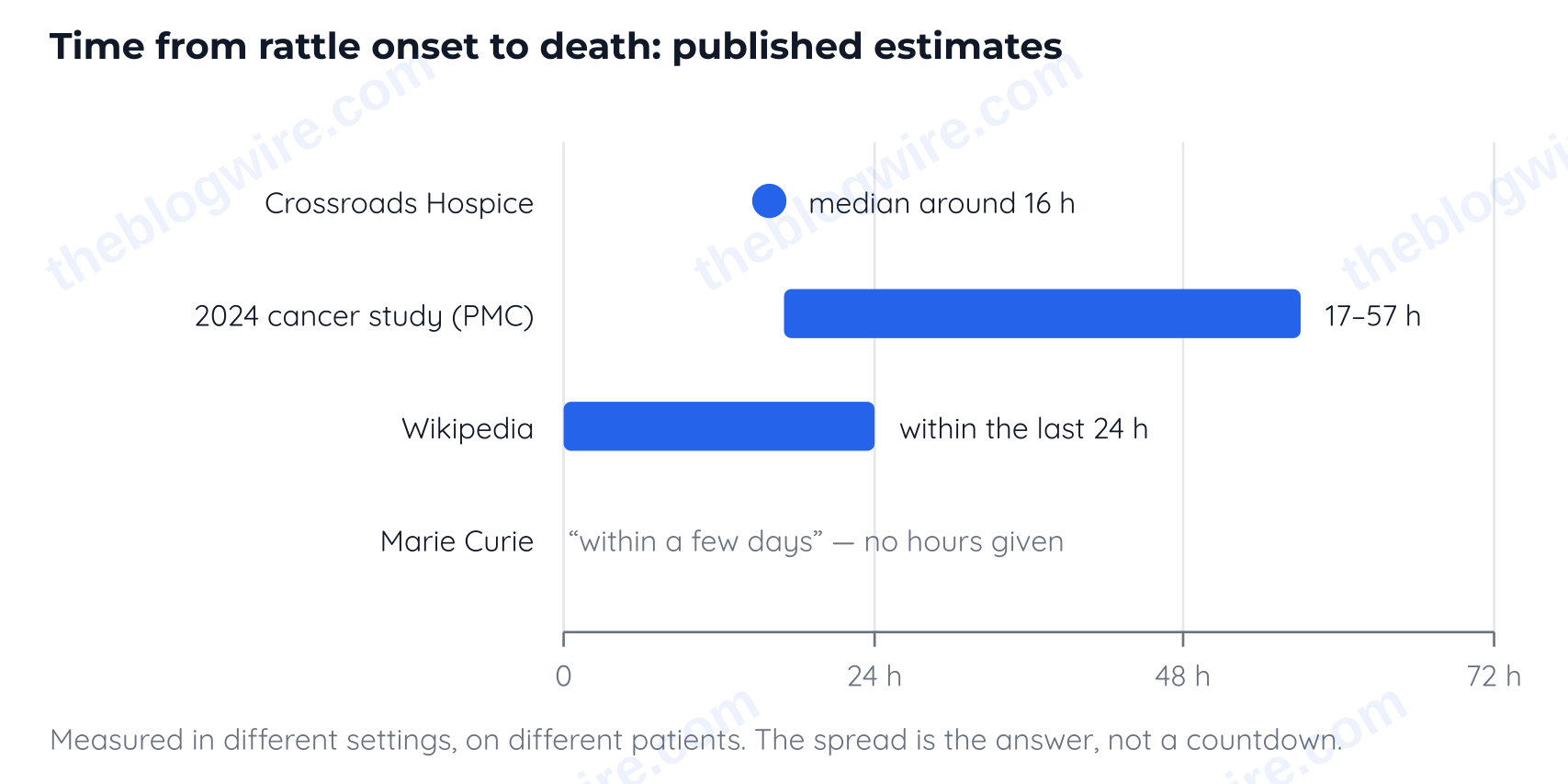
Usually hours to a few days. That is a range, not a countdown. Hospice nurses know the approximate range, but giving an exact time is very difficult, and that’s why nurses don’t like to give an exact time.
It is the range that gives the most useful information. We should pay attention to the spread. The published estimates genuinely disagree with one another, and the spread shows us that one number carries false precision:
| Source | Time from onset to death |
|---|---|
| Crossroads Hospice | Median around 16 hours; final stage typically the last 24–48 hours |
| 2024 descriptive study of patients with cancer (NCBI/PMC) | Roughly 17 to 57 hours |
| Wikipedia | Most commonly appears during the last 24 hours of life |
| Marie Curie | Most people will die within a few days |
One end of the spread was less than a day; the other end was more than two days. No one is wrong; the measurements are just being taken in different locations, on different patients. That spread is the honest answer to “how long do we have.”
Quieter does not mean better
Quieter does not mean the process is better or more merciful. One pattern confuses families more than any other. In a cohort of 200 patients, 54.5% developed audible secretions at some point; however, only 34.5% were reported to have them at the moment of death — a figure reported in secondary coverage rather than read from the primary paper, so treat it as indicative. The point is that the rattle will not always be present at the end and will sometimes return.
Neither the fading of audible secretions nor the return of rattling breaths should be misread as improvement or worsening of the patient.
It is also different from the breathing patterns people often confuse it with, which include agonal breathing, Cheyne-Stokes or periodic breathing, and Kussmaul respiration, which are all different things. Expect it alongside the other signs that cluster in the last days: changes in breathing rhythm, cool or mottled skin, less urine, deepening unresponsiveness, no interest in food or fluid.
What helps — and why suctioning usually backfires
Let’s start with what is effective, inexpensive, and readily available. Marie Curie’s guidance suggests repositioning the person to lay on their side with pillows under their head and chest, or raising the head of the bed. This helps drain the secretions away from the airway. Then:
- Gentle mouth care at the front of the mouth — moisten the lips and mouth with swabs, not deep suction.
- If a fluid drip is running, ask whether it can be stopped or reduced, in case it is making the secretions worse.
- Talk, touch, play music, just be there. Hearing is thought to persist when the person can no longer respond.
Suctioning deserves the honest version, because no ranking page gives it. Clinical review states that trying to remove the secretions by suctioning leads to discomfort, bleeding, and vomiting. Yet in a survey of bereaved families, more than 70% believed suctioning reduced the rattle, made the patient comfortable and relieved them — while a similar proportion felt the patient was in distress during it. And the more distress families perceived, the more strongly they felt that care needed improving.
That is the crux of the situation. Deep suctioning often soothes the listener at the patient’s expense.
Hospice nurse and doctor feedback is always beneficial, and especially useful for a new rattle, visible struggle or grimacing, distress you cannot settle — or simply because you need someone else in the room.
Do the medications work — and why prevention beats treatment
The mechanism is everything here. Antimuscarinic (anticholinergic) drugs reduce the production of new saliva and secretions. They dry what is coming. They cannot clear saliva and other secretions that have already pooled.
Medications you may be offered are hyoscine butylbromide (scopolamine butylbromide, Buscopan), hyoscine hydrobromide (scopolamine), glycopyrronium bromide or glycopyrrolate, atropine, and hyoscyamine — by tablet, subcutaneous injection, or syringe driver.
What the SILENCE trial found
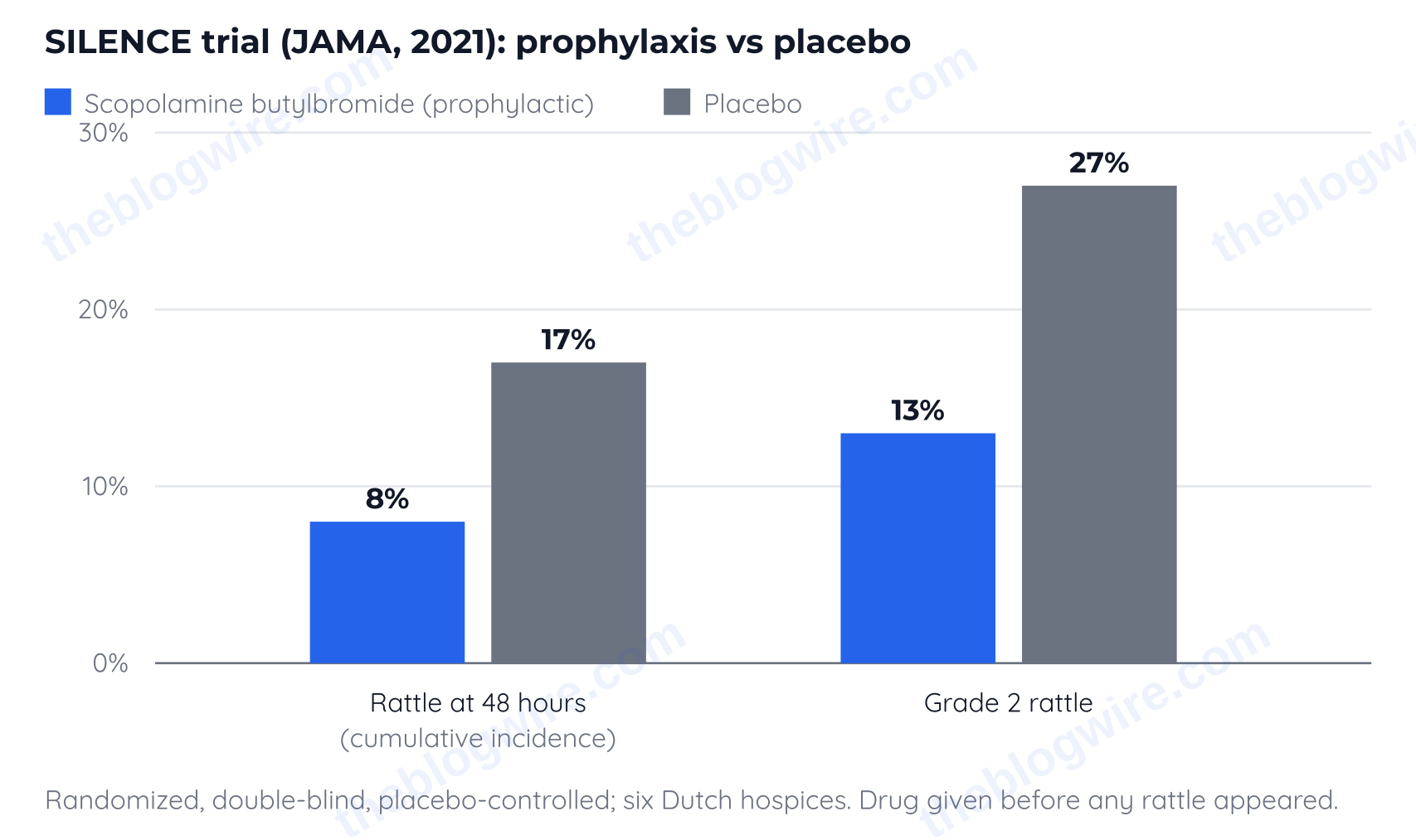
This is the information the top results never give families. The SILENCE randomized, double-blind, placebo-controlled trial, published in JAMA in 2021, was conducted across six Dutch hospices. The trial gave prophylactic subcutaneous scopolamine butylbromide to dying patients before any rattle appeared. Cumulative incidence at 48 hours was 8% in the treatment group, compared to 17% in the placebo group. Grade 2 rattle occurred in 13% in the treatment group compared to 27% in the placebo group. An ACP Journal Club independent evaluation of the SILENCE trial in 2022 came to the same conclusion.
Another open-label randomized study with 132 patients came to the same conclusion as the previous studies. The prophylactic use of hyoscine bromide was shown to significantly reduce rattle compared to the same drug used for treatment of established rattle.
The bedside conclusion follows. Once you are already hearing it, medication is working against the odds. That is not a reason to refuse it. It is the reason to expect modest results — and to weigh a drying mouth, sedation and the other anticholinergic effects against a sound the evidence says is not hurting the person in the bed.
Where the phrase comes from
Hospice webpages skip this, and dictionary sites rank alongside them for the exact phrase. Merriam-Webster writes that the first known use of “death rattle” was 1781. They describe it as the sound of air passing through mucus in the lungs and air passages of a dying person. The Oxford English Dictionary’s earliest evidence is also 1781, in the writing of J. Murray.
The use of the word can be dated even earlier. Etymonline gives 1752 as the first known use of “rattle” to describe a sound made in the throat, especially by a person near death. They also write that the word itself comes from Middle Dutch ratelen, probably imitative in origin. So, like many onomatopoeias, the definition and use of the word are intertwined, which is perhaps why the word and figure of speech travel so well — the death rattle of an empire, of an industry, a last audible sign of something ending, borrowed straight from the bedside.
The one thing to remember
Two answers then. The sound comes from secretions the body can no longer clear, and the measured evidence says it is not hurting the person; it is hardest on the people listening. Death usually follows within hours to a few days, though published ranges disagree enough that no one can honestly give you a time.
So, turn them onto their side with head and chest raised, keep the mouth and lips moist, skip the deep suctioning, and call the hospice nurse. Tell them exactly what you are hearing and ask what they would do. The live question in this field is no longer should we medicate the rattle, but should we pre-empt it, and SILENCE is the trial that has moved this practice along. Expect that to be the conversation the hospice nurse is having. Then sit down again and keep talking to them. For other pieces in this vein, see The Blog Wire.