The quick answer to “why are my ankles swollen?” is edema, which is a type of swelling that occurs from fluid leaking out of small blood vessels and building up in the soft tissue of your ankles and feet. There are a few reasons for edema, including standing or sitting for a long time, gravity, a side effect of medication, and a defective valve in your leg veins, to name a few. Sudden swelling of one leg, or the combination of swelling with shortness of breath, needs same-day care.
The information below is the shortlist that matters — eight causes and checks, ordered by the probability of each cause rather than alphabetically or by how frightening it sounds. Additionally, this information includes actual numbers or measurements rather than using abstract language such as, “certain medications can cause edema.” Furthermore, this information includes three questions that you can ask yourself which will narrow 15 possible causes down to 2 or 3.
1. Start here: the three questions that sort every cause
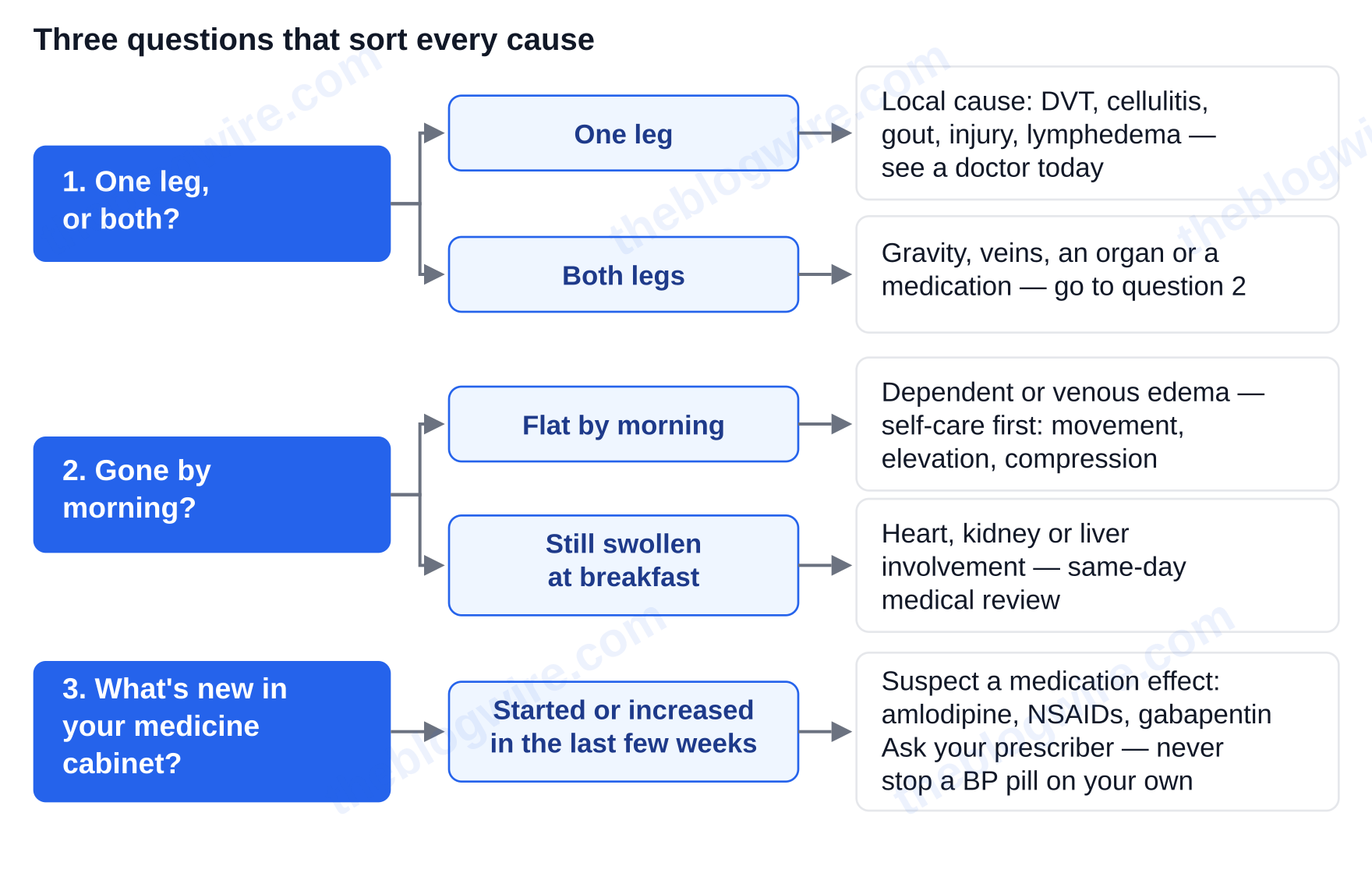
One leg or both? Gone by morning? What’s new in your medicine cabinet? Three things will help sort potential causes way more than any cause list will. One leg indicates a local issue such as an injury, clot, infection, or a lymphatic blockage, whereas both legs point more toward factors such as gravity, veins, an organ, or a medication. Swelling that is flat again by morning is very different from swelling that doesn’t resolve: a study published in the Journal of the American Board of Family Medicine states that venous edema is more likely than lymphedema to improve overnight. That one clue separates two completely different treatment pathways.
Your triage grid: four patterns, four next steps
| Pattern | Likely cause | Next step |
|---|---|---|
| Both legs, worse by evening, flat by morning | Dependent or venous edema | Self-care first: movement, elevation, compression |
| Both legs, no longer flat in the morning, with breathlessness | Heart, kidney or liver involvement | Same-day medical review |
| One leg, sudden, with calf pain, warmth or redness | Suspected DVT | Urgent care today — not wait-and-see |
| One leg, hot, red, tender, with fever | Suspected cellulitis | Same-day appointment for antibiotics |
People often jump to the most concerning item on a cause list. The grid stops that. It also shows why “when should I be worried about swollen ankles?” has no simple answer. It depends on which quadrant you are in based on your symptoms, not how puffy your ankles look.
2. Gravity and a long day upright — the most common explanation of all
Our calf muscles have a one-way pump that moves blood from the lower legs to the heart, and it can only function with muscle movement. If you are sedentary for a long time — a desk day or a shift behind a counter — the calf pump doesn’t work and fluid accumulates at the lowest point available. That’s dependent edema: by the end of the day, socks leave a mark by 6pm, your shoes bite, and your morning shoes fit fine. Heat makes edema worse because warmth dilates surface vessels, which is why your ankles puff in July and not January. Adding a high salt meal, prolonged flights, crossing your legs, or wearing tight, elastic stockings can also contribute to edema. The answer was benign since the edema resolved within a day or two of fixing the trigger, and no long-term changes occurred to the skin.
3. Failing leg vein valves — the most likely answer after 50
This is the option most consumer web pages hide. According to the JABFM review, in patients above 50 years, the most likely reason for leg edema is due to failing leg vein valves — venous insufficiency — and not due to cardiac, renal or hepatic causes. Lower-extremity edema affects about 20% of individuals over the age of 50 in industrialized countries. Medscape puts estimates for the prevalence of varicose veins and chronic venous insufficiency at between 40–73% in women and 20–56% in men.
Leg vein valves function like one-way valves. They stop blood from flowing backwards due to the effects of gravity. As explained by Harvard Health, those valves age too and work less efficiently over the years. This results in blood pooling in the legs, pressure rising, and fluids pushing out into the tissues. It fits the overnight pattern perfectly: after a night of lying down, the gravity load is reduced and the limb is less swollen by morning. Aching heaviness, visible veins, itching and eventually brown staining around the ankle mean it’s been going on a while.
4. Your blood pressure pill — the culprit with real numbers attached
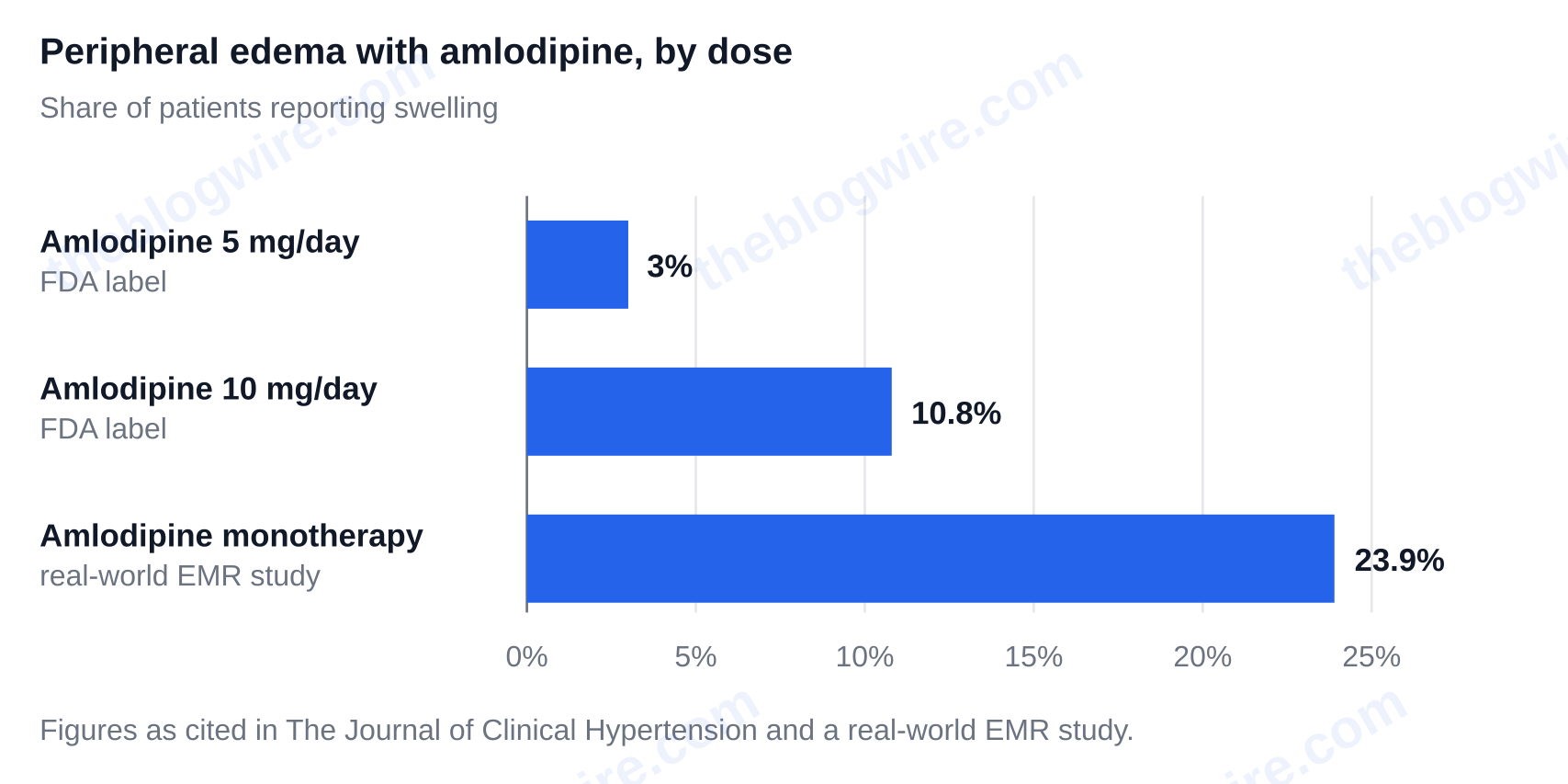
If your edema started within a few weeks of beginning or increasing your blood pressure medication, and is in both ankles, consider it a medication side effect until proven otherwise. Most of the other pages say blood pressure medications can cause this and stop there. Here are the numbers: The Journal of Clinical Hypertension states in FDA labels for amlodipine that peripheral edema occurs for approximately 3% of patients at 5 mg/day and 10.8% at 10 mg/day, with edema rates for calcium channel blockers as a class ranging from 5% to as high as 70% based upon the compound and dose. A real-world EMR study for amlodipine monotherapy showed that 23.9% of the patients reported pedal edema, which is much higher than what the clinical trial labels report.
It is more common to occur in women, the elderly, and in people with obesity. The key point here is that the cause is arteriolar dilatation leaking fluid into the tissue spaces, and it is not because of fluid overload. Therefore, a diuretic will not correct it, and that is also why a reduced dose will help correct it. It is also worth checking tonight:
- Calcium channel blockers — amlodipine, nifedipine, felodipine
- NSAIDs and Corticosteroids
- HRT and the Birth Control Pill
- Gabapentin and Pregabalin
- Some Antidepressants, Antivirals, Chemotherapy Agents, and Diabetes Medications
Discuss with your prescriber a reduced dose or an alternative agent. Never discontinue a blood pressure lowering medication on your own.
5. The chest causes: heart, and the one almost nobody lists
Cardiac swelling is rarely seen by itself. The British Heart Foundation describes it like this: the heart muscle is too weak or too stiff to pump blood forward, so it backs up in the leg veins, pressure builds up, and fluid is forced out into the tissues. What moves this up your list isn’t the swelling. It’s shortness of breath with activity or when you lie flat. It’s also waking up in the night with shortness of breath, weight gain over days, and swelling that no longer clears overnight.
Pulmonary Hypertension is seen on none of the big consumer cause lists. In the study cited by JABFM, of the patients who were clinically judged to have venous insufficiency, 20% actually had PH and another 22% had borderline elevation, often associated with Obstructive Sleep Apnea. The practical sign is both ankles swelling and loud snoring, plus witnessed pauses in the breathing or daytime sleepiness. If swelling is venous in nature but doesn’t improve with compression and elevation, the next question shouldn’t be a stronger compression stocking. The answer is what is happening in your chest at night.
6. One swollen ankle changes the rules
A systemic cause affects both legs, so a single swollen ankle indicates a condition that is local to the ankle, and some of those may be time-critical. Harvard Health puts it bluntly: new swelling of both legs often isn’t serious, but new swelling of just one leg is always something to bring to a doctor. Deep vein thrombosis (DVT) comes on over the course of hours to days and causes calf pain and tightness, a feeling of warmth, and a dragging ache. Cellulitis is an infection that is hot, red, tender and spreading, often with fever. Gout is characterized by a suddenly swollen leg that arrives suddenly and is too painful to touch. Lymphedema is firm, non-pitting, involves the toes, and doesn’t clear overnight. Injury explains itself — ankle sprains account for up to 40% of sports-related injuries. May-Thurner syndrome is worth naming for persistent left-leg swelling in younger people.
7. Pregnancy: expected, until these signs appear
Notice something new in your third trimester? Mild swelling in both ankles and feet is normal. Your body is making more blood, your uterus is growing and pushing on veins in your pelvis, and your body is holding on to more fluid. It is a gradual swelling in both legs that gets worse at the end of the day and is usually worse in hot weather. The swelling is usually better with rest, leg elevation and lying on your left side. Preeclampsia is the exception: if swelling is more sudden and affects your face, around the eyes, or your hands, or you have a sudden severe headache, you need to contact your midwife or maternity unit the same day. There are other symptoms of preeclampsia that you should be aware of including vision changes or pain under the ribs. Swelling can happen up to six weeks after delivery, so if you have swelling after delivery with those symptoms, that is not something to wait out — contact your care provider. Don’t take a diuretic in pregnancy unless it was prescribed to you specifically.
8. What actually works — and why a water pill usually doesn’t
Movement beats everything free, and compression beats everything buyable. Here is the hierarchy with the numbers the ranking pages leave out:
| What to do | The specific | Expect results in |
|---|---|---|
| Work the calf pump | Short walk every hour, or 20 ankle circles and 20 heel raises at your desk | Same day |
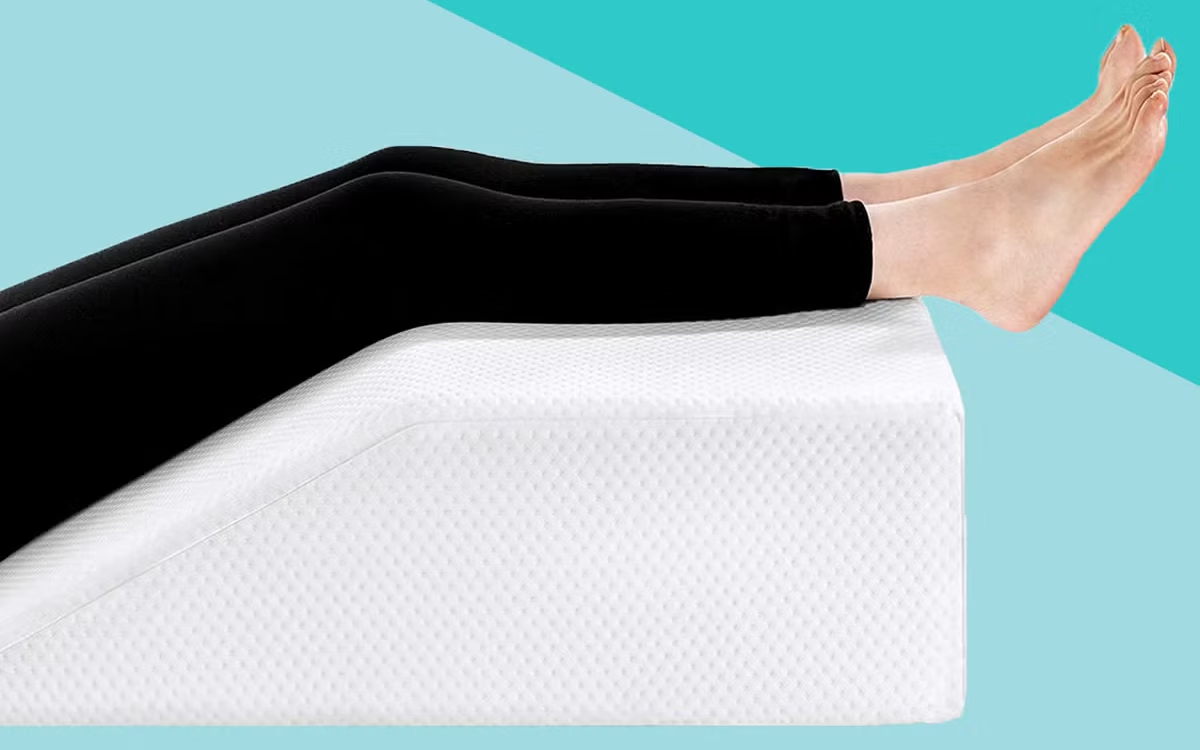
| Elevate properly | Legs above heart level, flat on a pillow stack, 20–30 min, 2–3× daily | Same day |
| Compression stockings | 20–30 mmHg — Medscape notes moderate 20–30 mmHg compression gives significant relief in most people with uncomplicated CVI, and is the range indicated for smaller varicose veins and mild disease. Put them on before swelling builds. | 1–2 weeks |
| Cut hidden sodium | Processed food, bread, sauces, takeaways — not the salt shaker | 24–48 hours |
| Skin care | Wash, dry between the toes, moisturise — stretched skin invites cellulitis | Ongoing |
Grade your own swelling so you can describe it. Press firmly with your thumb over the medial malleolus (the boney protrusion on the inside of your ankle) for about five seconds and time the rebound. Roughly 2 mm springing straight back is 1+; about 4 mm rebounding in 10–20 seconds is 2+; 6 mm taking 30–60 seconds is 3+; 8 mm or deeper taking minutes is 4+.
Why diuretics backfire
In the case of chronic edema, the instinct to reach for a water pill is understandable, but misguided, as most ankle swelling is a pressure or drainage problem in one limb’s plumbing, not generalized fluid overload. The American Academy of Family Physicians (AAFP) states that diuretic therapy should be avoided in chronic venous insufficiency unless a comorbid condition such as CHF requires it. In addition, the AAFP states that diuretics have no place in the treatment of lymphedema. There’s a worse trap: using a diuretic long-term for idiopathic swelling can lead to rebound worsening when the drug is withdrawn, which leads to the false belief that the diuretic is essential. Management is supervised withdrawal over three to four weeks, riding out that initial flare. In general, diuretics genuinely belong in heart failure, significant kidney disease and cirrhosis with ascites — prescribed and monitored.
9. Get help today if any of these apply
Call 999 or go to hospital now for shortness of breath or struggling to breathe, a tight, heavy or painful chest, coughing up blood, noticeable palpitations, or feeling lightheaded, faint, confused, sick or clammy — the NHS lists these as signs of a blood clot in the lungs.
You should contact your GP for an urgent appointment or call NHS 111 (in the US, urgent care or your doctor the same day) for swelling on one leg, foot or ankle that is unexplained; if you have a lot of swelling after an injury; if the swelling is getting worse, severe or sudden; if you also have a lot of swelling in your face or tummy; if the swollen area is red or hot to the touch; if you have a very high temperature or feel hot and shivery; or if you have any swelling on the feet, ankles or legs and you also have diabetes.
You should contact your GP for a routine appointment if your swelling has stopped clearing overnight, if it hasn’t improved after two weeks of honest effort, if the swelling occurred after you started a new medication, or if your skin is leaking, breaking down or browning at the ankle. You should bring a week of evening and morning photos, your thumb-test grade, and your actual medication boxes. History and a venous duplex ultrasound do most of the diagnostic work.
The single best starting point for most readers
If you’re over the age of 50 with both ankles swelling by evening and flat by morning, your best first move isn’t a doctor’s appointment or a water pill — it’s 20–30 mmHg compression stockings worn from first thing, plus hourly calf-pump movement, for two weeks. That one combination addresses the most probable cause for the largest group of people asking why their ankles are swollen. Rule of thumb to remember: both legs and gone by morning can wait; one leg or still swollen at breakfast cannot. For more like this, explore The Blog Wire.
People Also Ask
Does swelling in my ankles that goes away overnight mean it’s harmless?
It’s reassuring, but it isn’t a clean bill of health. Gravity being the driving force points towards dependent or venous edema — the JABFM review notes venous edema is more likely than lymphedema to improve overnight. So it makes a clot, lymphedema and advanced organ disease less likely. It doesn’t rule out early chronic venous insufficiency or a medication effect, both of which clear by morning in the early stages. Skin changes from chronic venous stasis should not be allowed to occur, so if it’s happening most days, it’s worth sorting out.
Why do my ankles swell when I fly but not when I drive the same distance?
Mostly because you move less. On a long drive you stop, get out and stretch, which keeps the calf muscle pump working. On a plane you are stuck in the same position for hours, with the seat edge pressing behind your knees. Cabin conditions add to the fluid shift. The important difference isn’t the puffiness itself — it’s that post-travel swelling in one leg with calf pain or warmth needs same-day assessment, because immobility raises clot risk. Both ankles, evenly, settling within a day or two is the benign pattern.
Can drinking more water reduce ankle swelling, or does it make it worse?
For most people, it won’t make a difference either way. Ankle swelling (edema) is usually a pressure or drainage problem in your legs and not how much you drink. Cutting liquids doesn’t make the swelling go away and can also leave you dehydrated. The dietary factor that is really important is sodium — and most of it hides in processed food, bread, sauces and takeaways rather than the salt shaker. If you have problems with your heart, kidney or liver, it is best to follow the fluid advice your own clinician gave you. These are the situations where intake is deliberately managed.
How do I know if my amlodipine is causing my swollen ankles?
Look at if there is a pattern and when it started. Edema caused by medication usually occurs in both ankles and starts within weeks of beginning the medication or increasing the dosage. The dose matters: The Journal of Clinical Hypertension reports FDA labelling showing edema in about 3% of patients at 5 mg/day of amlodipine versus 10.8% at 10 mg/day, and a real-world EMR study of amlodipine monotherapy found 23.9% reported pedal edema. It is more common in women, older people and people with obesity. Talk to your prescriber about decreasing your dose or trying a different agent — don’t stop taking your blood pressure medication yourself.
What does it mean if only one ankle is swollen?
It changes your focus. Systemic causes affect both legs, so if only one ankle is swollen, it is likely localized — and several of those are time-critical. Sudden swelling with calf pain, warmth or redness may be a DVT and needs to be evaluated today. Hot, red, tender, spreading swelling with fever may be cellulitis and needs same-day antibiotics. Firm swelling involving the toes that never clears overnight points to lymphedema. Harvard Health’s rule of thumb is a good one to hold onto: new swelling in just one leg is always worth a doctor’s opinion.
How long should I give self-care before seeing a doctor?
About two weeks of genuine effort — compression at 20–30 mmHg worn from morning, hourly calf pumps, proper elevation above heart level, and less hidden sodium. Gravity and salt-related swelling settles in a day or two. Venous swelling usually improves within one to two weeks. If nothing has shifted after a fortnight, book an appointment. Jump the queue immediately for anything on the urgent list: one-sided swelling, heat or redness, fever, breathlessness, swelling spreading to your face or abdomen, or any leg swelling if you have diabetes.