About 90% of the time, dogs throw up due to eating something they shouldn’t have, and they typically clear it up in 24 hours. That being said, when a dog owner asks why is my dog throwing up? There are a lot of serious conditions that it can indicate including obstruction, bloat, pancreatitis, parvovirus and organ disease. The key is in recognizing the pattern and not the individual episodes.
This article will cover everything having to do with a dog owner’s decision regarding their dog’s vomiting including how to identify vomit vs. regurgitate, how to interpret the color of the vomit, what conditions cause symptoms that can’t wait to be seen by a vet, what home tests can help sharpen your assessment, and what your vet will actually do. It’s important to answer the first question because it determines the rest.
Is your dog actually vomiting, or regurgitating?
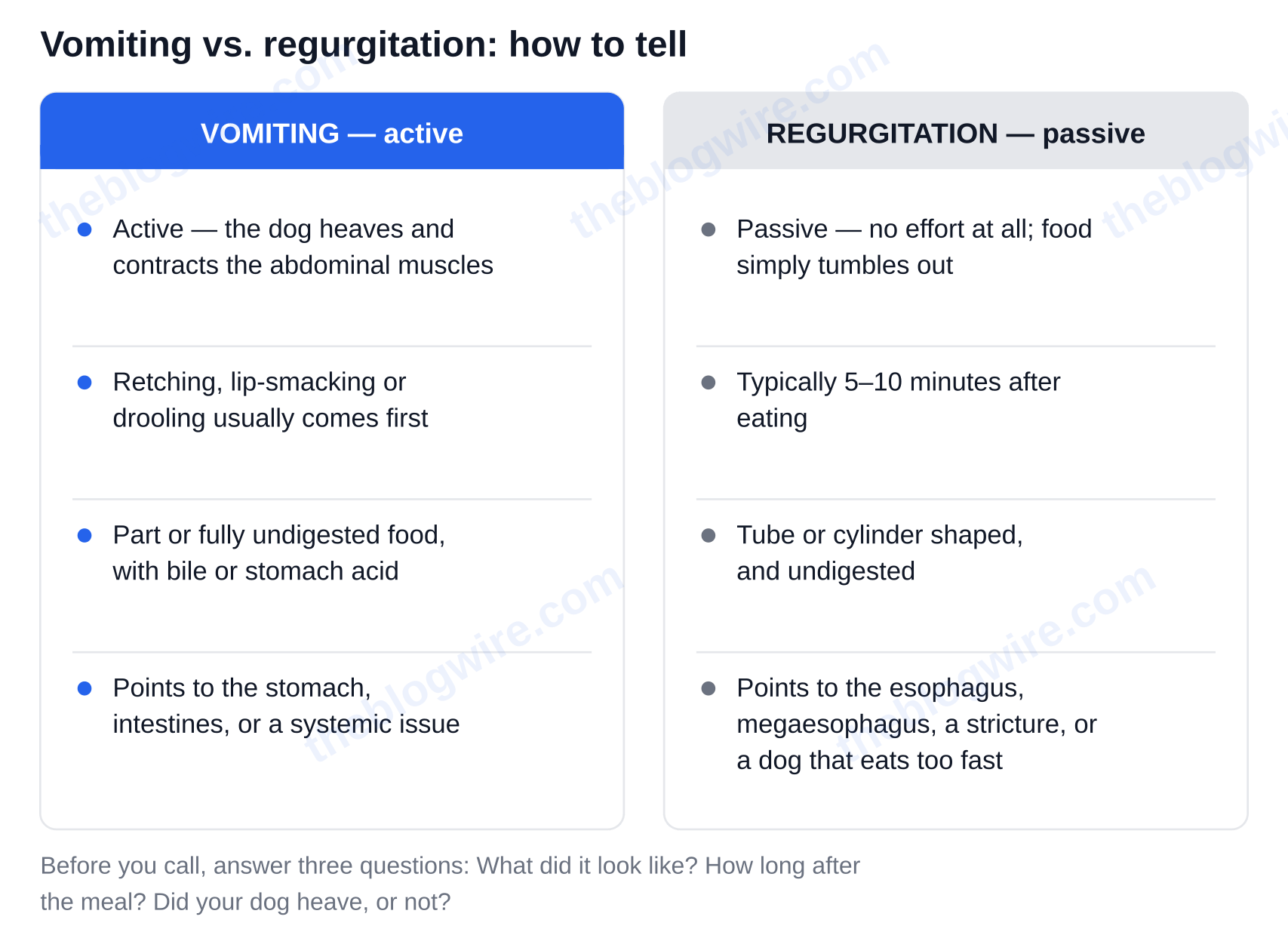
Vomiting and regurgitating look the same when they occur, but the process and what they indicate is very different. Vomiting is active. Regurgitation is passive.
How to tell the difference in the moment
With vomiting, the food typically comes up in part or completely undigested with bile or stomach acid, and the dog will usually show signs of trying to throw up such as heaving and/or contracting the abdominal muscles. There’s usually retching, lip-smacking or drooling first.
When something is regurgitated, it typically looks like a tube or cylinder, is undigested, and occurs 5–10 minutes after eating — a timing detail the American Kennel Club’s vomiting-versus-regurgitation guide leans on, because it’s the clearest signal an owner can actually observe. Regurgitation takes no effort at all. Food simply tumbles out.
Before calling us, run through the following three questions: What did it look like? How long after the meal? Did your dog heave, or not?
When regurgitation points to the esophagus instead of the stomach
Vomiting usually points to the stomach, intestines or a systemic issue. Regurgitation usually points to the esophagus, megaesophagus, or a stricture, or a dog that eats way too fast.
This distinction is important. Regurgitation usually means the problem is further up in the system and hence the imaging should focus on that area. If the pattern is recurring regurgitation, the workup is esophageal imaging, not general GI bloodwork. Say the word “regurgitation” on the phone and describe the passive, undigested, tube-shaped material. If the problem is recurrent and you call it “vomiting” you’ll likely get general GI blood work which probably isn’t needed.
The triage rule that beats counting episodes
You need to read the pattern instead of counting episodes. Almost all owners assume “my dog ate a bad food, I’ll just observe him for 24 hours.” Most of the time this assumption is correct, but in a few cases this can be very dangerous.
Why “he vomited three times” tells you less than you think
Looking at episode counts do not usually indicate how bad it is. As Vetster says, dogs usually empties their stomach by repeatedly retching and once the stomach is empty they usually feel better. However, 5 episodes of a dog retching to empty the stomach matters a lot less if your dog is a senior and looks lethargic.
The clinical threshold is duration and frequency. The Merck Veterinary Manual says acute vomiting is defined as less than 3 to 4 days with no additional symptoms, and chronic vomiting is persistent or recurrent (occurs more than once or twice a day). If you combine these two definitions, a dog that vomits twice daily for a week has a chronic condition and needs diagnostic testing.
This reframe is important because most when-to-worry checklists say to count to three in a single day. Counting is the least helpful activity you can do with the data you’re given.
The three patterns that override the wait-and-see default
Bright, eating and drinking after one bout? Monitor, with a fixed re-check time. Repeated low grade vomiting across days or weeks, even when each episode looks minor? Get it tested. Nothing coming up, and a belly that looks and feels bigger behind the ribs? Go now.
The third pattern is the fastest way to tell if your dog is in a true emergency. If your dog is unproductively retching (gagging) and has a distended abdomen, it could be gastric dilatation-volvulus (bloat, or GDV) until proven otherwise, and vet emergency protocols say to get it surgically corrected within 4 to 6 hours or it could be fatal.
The “monitor 24 hours” rule also outright excludes some dogs: unvaccinated puppies, diabetic dogs, dogs currently on medication, dogs with known kidney and/or liver disease, and dogs with undiagnosed Addison’s disease. For these dogs the guidance is actually the opposite of waiting. Make same day contact.
What does the color of your dog’s vomit mean?
Color helps determine the cause, and in two cases, tells you whether you need to leave the house. Here’s what PetMD has to say.
| What you see | What it usually means | What to do |
|---|---|---|
| Yellow or green | Bile, which usually means the stomach was empty | Common with morning or late-evening episodes; see the bile section below |
| White and foamy | Often acid reflux or an empty stomach — but white foam with unproductive retching can signal bloat | Context decides; check the belly and the effort |
| Clear liquid | Water or stomach secretions, often from drinking too fast after vomiting; occasionally early obstruction | Slow the water down and watch closely |
| Mucus or slimy | Throat and esophageal irritation, often from post-nasal drip or repeated retching | Monitor if your dog is otherwise well |
| A streak or few spots of fresh red blood | Usually irritation of the throat from forceful retching | Photograph it and call — volume is the deciding detail |
| A large volume of fresh red blood | Bleeding further down the tract | Emergency. Go now |
| Dark, granular, “coffee-ground” | Digested blood from the stomach or upper intestine | Emergency. Go now |
| Brown | Digested blood from lower down, or in rare cases fecal material | Same-day call at minimum |
| Green with grass in it | Usually just grass eaten shortly before | Not meaningful on its own |
Reading bloods in vomit: a streak versus coffee grounds
This is where most websites skip over details. PetMD explains that blood in the vomit of any kind is a medical emergency. Vetster draws a finer line and gives owners the details they need to decide whether they need to bring their dog to the ER or not: a few spots or one small streak of fresh red blood is usually throat irritation from violent retching, while a large volume of fresh blood, very dark vomit, or coffee-grounds like material points to bleeding further down the tract.
Both framings exist in print, and the conflict is why owners rush to the ER over a pink streak while genuinely bleeding dogs wait at home. The detail that decides it is volume and color, not the mere presence of blood. Is your dog vomiting blood? Photograph it and call. A picture tells a thousand words.
What are the most common reasons dogs throw up?
Vetster says the most common reason dogs vomit is from eating something they aren’t supposed to, like garbage, table scraps, another pet’s food, houseplants, bones, a sock or toy stuffing.
After that, the everyday causes cluster around how your dog eats rather than what’s wrong with them. Eating too quickly or too much, leading to air being consumed along with food (as is common with multi-dog households), is a surprising cause, and a slow feeder bowl solves that. Then comes a sudden change in diet or the introduction of a new treat with no transition, food intolerance (if it is repeated and related to a single food ingredient), intestinal parasites (common with puppies and newly adopted dogs), and motion sickness (again, mostly common with puppies and they grow out of it).
Why is my dog throwing up yellow bile in the morning but acting fine?
This is called “bilious vomiting syndrome” and it is the most common cause when a dog throws up and then acts 100% normal. Most general vomiting guides will not address yellow bile or may only address it as a color on a list.
“Bilious vomiting” describes the pattern. A small amount of yellow or green bile is vomited, and it only happens when the dog’s stomach is empty. Most commonly, this occurs in the morning or very late at night. After they vomit, the dog acts completely normal and eats breakfast normally. Bile refluxes into an empty stomach, and overnight is when the stomach sits empty longest.
It is recommended that the dog be fed, rather than medicated. Veterinary guidance on bilious vomiting syndrome is to shorten that overnight gap: 2 to 4 smaller meals through the day plus a small high-protein or dry snack late in the evening. After implementing this change, many dog owners report that the syndrome cleared up in only a few days.
Give it a week. If a dog is otherwise healthy and still vomiting after a week of shortened gaps, Merck says it’s chronic, and testing is warranted, not more meal tweaking.
What are the serious causes you can’t wait out?
Foreign body obstruction, gastric dilatation-volvulus (GDV), pancreatitis, and parvovirus are the big ones. These conditions warrant an immediate trip to the vet.
Foreign body obstruction is characterized by repeated vomiting, including the inability to keep water down, straining and the inability to pass stool, and a stretching position similar to prayer. Imaging and frequently surgery are the next steps. GDV is characterized by unproductive retching, a distended abdomen, restlessness, and drooling with pale gums; risk is highest in large, deep-chested breeds and rises with age. Pancreatitis is characterized by vomiting with severe abdominal pain, classically after a fatty meal, with the same hunched posture. Canine parvovirus is often characterized by lethargy and loss of appetite, followed by severe bloody vomiting and diarrhea and is most often seen in young, unvaccinated or partly vaccinated puppies. It damages the intestines and immune system and can progress to septic shock, which makes it a same-hour emergency.
For suspected toxin ingestion — xylitol, grapes, chocolate, antifreeze, rodenticide, medications, certain houseplants — call the Pet Poison Helpline at 855-764-7661, the number PetMD points owners to, and/or your emergency vet as you’re already headed there. Don’t induce vomiting unless you’re told to.
Other causes of chronic vomiting may include organ diseases such as kidney and liver disease, where vomiting is often the first visible sign of a problem that’s been building. Some types of cancer may also sit behind a share of chronic vomiting in senior dogs.
The endocrine cause worth naming out loud
Addison’s disease may also be responsible for chronic vomiting and should be mentioned. Some of the signs of Addison’s disease — vomiting, lethargy and poor appetite — may also be the result of other more common conditions (such as kidney disease or plain GI upset). One of the recent publications reports a case of Addisonian crisis that closely resembled acute kidney injury. In fact, azotemia, hyperkalemia and hyponatremia occurred along with the other signs, so it was very confusing — meaning the severity of the azotemia alone can mislead. If recurring vomiting has no explanation, ask your vet specifically about adrenal testing rather than monitoring another month.
Which dogs are at higher risk than the average case
Puppies are at risk because they dehydrate quickly, and they carry parvo risk. Senior dogs are at risk, as they have fewer reserves and have other conditions occurring at the same time. Barrel-chested large breeds are at risk for GDV. And any dog taking medications or having a known chronic condition gets less benefit of the doubt than a healthy adult.
Should you call your vet, go to the ER, or watch at home?
Decide based on what’s happening with your pet. Match what you’re seeing to one of three actions.
- Go to the ER now if: retching isn’t bringing anything up, with swelling or hardness of the abdomen; a large volume of fresh blood, very dark vomit, or “coffee-ground” material; if you believe your dog has ingested a toxin or foreign object; your dog is not able to keep any water down; weakness, collapse, or pale gums; severe abdominal pain or a persistently hunched posture; bloody vomit and/or diarrhea in an unvaccinated puppy.
- Call your vet the same day if: vomiting occurs more than once or twice a day and/or has lasted more than one day; an appetite has been absent for more than 24 hours; diarrhea is also present; your dog is elderly, a puppy, diabetic, on medication, or has known liver, kidney, or adrenal disease; or mild-looking vomiting keeps recurring over weeks.
- Monitor at home if: vomiting has only occurred once or twice and your dog seems normal — bright, alert, drinking and holding water down, with no blood, no bloating, no pain and no other symptoms. In this case, a 12 hour check-in is advised instead of a vague, “see how he does.”
The home dehydration checks that sharpen your decision
Two simple, quick tests help evaluate dehydration: the skin tent test and the mucous membrane test. To perform the skin tent test: pinch a fold of skin, located on the back of the neck, between your thumb and forefinger and let it go. If the skin does not immediately snap back to position, this means the skin is tented, and your dog is dehydrated. The mucous membrane test: PetMD’s guidance is that the gums should be pink and moist rather than tacky, with color returning within about 2 seconds after you press. Dogs that fail either test need to be seen today regardless of how the vomiting looks.
What to tell the vet when you call
Be prepared with the time of the first episode, how many, and approximately how much. What did the vomitus look like? What did your dog eat? Is your dog eating and drinking normally? What is your dog’s energy level like? What was the last normal stool? What are your dog’s current medications? Bring the photo. It does more work than a description.
How do you care for a mild case at home, and what should you feed?
Dogs that qualify for the “monitor” column should receive care that is appropriate for that individual, instead of defaulting to a flat 24-hour fast.
How long to withhold food, by age and health status
Merck’s owner page and PetMD still suggest withholding food and limiting water for 24 hours. Newer vet-authored guidance scales it: roughly 6 to 12 hours for puppies and older dogs, and up to about 24 hours for a healthy adult dog. Don’t fast puppies, diabetic dogs or dogs with existing conditions at all without consulting your vet first. This is where the “one size fits all” advice is most detrimental.
Always keep water available, and offer small amounts often, or provide ice cubes to slow gulping, as a dog that empties its bowl will send it right back up.
The staged refeed: 10%, then 25%, then 50%
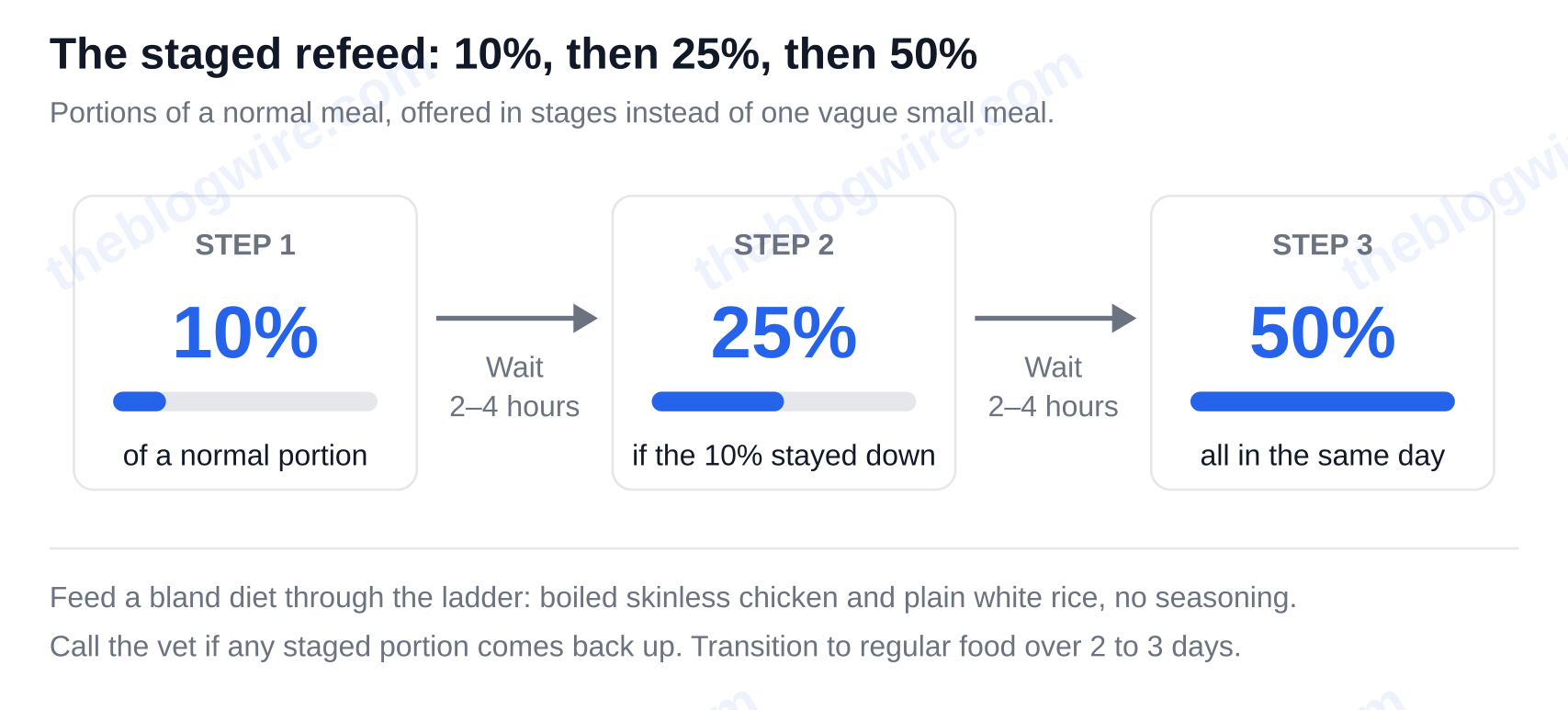
Current recommendations suggest a refeed should be done in stages rather than one vague “small meal.” Current guidance quantifies it:
- Offer about 10% of a normal portion. Wait 2 to 4 hours.
- If it stays down, go to about 25%. Wait again.
- Then about 50% — all within the same day.
Feed a bland diet through that ladder: boiled skinless chicken and plain white rice, with no oil, butter, salt or seasoning. A vet-prescribed GI diet works just as well if you already have one. Transition back to the regular diet over 2 to 3 days by mixing increasing amounts of the regular food in, not by switching in a single meal.
The owner should contact the vet if any staged portion of the diet is brought back up, if the dog starts to vomit again after holding food down, or if the dog starts to show lethargy at any point. Human anti-nausea and anti-diarrheal medications should not be used, and vomiting should not be induced at home unless a vet or a poison line tells you to.
How will your vet diagnose and treat it?
The veterinarian will start by performing a physical examination and checking the oral cavity (a string foreign body can be stuck under the tongue), the abdomen by palpation, and hydration and pain. Blood work and urine tests can be done to assess organ function, check electrolytes and pancreatic markers. Fecal tests can be done to check for parasites. Although, adrenal disease can also present with abnormal electrolytes — electrolyte patterns are where it first starts to show itself.
If obstruction or bloat is a concern, x-rays can be done. X-rays show gas patterns, obstructions and the twisted-stomach appearance of GDV. Abdominal ultrasound can also be done to check the pancreas and provide additional soft-tissue details.
The path diverges for chronic cases. If why is my dog throwing up has become a question about weeks rather than hours, the workup shifts toward endoscopy with biopsy, structured diet trials, or focused endocrine testing, which is why getting the acute versus chronic threshold right is key at home.
Treatment commonly includes anti-nausea medication such as maropitant (Cerenia), metoclopramide or ondansetron; gastroprotectants such as famotidine, omeprazole or sucralfate; and IV or subcutaneous fluids to correct dehydration. Additional therapies layer on based on the diagnosis: deworming for parasites, hospitalization and intensive support for parvovirus, and emergency surgery for GDV or GI obstruction.
How to lower the odds of the next episode
The key to preventing vomiting is prevention — mostly logistics. No table scraps or cooked bones, and secure the trash and compost. For a gulper, use a slow feeder bowl. Transition a dog to new food gradually over about a week, and keep parasite prevention year-round and vaccinations up to date. Store medications, toxins and small swallowable objects somewhere your dog genuinely can’t reach.
Most of the time, why is my Dog throwing up has a boring answer: your dog ate something they shouldn’t have and will be just fine tomorrow. The case you’re deciding on isn’t about the number of times your dog vomits.
Three things to keep in mind. First, the pattern always beats the count — unproductive retching with a distended abdomen, coffee-ground or heavy fresh blood, or relentless low-grade vomiting over days on end always wins over any single day’s total. Second, the “wait 24 hours” rule doesn’t apply to unvaccinated puppies, seniors, diabetics, medicated dogs, or dogs with kidney, liver, or adrenal issues. Third, do the 3 checks — heaving or passive, what the vomit looks like, and the skin pinch test — and decide if you want to monitor it with a 12-hour re-check, call your vet today, or go to the ER. For more like this, explore The Blog Wire.
People Also Ask
Why is my dog throwing up undigested food hours after eating?
Food that is still undigested hours later and looks the same as it did when eaten suggests it sat in the stomach instead of moving on, which points at delayed gastric emptying, a partial obstruction, or an irritated stomach. It’s different than food tumbling out within about 5 to 10 minutes of a meal, which is regurgitation and points at the esophagus. If this only happens once and your dog is otherwise bright and alert and eager to eat the next meal, and then holds that meal down, you can keep an eye on it with a 12-hour re-check. If it repeats, if your dog can’t keep water down, or if you see straining, no stool or a hunched posture, call the same day — repeated undigested vomiting is one of the patterns that earns imaging rather than a wait.
How long is too long for a dog to keep vomiting?
Use the clinical thresholds rather than a single day’s count. The Merck Veterinary Manual treats vomiting as acute when it lasts less than 3 to 4 days with no other symptoms, and as chronic when it persists long-term or happens more than once or twice daily. So a dog vomiting twice a day for a week has crossed into chronic territory and needs testing, even though no individual day looked alarming. Anything past 24 hours, or any vomiting with blood, abdominal pain, dehydration, weakness, fever or weight loss, deserves a same-day call. Unproductive retching with a swelling belly is immediate, not a waiting game.
Can I give my dog Pepto-Bismol or another human medicine for vomiting?
No — you first need a vet to give you the ok to do this. There are human anti-nausea and anti-diarrheal meds that can really hurt your dog, can mask the signs your vet needs to see, and can interact with medication your dog is already on. Don’t try to induce vomiting at home either, unless a vet or a poison line specifically instructs you to; with some toxins and with a swallowed object, bringing it back up causes more damage. There are meds that vets use to control nausea and vomiting, including maropitant (Cerenia), metoclopramide and ondansetron, and others that protect the stomach lining like famotidine, omeprazole and sucralfate. If you suspect a toxin, call the Pet Poison Helpline at 855-764-7661 or your ER on the way.