Novellas are slightly longer than short stories, but shorter than a novel. A general range of 17,500-40,000 words is a good starting range to differentiate novellas from a novel. That word count is the only hard line in the novella vs. novel question. Most novellas and novels share similar characteristics except for one, length. Although novellas and novels differ in length, they often differ in other aspects of a novel, such as point-of-view or the number of plots — one or two points of view instead of a dozen, a single conflict instead of braided subplots.
So instead of what’s the difference between a novella and a novel, the better question is what do I do with my word count, novella or novel? This page answers both, and names the rule-making bodies behind the numbers most articles repeat without a source.
What is the difference between a novella and a novel?
Novellas and novels often have fixed word counts and are often awarded for their length. A novella is usually between 17,500 to 39,999 words, and a novel starts at 40,000 words. Word counts aren’t floating around without a definition. The awards bodies had to come up with a way to differentiate between their categories.
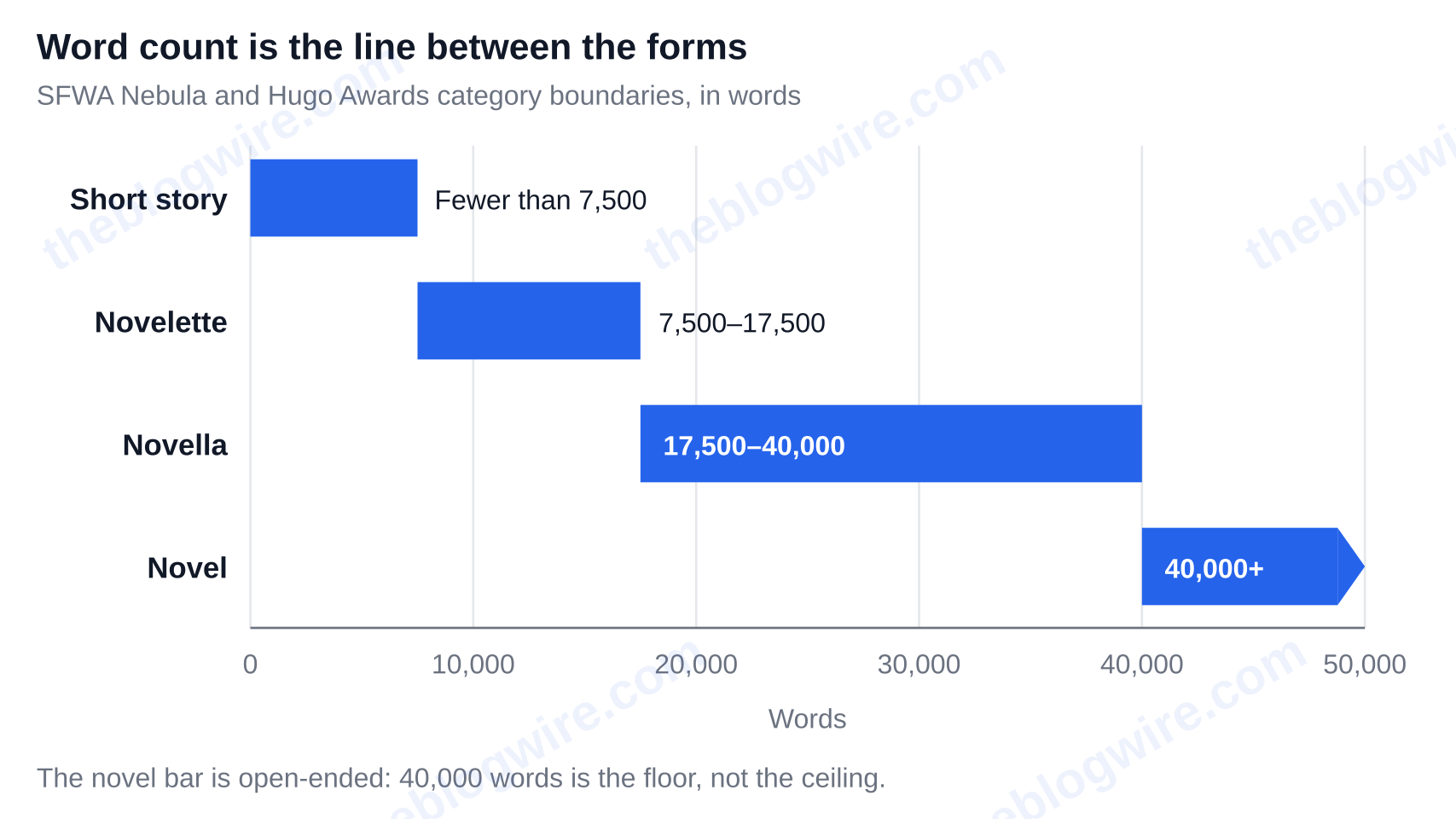
The Science Fiction and Fantasy Writers Association’s Complete Nebula Awards Rules defines their length categories as flat numbers: a short story is defined as “fewer than 7,500 words”; a novelette is defined as “at least 7,500 words but fewer than 17,500 words”; a novella is “at least 17,500 words but fewer than 40,000 words”; and a novel is “40,000 words or more.”
The Hugo Awards category definitions also draw these lines and spell them out. The Best Novella category is defined as a story “between seventeen thousand five hundred (17,500) and forty thousand (40,000) words,” and the Best Novel category is defined as “forty thousand (40,000) words or more.” Because these independent organizations have come to a consensus on these categories and boundaries, these definitions have become standard and accepted within the publishing industry rather than one organisation’s house rule.
Where novelette and short story sit on the same scale
Where do you fit on the scale?
- Flash fiction — well under short story length
- Short story — fewer than 7,500 words
- Novelette — 7,500 to 17,500 words
- Novella — 17,500 to 40,000 words
- Novel — 40,000 words or more
Three questions worth answering flatly. Is a novella a book? Yes — it’s published and sold as a standalone volume. What’s the shortest work that counts as a novel? 40,000 words. Is 30,000 words a short novel? No. It is a novella, according to both SFWA and Hugo definitions.
How many pages is a novella?
A novella is approximately 60–150 pages, whereas a novel is approximately 150-400+ pages, according to Selfpublishing.com’s breakdown. In reading time, a 20,000–40,000-word novella is approximately a one-to-three hour read at an average adult pace. This time commitment is approximately the same as the length of a film, which is why novellas are meant to be read in one sitting.
One important note: word count is the deciding factor, not page count. Pages vary with the size of the book, font and line spacing. Always classify a draft by its word count.
| Form | Word count | Typical pages |
|---|---|---|
| Short story | Fewer than 7,500 | Magazine or anthology length |
| Novelette | 7,500–17,500 | Chapbook length |
| Novella | 17,500–40,000 | 60–150 |
| Novel | 40,000+ | 150–400+ |
My draft is X words — what is it, and what does that mean?
The following table shows the award category and the consequences that affect your next step. It joins the award category to the consequences that actually change your next move.
| Word count | SFWA / Hugo category | Approx. pages | Reading time | Fits a Kindle Short Reads band? | Queryable standalone? | POVs and subplots it carries |
|---|---|---|---|---|---|---|
| Under 7,500 | Short story | Under 30 | Under an hour | Below the listed bands | No — short-fiction markets | One POV, no subplots |
| 7,500–17,500 | Novelette | 30–60 | About an hour | Lands in the 44–64-page range | No — short-fiction markets | One POV, one conflict |
| 17,500–25,000 | Novella (lower band) | 60–100 | One to two hours | Yes — within the 65–100-page band | Rarely; indie press or self-publish | One POV, single conflict |
| 25,000–32,000 | Novella (mid band) | 100–130 | Two to three hours | Above the listed page bands | Rarely; indie press or self-publish | One or two POVs, one subplot at most |
| 32,000–40,000 | Novella (upper band) | 130–150 | Around three hours | No — competes as a full-length book | Rarely; indie press or self-publish | Two POVs, one contained subplot |
| 40,000–55,000 | Novel (short) | 150–220 | Multiple sittings | No | Yes, though short for most genres | Two to three POVs, a real subplot |
| 55,000–90,000 | Novel (standard) | 220–350 | Multiple sittings | No | Yes — the commercial sweet spot | Several POVs, braided subplots |
| 90,000+ | Novel (long) | 350–400+ | Days or weeks | No | Yes, genre depending on | A dozen POVs is possible. |
The gray zone: what happens near 17,500 and 40,000 words
One important thing ranking pages don’t tell you: the two organizations come to different decisions about borderline cases.
The WSFS Constitution states that the Worldcon Committee may move a work in or out of a written-fiction category if they feel it is more appropriate, as long as the work is within twenty percent (20%) of the word count limits of the new category. Effectively this means a ~35,000-word work may be moved into the Novel category, and a ~20,000-word work may be moved into the Novelette category.
In the Nebula Awards, SFWA gives no similar leeway. The thresholds are strict cutoffs, and the only room for measurement is in cases of translation, in which case the work is counted in its English word count.
This means if your work is close to the cutoff, you may find yourself with leeway in one case and completely locked in the other.
Why the 20% tolerance matters at 38,000 or 42,000 words
Awards aside, the practical read is the same either way. The side with more ramifications for production and marketing is the side you should take, and write for the middle of that category rather than its edge. A work parked on a boundary gets judged against both categories, and meets neither; too long to read in one sitting, too short for a reader to feel satisfied if they paid for a full length work.
If you plan to cite the relocation rule, check the date. The version of the regulations that governs it is valid as of 12 August 2024, with a more recent version posted in 2025. Sections should be checked against the most recent posted version. Older articles quoting a 5,000-word alternative threshold are citing superseded text.
How do novellas and novels differ in craft, not just length?
These aren’t separate rule sets. Both novellas and novels are consequences of adhering to the word budget. 25,000 words can’t sustain what 90,000 can.
- Point of view. A novella usually has one or two points of view, and adding a point of view to a novella costs a big chunk of the budget, because each new point of view requires scenes to establish it. Novels can support a dozen or more, per Kindlepreneur’s craft comparison.
- Plot structure. A novella supports a single main conflict with subplots limited or cut outright. A novel supports multiple plots that braid and converge.
- Character development. A novella and a novel are distinct beasts. Character development in a novella is confined almost entirely to the protagonist — there’s no room to develop a secondary cast. A novel has the luxury of developing supporting characters as well, and can hand one a full arc.
- Pacing and scope. Novellas and scope are closely linked to pacing. A novella runs fast and relies on a central or pivotal event to achieve its conclusion. A novel can take the time to gradually build to a conclusion by using rising and falling action, digression, and subplot resolution across hundreds of pages.
- Reading experience. A novella is meant to be read in one sitting and therefore requires an early set up, which changes how much setup a reader will tolerate before the central problem arrives. Novellas lack the luxury of using pages and pages of buildup. Get there early.
Famous novellas vs. famous novels
Each of the canonical novellas displays the central pressure or pivotal event upon which the novella is built. Of Mice and Men, Animal Farm, The Metamorphosis, Heart of Darkness, The Old Man and the Sea, A Christmas Carol, Breakfast at Tiffany’s, and Stephen King’s The Mist all demonstrate central pressure or events and serve to demonstrate the novella. Compare them to The Count of Monte Cristo, War and Peace, or Gone with the Wind, for example, and the difference in scope is obvious before you read a line.
How genre changes the expected word count
Inside the novel band, 40,000 words is the floor, not the goal. Different genres have different expectations — romance, thriller, middle grade and science fiction or fantasy each carry different reader-expected lengths — and going under the expected word count for your genre will make your work feel thin even when it clears the technical definition. It’s best to check comparable titles in your category before you set a target.
Should you write a novella or a novel?
Ask yourself, does your story work for both a novella and a novel? Make sure your publishing route agrees with your story. Both have to agree.
The story test. Stress-test your novella. Count your viewpoint characters, your subplots, and the major events that drive the plot. Traditionally, a novella has one protagonist, one central conflict, and one major event that changes the course of the story. Three viewpoint characters and two subplots will not compress into 35,000 words without damage — you’ll end up summarising scenes that needed to be dramatised.
If you’re self-publishing
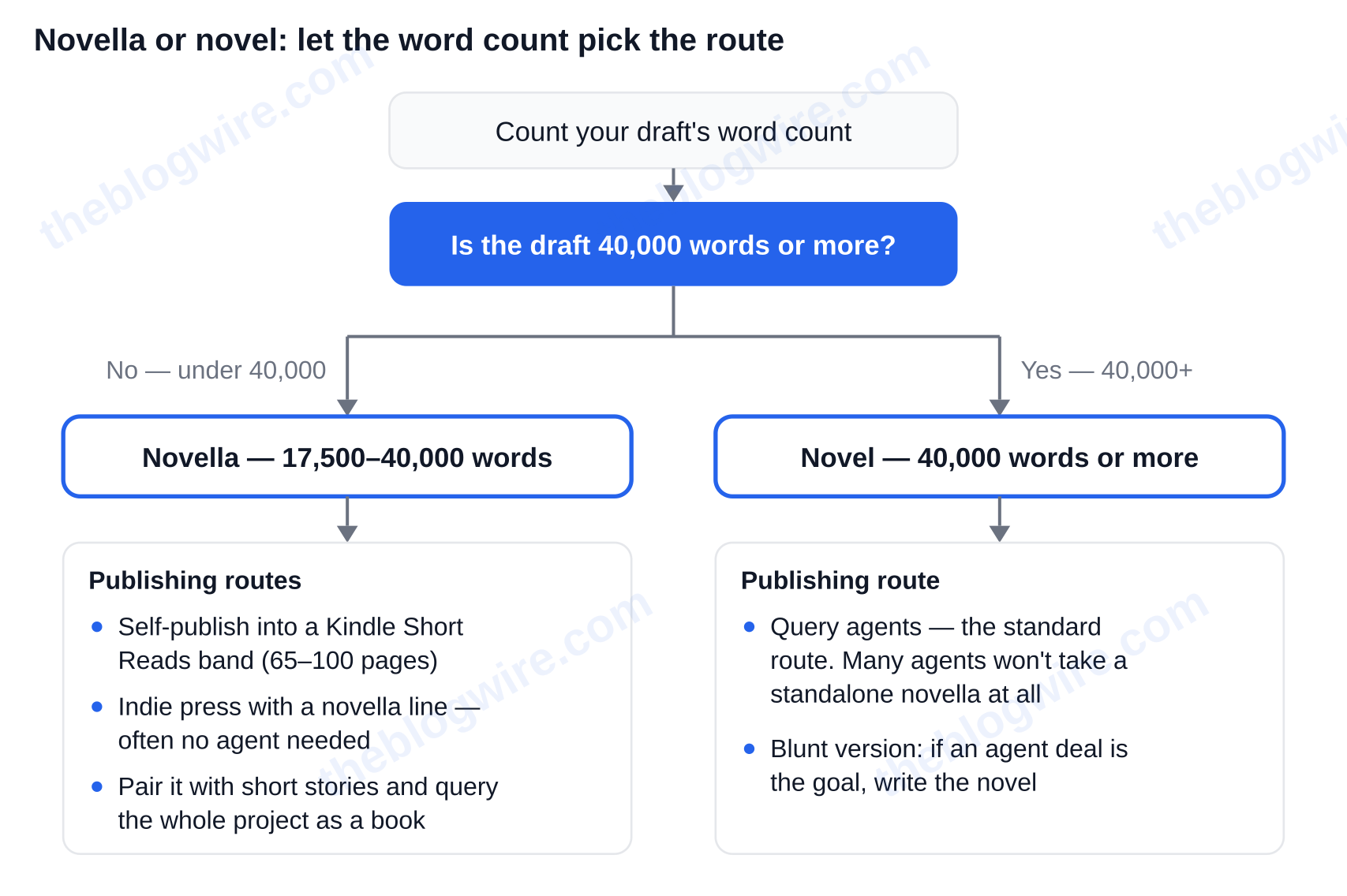
Amazon categories novellas as ‘reading time’ rather than word count. They organize their Kindle Short Reads store in page-count bands — “Two hours or more (65–100 pages)” and “90 minutes (44–64 pages)” among them. A novella on the lower end of the word count spectrum can fit into one of these browsable bands. A novella towards the higher end, near 40,000 words, generally can’t fit into one of the bands and competes as a full-length book instead.
That makes the short end genuinely strategic rather than a compromise. Novellas can be effective reader magnets, series prequels, and inexpensive, low-cost entry points into a series, especially when bundled several at a time into a box set that reads and prices as a full-length book.
If you’re querying agents
Most articles omit this exception. Many literary agents won’t consider a standalone novella at all because there are too few markets to pitch it to. A novella is too long for the zines that specialise in short fiction, and too short for agents who specialise in novels, as LitReactor’s agent column lays out.
There are two workarounds related to that same agent-side view that are worth mentioning. First, if you can get your novella to book length by pairing it with short stories, you can query the entire project as a book and bypass having to query the novella as a standalone work. If you prefer, you can bypass the querying process altogether and look for indie presses with dedicated novella lines, which often don’t require an agent at all.
So: do novellas get published? Novellas can certainly be published, but far more typically through an indie press, a short-fiction market, or self-publishing than through a standalone agent query. Blunt version: if traditional publication with an agent is the goal, write the novel.
The line that settles it
There are around 17,500 to 40,000 words in a novella. Anything over 40,000 words is a novel. The main differences in a novella vs. a novel are the POV count, subplot load, cast size, and pacing. There really isn’t a separate rulebook. That’s just the norm, and it comes from the word count.
Next step: figure out what word count your draft is, and find the row it corresponds with in the decision table above. Let that row determine the format and publishing route before you write another scene. You’ll find more posts like this one throughout The Blog Wire.