
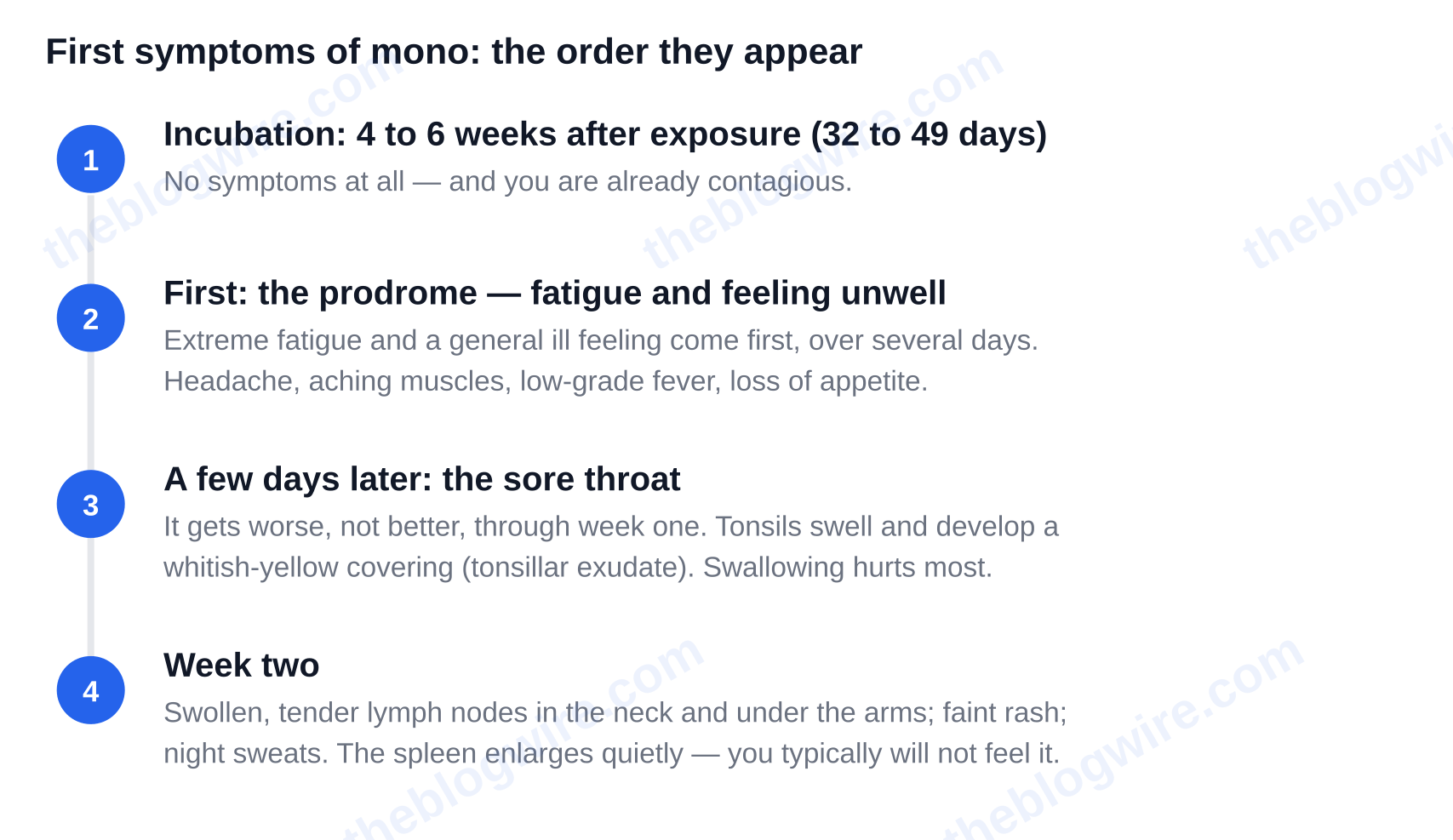
Full arc of early mono: which symptom arrives first, why it started weeks after you were exposed, the one physical sign that separates mono from strep, how testing timing can mislead you, and what to do in week one. The first ones to appear with mono include extreme fatigue and generally feeling unwell. With mono you can expect a low-grade fever, body aches and a headache. A sore throat usually appears a few days later. With mono, the throat will become very irritated and painful with swollen tonsils and enlarged lymph nodes, and it gets worse, not better. Symptoms begin roughly 4 to 6 weeks after exposure to Epstein-Barr virus.
First, let’s start with one number. According to the CDC’s page on Epstein-Barr virus, about 9 out of 10 adults have antibodies to Epstein-Barr showing that they were either currently or previously infected. Nearly everyone gets this virus eventually. Most never notice. The reason mono feels like its own, distinct illness is because at least 1 in 4 infected teenagers and young adults develop full symptomatic infectious mononucleosis — and it is much worse than the common cold.
What are the first symptoms of mono, and in what order do they appear?
With most illnesses there are generally some symptoms that precede others. With mono the list of symptoms is essentially the same with every source but there is no clear sense of order. The order is extremely important when you are 3 days in, listless and trying to decipher what’s going on with you.
The early prodrome: fatigue before the sore throat
Mono begins slowly. According to Penn Medicine, during the early stages of mono, fatigue is accompanied by a general ill feeling, headache and sore throat, with the throat then slowly getting worse. Usually fatigue and general malaise come first, over several days rather than overnight, and mono sets in with an overall flattened feeling. You sleep and it does not help. You may develop a headache, aching muscles, a low-grade fever and lose your appetite. This general ill feeling is the prodrome and is described as “I was just run down.”
A few days after the general feeling of illness and fatigue sets in, you begin to develop a sore throat. In the subsequent week, the sore throat gets worse instead of better. The tonsils become swollen and develop a whitish-yellow covering — tonsillar exudate, in clinical terms. Swallowing becomes the most painful part of the day.
Symptoms that show up in week two
Swollen and tender lymph nodes develop in the neck and under the arms, following the sore throat. You may also develop a faint rash and lose your appetite, and may also experience night sweats. In the meantime, something happens quietly: your spleen becomes larger. Splenomegaly is present in nearly all cases according to the American Academy of Family Physicians, yet physical examination detects it with only 20% to 70% sensitivity — and you typically will not feel it at all. The liver sometimes enlarges too.
I will address one issue up front: There are variations to the symptoms of mono. You can contract mono with just a mild sore throat or no sore throat at all, and without a high fever, especially early. The absence of one textbook symptom rules nothing out. Infectious mononucleosis — “the kissing disease” — is caused in over 90% of cases by Epstein-Barr virus (EBV, human herpesvirus 4), per Cleveland Clinic, and there is no reason to believe that EBV will read the checklist. It will have its own plan.
Why did my symptoms start weeks after I was exposed?
Because of the long incubation period of EBV. The CDC estimates the onset as 4 to 6 weeks post infection. A rapid evidence review done by the AAFP put that estimate at 32 to 49 days. That single fact changes two things.
First, you can’t trace this to last weekend. This includes the kiss, the shared drink, and your roommate who had a sore throat on Friday. This may have happened more than a month ago and you probably will never be able to identify the source. You should stop focusing on this.
Second, something that almost no consumer page connects for you is that, per the CDC, when you first get EBV you can spread it for weeks, and even before you have symptoms. EBV is mainly transmitted through saliva, i.e shared drinks, bottles, utensils, lip balm, toothbrushes, and other bodily fluids. So, when you are warning people about exposure, you are looking back a few weeks not a single day. So, tell your household and people you’ve shared drinks with that they may have already been exposed and then stop sharing drinks and utensils from this point on. There is no EBV or mono vaccine, so your behavior is the only thing you can control.
Is it mono or strep throat? The two signs you can check in a mirror.
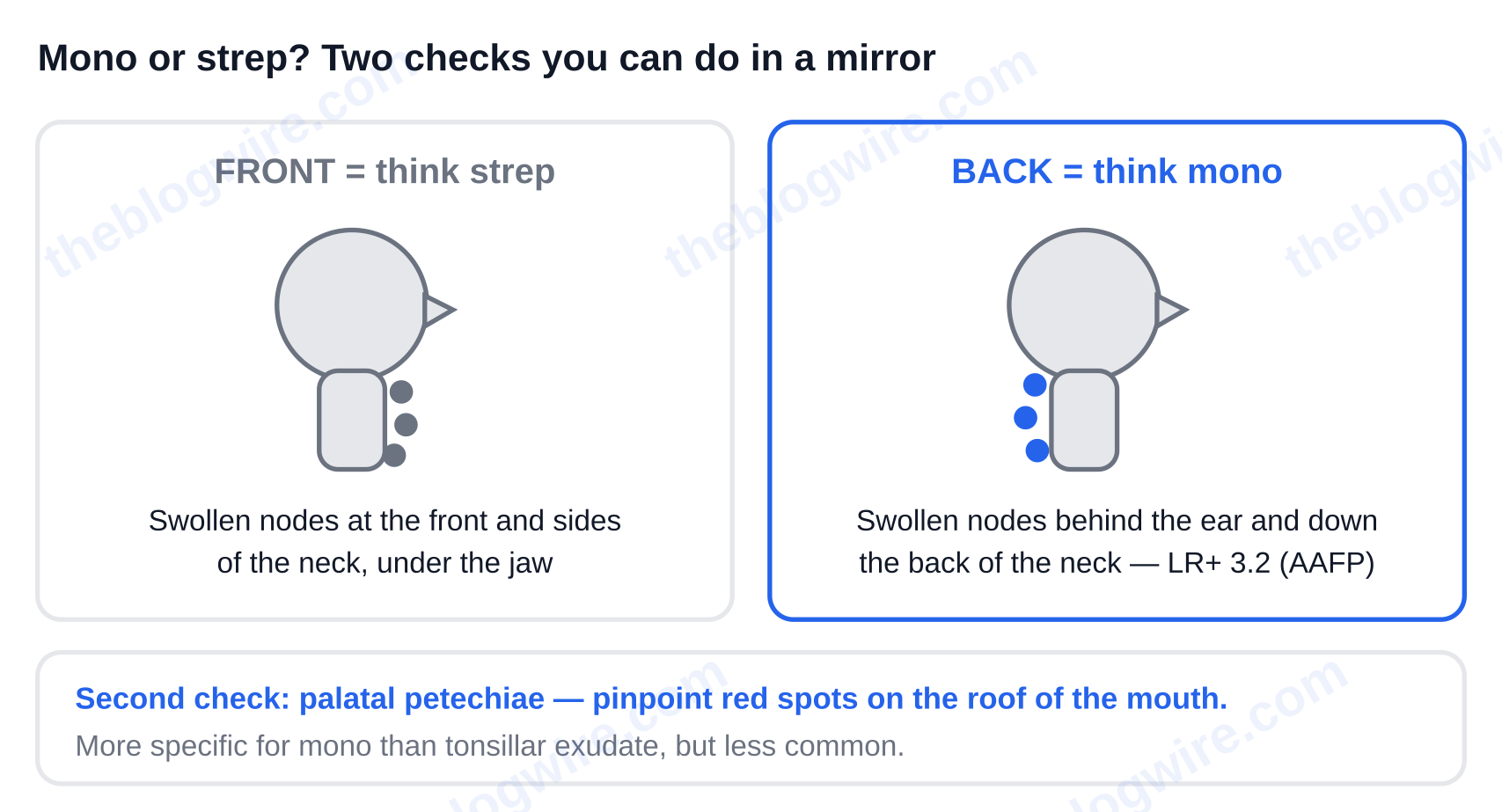
Here is what the top-ranking pages leave out. Almost all consumer pages say “swollen lymph nodes in the neck, armpits, or groin” and move on as though no other detail is necessary. Location is everything.
The back-of-the-neck test: posterior cervical lymphadenopathy
Reach back, behind your ear, and along the muscles running down from the base of your skull. Swollen, tender nodes here are classically known as posterior cervical lymphadenopathy, and they have the strongest positive likelihood ratio among clinical findings for mono, at LR+ 3.2 in the AAFP review. Strep throat typically causes swelling of the nodes located at the front and side of the neck, under the jaw. Front means think strep, back means think mono. It’s not a diagnosis, but it is the single most discriminating thing you can check on yourself.
Palatal petechiae: pinpoint red spots on the roof of the mouth
Look at the roof of your mouth, toward the soft back portion, in good lighting. Pinpoint red spots there are palatal petechiae. According to the AAFP review, they are more specific for mono than tonsillar exudate, but less common — so finding them is meaningful, and if you are unable to find them, that is of no consequence. Pair the two checks: back-of-neck nodes plus palatal petechiae. That is a two-item self-check you can actually perform before going to see a medical professional.
Why a negative mono test in week one means almost nothing
The most useful information on this page. Heterophile antibody testing — the monospot — has 87% sensitivity and 91% specificity overall, but it can miss up to 25% of cases in adults during the first week of symptom presentation, and in children younger than five. Because of this many pages that rank for this topic state, “your doctor can do a blood test.” However, they fail to add the missing information that a quarter of early tests miss it.
The practical rule: if you test in the first few days of feeling sick, the result is negative, and your symptoms persist and get worse, that negative does not rule out mono. Come back. Ask for EBV-specific antibody testing — viral capsid antigen (VCA) IgM — or a repeat monospot about a week later. These rules are based on the AAFP rapid evidence review published in January 2023, and knowing this is the difference between a wasted week and an answer.
How mono differs from a cold, the flu, and strep throat
How quickly symptoms present is the biggest way to tell these apart.
- Mono: symptoms present gradually over days. Crushing fatigue far beyond normal, out of all proportion to everything else. Sore throat that worsens through week one. Swollen glands including at the back of the neck. An enlarged spleen and/or liver may also be present.
- Strep throat: sudden onset, high fever, very sore red tonsils often with white patches, nodes at the front and sides of the neck, and little or no fatigue. Strep usually responds quickly to antibiotics, mono does not.
- Flu: abrupt onset with high fever, prominent body aches and cough, resolving in about a week rather than dragging on for a month.
- Common cold: a runny nose and sneezing lead, fatigue is mild, no dramatic tonsil swelling, gone in a few days.
Cytomegalovirus (CMV) and acute HIV are look-a-likes worth knowing about if your tests come back confusing — both can mimic early mono closely enough that a clinician will consider them.
How is mono diagnosed, and what should you ask for?
The exam looks for four things: posterior cervical nodes, tonsillar exudate, palatal petechiae and an enlarged spleen. Make sure your physician examines your palate for petechiae. Remember that last one is unreliable by touch alone — 20% to 70% sensitivity on examination, per AAFP.
Bloodwork does the rest. Ask for a CBC with differential; mononucleosis is typically supported by the presence of atypical lymphocytes and lymphocytosis. The monospot gives a fast answer when it is positive. When timing or results are unclear, EBV-specific antibodies sort it out: VCA IgM persists four to six weeks, VCA IgG appears about two weeks after infection and stays for life, and EBV nuclear antigen (EBNA) antibodies become detectable six to eight weeks after infection. That timeline is also how a clinician can tell a current infection from one you had years ago.
A rapid strep test would also be helpful. A sore throat this severe deserves ruling strep in or out, and the two can co-occur.
How long does mono last, and when does the fatigue lift?
Roughly 32 to 49 days of incubation with no symptoms at all — while you are contagious. Then the prodrome of fatigue, headache and loss of appetite. Then the sore throat, peaking across weeks one and two. Penn Medicine puts the fever break at about day 10, with swollen glands and the spleen healing in about 4 weeks. The CDC says most people recover in 2 to 4 weeks. Fatigue is the straggler: commonly 2 to 3 months, and in some people 6 months or longer.
Why antibiotics do not work on mono
Epstein-Barr virus (EBV) is a viral infection and therefore, there is no true treatment for mono, but to manage the symptoms. It is recommended to get lots of rest, drink a lot of fluids, use throat comfort measures, and take over-the-counter fever reducers and pain relievers if needed. Taking antibiotics does nothing to EBV and can actually be harmful: 90% to 100% of mono patients with recent beta-lactam exposure such as amoxicillin or ampicillin develop a widespread maculopapular rash. This rash is often misdiagnosed as a drug allergy and can mislabel you as being allergic to penicillin for life. The CDC’s mono page says to avoid penicillin antibiotics, and now you know the reason and the rate. If a clinician wants to give you an antibiotic on spec for this sore throat without testing, say you may have mono and ask the doctor to confirm if you have strep first.
One last treatment note, corticosteroids are not routinely used. The AAFP review found insufficient evidence for their use in general, and reserves them for airway obstruction.
When you can return to the gym and contact sports
Hold contact sports and heavy lifting for at least three weeks from when your symptoms started. Then restart with light, non-contact exercise once you are clinically well and fever-free. The reason for the three week mark is not arbitrary — it maps onto the spleen-risk window described below.
When should you see a doctor today — or go to the ER?
Anytime you have sharp pain in your upper left abdomen you should get to the ER as this could mean your spleen has ruptured. Splenic rupture occurs in 0.1% to 0.2% of mono cases and has a 9% mortality rate, and the timing is what makes the three-week rule make sense: 73.8% of ruptures happen within 21 days of symptom onset and 90% by day 31.
The Cleveland Clinic states other symptoms that also require urgent medical attention are: difficulty breathing and swallowing, fainting or dizziness, extreme muscle weakness, severe and persistent headaches, or persistent high fever. Other complications of mononucleosis include hemolytic anemia and hepatitis with jaundice, worth naming so you recognise them if they appear.
Two groups the classic symptom checklist actively misleads. Young children (under about five) generally do not experience classic mono symptoms, often having none at all or something indistinguishable from a brief mild childhood illness. They are a known false-negative group for the heterophile antibody test, and so a negative monospot in a young child is poor evidence. Adults over 40 are more likely to present with liver problems — fever, jaundice, raised liver enzymes — than with the textbook sore throat and swollen glands. Many older adults may have mono, but not have the textbook early signs. The people who get the full severe version are adolescents and young adults, roughly 15 to 24, and college students especially.
Those experiencing fatigue first and a worsening sore throat need to see their doctor and ask specifically for a CBC with differential, as well as a monospot — and if you are inside the first week and that monospot comes back negative while you still feel worse each day, ask for EBV-specific antibody testing or a repeat test seven days later before anyone calls it something else. For additional information, check out more explainers on The Blog Wire.