
Stomach pain is the leading reason for more than 10% of visits to the emergency department. A stomach pain map divides your abdomen into 4 quadrants, or 9 smaller regions. Each region is associated with organs located beneath it. Identifying the location of pain provides an initial list of possible diagnoses. Further details such as the character of the pain and if there are any warning signs, help determine the level of urgency for seeking help.
Pain in the lower left quadrant of the abdomen that is cramping and occurs with a fever points to diverticulitis, and means same-day care, not wait-and-see. Pain in the navel that shifts to the lower right quadrant over the course of a few hours is early appendicitis, even though no chart puts the appendix in the middle. One of the reasons this symptom fills waiting rooms is that a national analysis of US emergency department use found abdominal pain held steady at roughly 10.0% of all visits in both 2016 and 2023. It is hard to read from the outside.
How do you use a stomach pain map on yourself?
Before you look at any chart, you need to write down the following four things. The chart is almost useless without them, and the first question a doctor asks is usually one of these four things.
- The absolute worst spot. Not the general location, but the single square inch where pressing hurts most.
- The quality of the pain. Is it burning? Is the pain cramping? Waves that build and ease? Is it sharp and constant, or dull and boring through to your back?
- Where it started. Also mark the point where it is now. Often the point of pain’s origin matters most.
- What goes with it? Fever? Vomiting? Blood in stool or vomit? Yellow eyes? Burning urination? Missed period? Change in bowel habits?
Then put a clock on it. When did it start? Is it getting worse? What changes it? Food? Movement? Bowel movement? Lying flat? Leaning forward?
Pressing on your own abdomen: how to do it safely
Lie flat with your knees bent so the abdominal wall relaxes. Press gently with one or two fingertips, starting furthest from the sore area and working toward it. You are looking for the point where light pressure is worst, not how much pain you can produce. Stop if pressing causes severe pain or your abdomen feels rigid and board-like under your hand. That is a finding, and it means stop pressing and get assessed immediately.
What sits in each quadrant, and what the nine-region map adds
Most consumer guides use the same two lines crossing at the belly button to provide a four quadrant diagram. Cleveland Clinic uses this as well. The right upper quadrant has the liver, gallbladder and bile ducts, the right kidney and a part of the colon — think gallstones, cholecystitis, hepatitis. The left upper quadrant has the stomach, spleen, tail of the pancreas and left kidney — gastritis, pancreatitis, splenic causes. The right lower quadrant has the appendix and cecum, the right ovary and tube and ureter. The left lower quadrant has the sigmoid and descending colon, the left ovary and tube — diverticulitis, constipation, IBS, ovarian causes.
The rough rule worth keeping: upper pain points at the stomach, liver, gallbladder and pancreas; lower pain points at the intestines, bladder and reproductive organs.
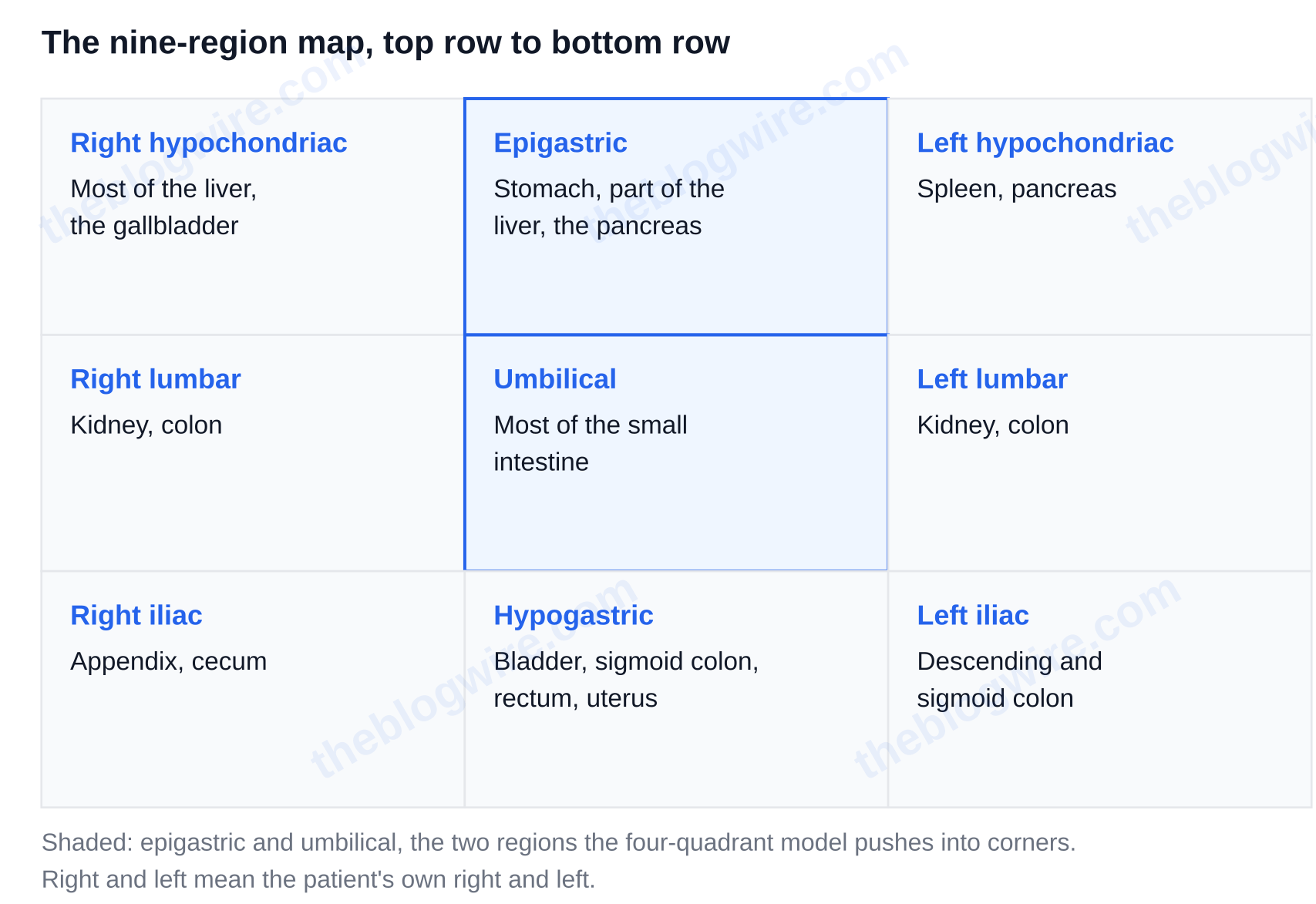
The nine regions, top row to bottom row
The anatomical version consists of a three by three grid, named and mapped in detail by anatomy references such as Kenhub. The top row consists of the right hypochondriac (most of the liver, the gallbladder), epigastric (stomach, part of the liver, the pancreas) and left hypochondriac (spleen, pancreas). The middle row is the right lumbar, umbilical (most of the small intestine) and left lumbar — the lumbar flanks hold the kidneys and colon, which is why back-of-the-waist pain belongs on this map rather than off it. The bottom row consists of the right iliac (appendix and cecum), hypogastric (bladder, sigmoid colon, rectum, uterus) and left iliac (descending and sigmoid colon).
Use quadrants to describe roughly where it hurts. Be precise when it matters — the four-quadrant model pushes the epigastric and umbilical regions into corners where they do not belong, and this is where readers misjudge the most. Separating burning epigastric pain from true right-upper gallbladder pain is the single most useful thing the finer grid buys you.
Why abdominal pain so often hurts in the wrong place
The consumer pain maps don’t tell you this, but the map is built on anatomy, while the pain you feel is built on nerves, and the two do not line up.
Visceral pain comes from the organs themselves. Per the MSD Manual Professional Edition, those organs are supplied by autonomic fibres that respond to stretching and contraction rather than cutting, so the pain is dull, vague, nauseating and badly localised. And it is referred to areas matching the embryonic origin of the affected structure. That one rule explains most of the confusion: foregut structures (stomach, duodenum, liver, pancreas) produce upper abdominal pain, midgut structures (small bowel, proximal colon, appendix) produce pain around the navel, and hindgut structures (distal colon and the genitourinary tract) produce lower abdominal pain.
Somatic pain is the second phase. Once the inflammation reaches the parietal peritoneum, somatic nerves take over and pain becomes sharp, pinpoint and worse with movement. That shift from vague to specific is not a detail — it is the signal that something has escalated.
The most common misreading is “it is in the middle, so it is just my stomach.” Early appendicitis is exactly where that misreading goes wrong.
If it hurts here, the organ may be there
Referred pain happens because nerve fibres converge at the spinal cord and the brain mislabels the source. Reversing the map catches readers whose worst pain is not even in the abdomen: pain under or around the right shoulder blade can be biliary colic from gallstones; groin pain can be renal colic from a stone moving down the ureter; and shoulder pain can mean blood or infection irritating the diaphragm. In practice, trust the character of the pain and whether it has changed location at least as much as the square it currently sits in.
What the type of pain adds, and what it means when pain moves
The second axis of the map is pain character. Colicky pain that builds to a peak and then eases is a hollow tube pushing against a blockage — biliary colic, renal colic, bowel obstruction. Burning or gnawing pain high in the middle, related to meals or lying down, is suggestive of gastritis, peptic ulcer or GERD. Cramping with bowel urgency that is relieved after a bowel movement points at IBS, constipation or gastroenteritis. Dull epigastric pain boring straight through to your back is worse lying flat and is relieved by leaning forward, and suggests pancreatitis. Sharp, constant pain that is worse when you cough or go over a bump in the car means the peritoneum is irritated, and that needs same-day assessment.
The 4–6 hour appendicitis timeline and McBurney’s point
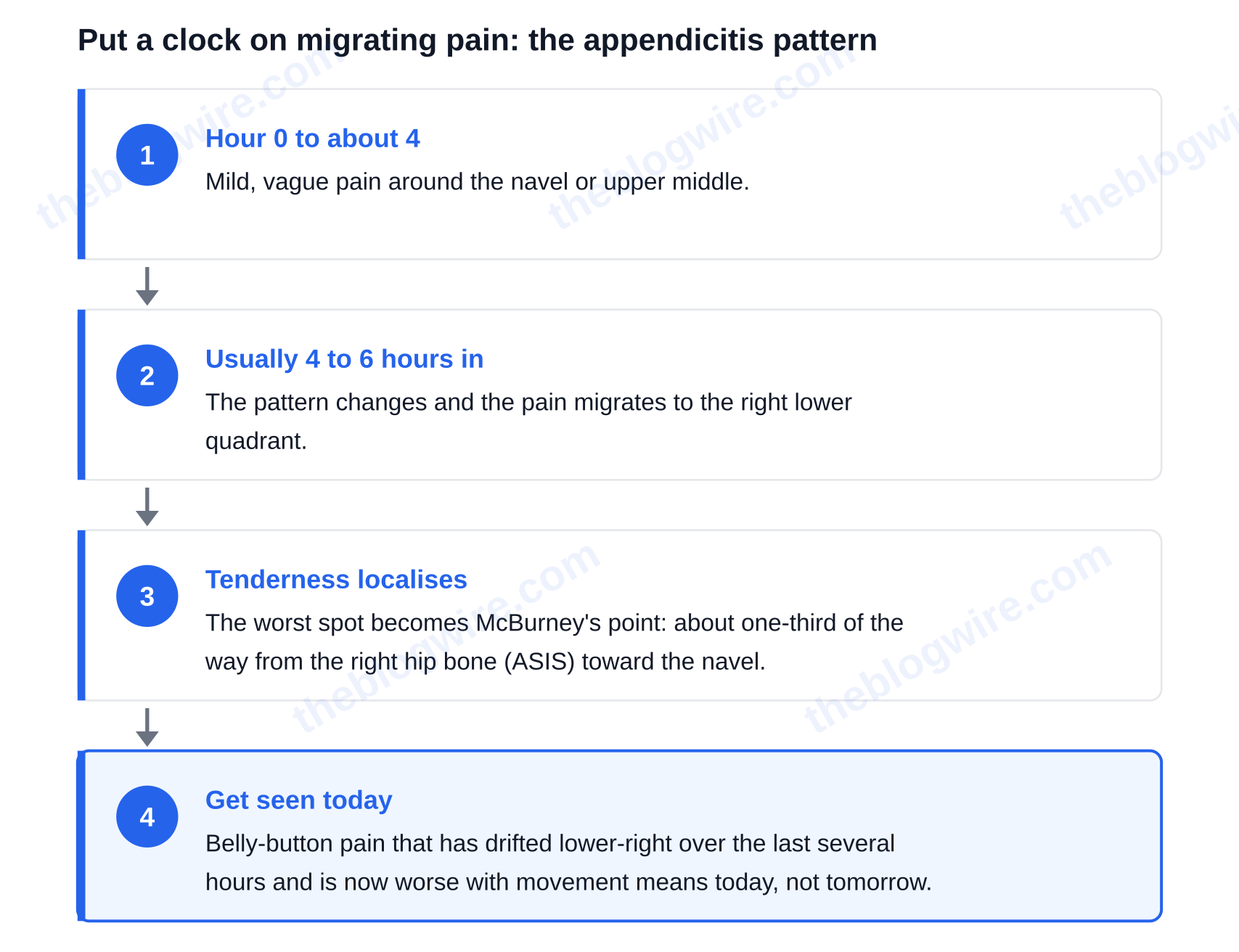
Put a clock on migrating pain. Medscape’s clinical description of appendicitis has it beginning as mild, vague pain around the navel or upper middle that usually lasts 4–6 hours before the pattern changes and migrates to the right lower quadrant. Tenderness then localises at McBurney’s point, which is about one-third of the way from the bony front of your right hip (the anterior superior iliac spine) toward your navel. Press there and that is the worst spot.
The concrete rule: if belly-button pain drifts to lower-right over the last several hours and is now worse with movement, get seen today, not tomorrow. Tracking pain movements is important. For example, flank pain travels to the groin as a stone descends. Epigastric pain can spread to the whole abdomen after a perforated ulcer. Right-rib pain can climb to the shoulder blade. And severe pain that suddenly stops is not automatically good news.
Where the stomach pain map stops working: women, children and older adults
Women have one-sided lower pain patterns that the standard charts skip. Mittelschmerz is a one-sided mid-cycle ache as a follicle swells and releases an egg. It can last anywhere from a few minutes to around two days. A ruptured functional ovarian cyst can cause sharp pain on one side that eases over hours as the fluid is reabsorbed. However, a sudden, severe pain on one side with vaginal bleeding, shoulder-tip pain, dizziness or fainting is the ectopic pregnancy pattern: call now, do not wait it out. In pregnancy, where the uterus displaces organs and the appendix shifts upward, any abdominal pain gets assessed rather than mapped.
Identifying the location of pain becomes extremely difficult beyond the age of 65, and that is where the location-plus-fever habit breaks down hardest. The American Academy of Family Physicians reports that only 23% of older patients with appendicitis had a temperature above 100°F (37.7°C), and that patients over 65 with peritonitis are about half as likely to present with the classic rebound tenderness or guarding. In the case of a patient over the age of 65, lower your threshold and do not always rely on classic signs.
Children localise poorly and frequently point at the navel regardless of the cause. Watch behaviour, whether they are drinking, and whether they walk normally instead. Signals are also blunted by diabetes, immunosuppression, recent abdominal surgery, steroids and strong painkillers.
ER now, same day, or wait? Turning the map into a decision
Region plus character plus companions gives you both a shortlist and an urgency level in one step.
| Where it hurts | How it feels and what comes with it | Likely shortlist | What to do |
|---|---|---|---|
| Whole abdomen | Sharp, constant, rigid board-like belly, agony on any movement | Perforation, peritonitis | Call 911 / ER now |
| Lower, one side | Sudden and severe with vaginal bleeding, shoulder-tip pain or faintness | Possible ectopic pregnancy | Call 911 / ER now |
| Navel, then lower right | Vague for hours, now sharp and worse with movement | Appendicitis | Get seen today |
| Right upper, under the ribs | Waves after eating, climbing to the right shoulder blade | Gallstones, cholecystitis | Same day; ER with fever or yellow eyes |
| Lower left | Cramping with fever and a change in bowel habit | Diverticulitis | Same day |
| Flank to groin | Severe waves, can’t sit still, blood or burning on urination | Kidney stone (renal colic) | Same day; ER with fever |
| Epigastric, through to the back | Dull and boring, worse lying flat, better leaning forward | Pancreatitis | Same day |
| Epigastric | Burning or gnawing, tied to meals or lying down | Gastritis, peptic ulcer, GERD | Appointment this week |
| Lower, either side | Cramping with bowel urgency, eases after a bowel movement | IBS, constipation, gastroenteritis | Appointment this week |
Go straight to the ER for the conditions listed below, regardless of which square they occur in:
- Sudden severe pain, or a rigid board-like abdomen
- Vomiting blood or green bile, or bloody or black tarry stools
- No bowel movement and no passing gas
- High fever with chills or confusion
- Chest pain, shortness of breath, fainting or dizziness
- Pain after abdominal injury, or any abdominal pain in pregnancy
- Inability to keep any fluids down
The threshold at Cleveland Clinic is broader than people think. You need to see a provider for any unexplained, severe or persistent pain, after any injury, or during pregnancy. You also need to seek care for persistent fever, unrelenting vomiting, blood in your stool, urine or vomit, abdominal swelling or tenderness, jaundice or shortness of breath.
While you wait to be seen, do not eat if you are vomiting. Sip small amounts of clear fluids. Do not take a heat pad to an undiagnosed sharp pain. Do not take NSAIDs if an ulcer is on the list. Do not take laxatives if you have no bowel movement and no gas. Do not load up on painkillers right before you are assessed — they hide the answers clinicians are looking for when they examine you. Expect an abdominal exam, blood work, a urine test, a pregnancy test if applicable, and ultrasound or CT depending on the region.
What’s important to remember is the map narrows the list of organs, but referred pain, migrating pain and blunted signals bend the map out of shape. So always read location, then character, then companions. The next step is to write down the location of where the pain originally started, the location of where the pain currently is, the type of pain and your temperature, check that against the three levels of urgency above, and act on whichever one you land in. You’ll find more guides like this across The Blog Wire.
Common Questions
What organ is under my right ribs when it hurts there?
The right upper quadrant — the right hypochondriac region on the nine-region map — includes most of the liver, the gallbladder and bile ducts, the right kidney and part of the colon. Pain in that area that comes in waves after a fatty meal and climbs to your right shoulder blade is the classic gallstone pattern. If you also have a fever and your eyes are turning yellow, it becomes an ER visit, not a wait.
How do I tell trapped gas from something serious?
Pain that moves around probably isn’t serious. Pain that changes when you shift position or pass gas probably isn’t serious. Pain that feels better after a bowel movement probably isn’t serious. Pain without fever or vomiting probably isn’t serious. Serious pain tends to settle in one spot and stay there. It is more likely to get worse over a period of hours and feel worse after you’ve coughed or hit a bump in the road. Pain that started vague and has become sharp and pinpoint has escalated — that shift means somatic nerves are now involved, and it needs same-day assessment. Same thing for a rigid abdomen, or having no bowel movement and no gas at all.
Why does my shoulder hurt at the same time as my stomach?
Because nerve fibres from your organs and your skin converge at the spinal cord, so your brain can mislabel where a signal came from. The MSD Manual gives the classic examples: pain near the right shoulder blade from biliary colic, groin pain from a kidney stone, and shoulder pain from blood or infection irritating the diaphragm. Shoulder-tip pain along with sudden severe one-sided lower abdominal pain, bleeding or faintness is an emergency pattern — call now.