Most think the rooster crows because the sun is rising. The sun isn’t the reason he crows. Why do roosters crow? Roosters crow to communicate. They crow to set boundaries on their territory. They will crow to answer a challenge from another rooster. They will crow to regroup the hens. Roosters will also crow to signal danger. Roosters have a built-in clock that will make them crow at dawn. This clock will start about two hours before first light, which is why roosters crow in the dark.
This article will discuss all of this and more. It will cover what is really being communicated when a rooster crows. It will cover the measured clock numbers most explainers leave out. It will cover the brain chemistry behind the urge. It will cover which bird in a flock of roosters is responsible for setting the alarm for all the other roosters. It will cover the real volume of a crow. It will cover what genuinely reduces it.
Why do roosters crow in the first place?
A crow is a broadcast. It is one loud, long call that reaches every rooster and every hen within earshot at the same time, and it contains multiple messages. It is easier to say several things at once by calling instead of by physical means.
The first message is territorial. It is telling other roosters that this area is claimed. This is why other roosters will crow after a neighbouring rooster crows first — each rooster is replying to a claim, not greeting the morning.
The second message is his status. How aggressive he is in answering back challenges, and how often he calls, gives other roosters a message about what he can back up.
The third is flock management. According to Grubbly Farms, a rooster’s crowing is communication with his hens. He calls the stragglers back in to the group. He regroups the flock after a disturbance, and he signals all-clear to the group. He even calls a food find. So in essence, he is a public address system with legs.
A rooster has to communicate this way because he cannot physically see all of the hens in his group. All of this is inherited. Domestic chickens are descendants of the red jungle fowl (Gallus), a bird of the dense forest. In the jungle, you can’t be seen because of the undergrowth, but you can definitely be heard. A vocal signal beats a visual display when the sight lines are two metres.
Crowing versus the hawk call and the ground-predator call
Crows do not function as an alarm call. Chickens have a separate, quieter vocabulary for threat calls. Grubbly Farms states that chickens do make specific calls for a hawk (or other overhead predator) and a ground predator (like a coyote). These calls are specific warnings to the flock. A crow, on the other hand, is a general call to the whole world.
One myth worth killing here: crowing has nothing to do with eggs. Hens do lay with or without a rooster. He fertilises eggs; he has nothing to do with causing them.
Why do roosters crow at 3 a.m. instead of at sunrise?
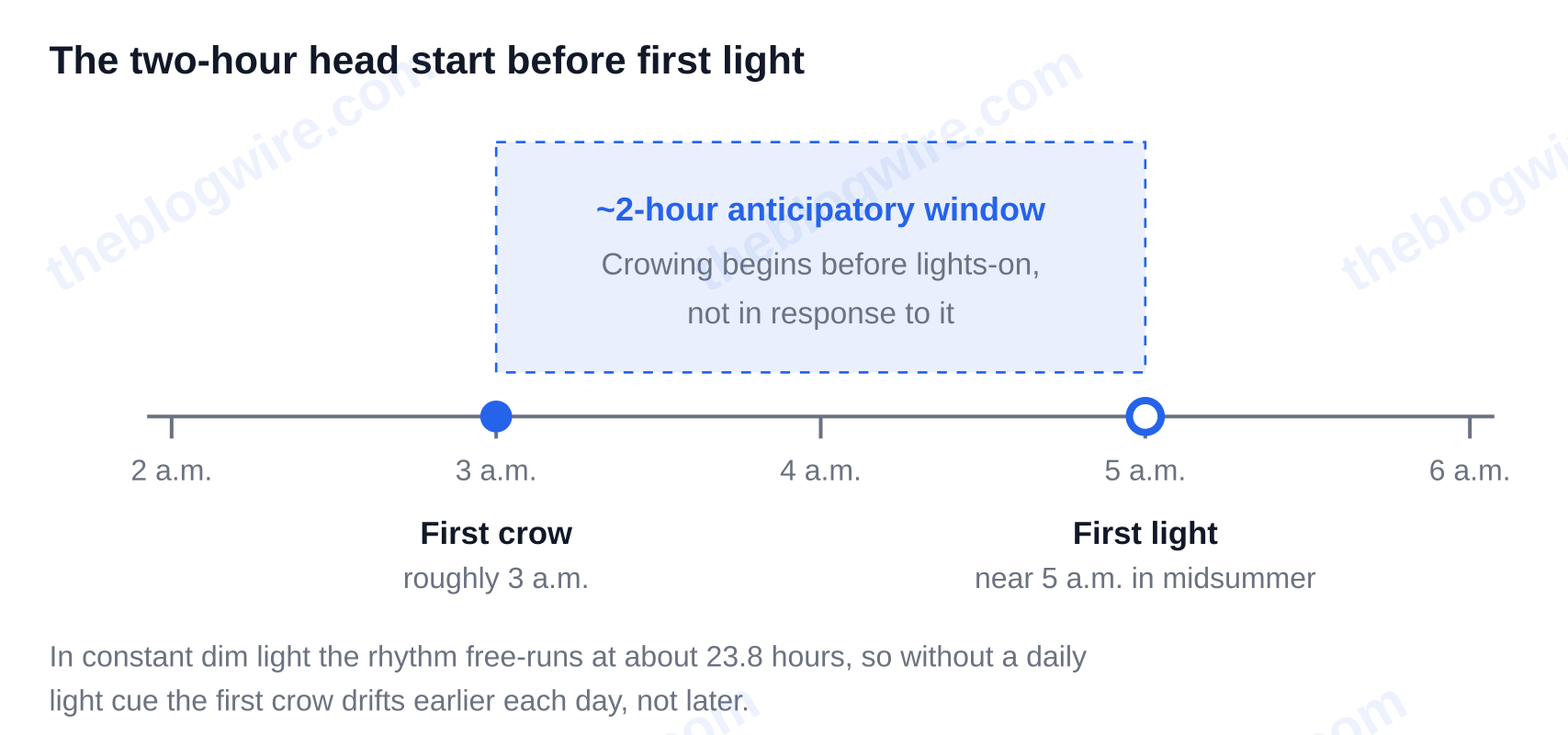
One of the strongest physiological rhythms is the call to crow, which occurs about two hours before the break of day. With that in mind, a midsummer dawn plus a two-hour head start means he is crowing at 3 a.m. This is the main question people really want to know, and it is actually answerable with hard data as opposed to a folk explanation.
The two-hour head start before first light
Roosters have been shown to anticipate the start of the day by roughly two hours, crowing before the first light of the day. First, the research. In a 2013 study published in Current Biology, Tsuyoshi Shimmura and Takashi Yoshimura of Nagoya University studied roosters in a fixed 12-hour light, 12-hour dark cycle. In this study, the birds began crowing roughly two hours before lights-on, regardless of the actual time. The research suggests that the crowing is anticipatory, and not a response to the onset of light.
Now do the math the explainer pages skip. If first light in your area is near 5 a.m. in midsummer, a two-hour anticipatory window puts the first crow at roughly 3 a.m. The 3 a.m. crow is not a sick bird, a fault, or a miscue. It is the clock producing what it is designed to produce.
Why an unlit coop makes him crow earlier, not later
Second half of the finding matters more than the first. When the same roosters were kept in constant dim light for two weeks, crowing kept cycling on a free-running period of about 23.8 hours — reported as 23.7 hours in some coverage of the paper, including National Geographic’s write-up. Either way, it is shorter than 24.
Consider what happens in a sub-24-hour cycle without a daily reset. A rooster with no reliable light cue — a windowless shed, a heavily shaded coop, a long stretch of thick overcast — drifts a little earlier each day, rather than later. His crowing creeps more and more toward the small hours instead of settling. Removing the daily light cue allows the rooster to drift earlier; the daily light cue is what pins him to sunrise, and without it, he won’t settle to crow at sunrise.
Why the same headlight triggers a crow at 4 a.m. but not at midnight
External triggers are very real. A passing truck, a porch lamp, a rival’s crow, or a car headlight can all induce crowing in a rooster. The Current Biology research on circadian control of rooster crowing found that the strength of that induction is itself gated by the clock. In other words, birds are more likely to respond to a sudden light or a rival’s call at or near dawn than at other times of day. So in fact the same headlight that gets ignored at midnight pulls a full crow at 4 a.m.
In practice this means the dawn crow is more of an internal process with an external veneer. You can eliminate all external triggers on the property, but the process will still happen and you can still be woken up.
Do roosters only crow in the morning, or all day?
All day, and in to the evening. Grubbly Farms reports crowing through morning, afternoon and evening, with the morning crowing and the crowing around dusk being the loudest. So while the loudest crowing occurs during the dawn chorus, the process happens throughout the day.
Most daytime crowing is reactive, layered on top of the clock-driven baseline. Think of a dog barking, a gate opening, a car door. One crow can even stimulate another down the road. Give your rooster the benefit of the doubt. He isn’t randomly crowing. There is a reason, even if you don’t notice it.
As long as your rooster gets a daily light cue to reset his internal clock, he can be fairly consistent with timing each day. This gives a gradual shift with sunrise through the seasons. The bird waking you at 3 a.m. in July is not the bird waking you at 3 a.m. in December.
Why a young cockerel’s crow sounds broken
Young cockerels crow more often than mature roosters, according to Grubbly Farms, and immaturity explains cracked, truncated, off-pitch crowing. Cockerels gain the motor control and necessary hormone levels to fully perform the crow with maturity. This can take a few months from when they start. Breed and individual differences play a role as well.
What makes a rooster crow — hormones, brain chemistry, or learning?
Not learning. A rooster raised without other roosters still has the innate ability to crow, which points to an innate motor program rather than imitation. Ask why do roosters crow at the mechanical level, and most answers stop at one word: hormones. There is a more specific answer than that.
A 2019 paper in Scientific Reports traced the trigger to cholecystokinin (CCK) binding the CCKB receptor in the nucleus intercollicularis, a region of the midbrain. Testosterone increases the level of that receptor. This is the concrete mechanism behind the vague observation, and it is the reason crowing ramps up as the cockerel comes into hormone rather than arriving fully formed.
Direct evidence is evocative. Chicks treated with gastrin, a CCKB-receptor agonist, crowed more frequently than the controls. Push the chemistry and you get more crowing.
This explains two things keepers already know from the yard. Crowing can’t be trained out of a bird. You can’t reason with a habit, and that’s the case with crowing. Also, capons — castrated males — lose the drive because, as testosterone is responsible for up-regulating the receptor, it is lost when the bird is castrated. The urge is chemical, not behavioural.
Can hens crow like roosters?
Yes, it has been documented and is uncommon but not strange. According to The Feather Brain, there are breeds and individual birds dispositional to it, and it occurs most often when a rooster is not present and the alpha hen takes on the vacant role, or after hormonal changes following peak laying years. A crowing hen is not a health emergency and is not indicative of anything amiss.
Which rooster crows first in a multi-rooster flock?
There is a starter rooster of the dawn chorus, and the role is inherited. So, which rooster crows first is more of a focus than why do roosters crow, and that has a hard number answer.
In a 2015 Scientific Reports study on rank and the timing of the first crow at dawn, the top-ranking rooster began the morning crow first on 97.6 ± 2.9% of mornings. Subordinates followed him within a few tens of seconds, and their timing tracked his closely — correlations of roughly 0.98 at the top of the order down to about 0.78 further down. They are not waiting for light. They are suppressing their own clock-driven urge in deference to rank.
The useful part: when the top bird was removed, the second-ranking rooster immediately assumed crow duties. The job did not disappear; it was filled.
Keep three roosters and see if your neighbour has stopped waving. Rehoming the loudest bird does nothing if it is not the dominant one. The others are answering, not starting. Rehoming the dominant one promotes the next in line and the chorus restarts the next morning at the same hour.
What to do before you rehome the loudest bird
For three or four mornings stand outside at the same time as the morning chorus and log which bird opens, not which bird is loudest. This is often a different bird than the loudest and makes a difference as to whether moving a bird will help any.
How loud is a crow, and what actually reduces it?
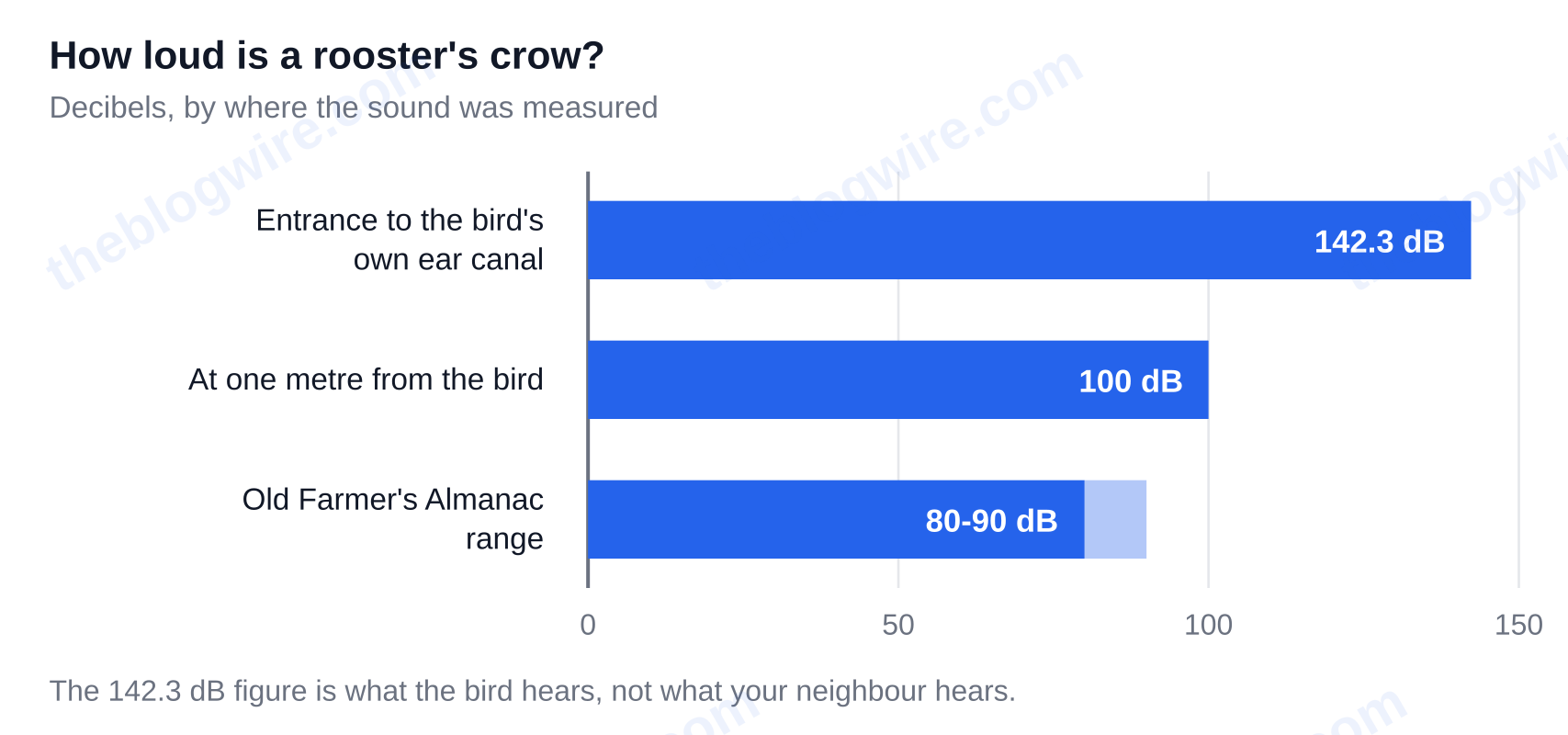
According to the Zoology study from the University of Antwerp and University of Ghent, a rooster’s crow measures about 100 decibels at a distance of one metre, and up to 142.3 decibels at the entrance to the bird’s own ear canal. The Old Farmer’s Almanac mentions 80 to 90 decibels with 142 decibels right next to the head — the gap between those figures is mostly measurement distance and individual bird. The 142 decibels is what the bird hears, not what your neighbour hears.
Why isn’t he deaf? Because opening the beak to crow mechanically closes his auditory canal — a built-in earplug — with soft tissue covering roughly half the eardrum. Hens’ canals only narrow when the beak opens; they do not seal. The full protection likely evolved as a rooster adaptation. Likewise, birds can regenerate damaged inner-ear hair cells, which we can’t, so incidental damage is recoverable, not permanent.
That last point cuts both ways for you. Remember, sound pressure falls off with distance, and nothing you apply to the bird changes the physics of how far the sound travels. Coop placement does more work than any gadget.
Now the honest accounting of the usual “fixes.”
| Approach | What it actually does | Realistic effect |
|---|---|---|
| Blackout coop, delayed morning release | Removes the visual trigger — skylight, headlights, porch lamps, dusk | Genuinely cuts reactive crowing. Does not stop the anticipatory crow: the Current Biology birds kept crowing on schedule in constant dim light |
| Distance and structure | Moves the coop away from bedrooms and boundaries; puts a wall or outbuilding in the sound path | The only lever that works on physics rather than on the bird. Most reliable single change |
| No-crow collar | Restricts airflow so the crow comes out quieter and squelched | Reduces volume only. Does not stop crowing. Needs correct fit and daily checking |
| Fewer roosters | Removes answering crows from the chain | Helps with total volume. Removing the dominant bird promotes his replacement rather than ending the chorus |
| Training, scolding, startling, waiting it out | Nothing | No effect. The behaviour is clock- and hormone-driven, not learned |
| Capon, hen-only flock, or rehoming | Removes the hormonal driver or the bird | The actual endpoints when noise is non-negotiable |
First, the standard internet advice: black out the coop and he will stop. It is half right and oversold. As MorningChores points out, the fully dark space with a late release is the most common recommendation. It does cut crowing triggered by light. It should never be sold as a guaranteed 4 a.m. silence, because the clock doesn’t care whether windows are boarded.
The short version, and what to do tomorrow morning
Now the short version. What to do tomorrow. So, why do roosters crow? To be heard — by rivals, by hens, by anything that needs telling. And they will do this whether it is light out or not, because an internal clock running near 23.8 hours starts the call about two hours before light, which makes a 3 a.m. crow normal output rather than a fault.
The research focuses more on the mechanism than the behaviour. The 2019 CCK and CCKB-receptor finding is the newest piece of research, and it is the thread that will help describe individual differences better than the broad word hormones will.
For now, focus on the smaller picture. For the next three mornings, write down the exact time of the first crow and which bird started it. This log will tell you if you have anticipatory clock-driven crowing — manage distance and expectations — or reactive crowing at a light source, which you can simply fix. And it tells you which rooster is setting the alarm, before you move a single bird. For more like this, explore The Blog Wire.