The Cleveland Clinic puts the amount of fluid your blood vessels can’t reabsorb at about 3 litres a day. Returning that fluid to your bloodstream is the first job of lymphatic system function. The same network also filters fluid via lymph nodes to catch infections and absorbs dietary fats and fat-soluble vitamins from your small intestine.
What happens when that system breaks? Some lymph nodes, like those in the armpits, are removed during cancer surgery. Fluid still travels to those nodes. The route home is gone. That’s why the arm on that side can swell for years afterwards.
What is the main function of the lymphatic system?
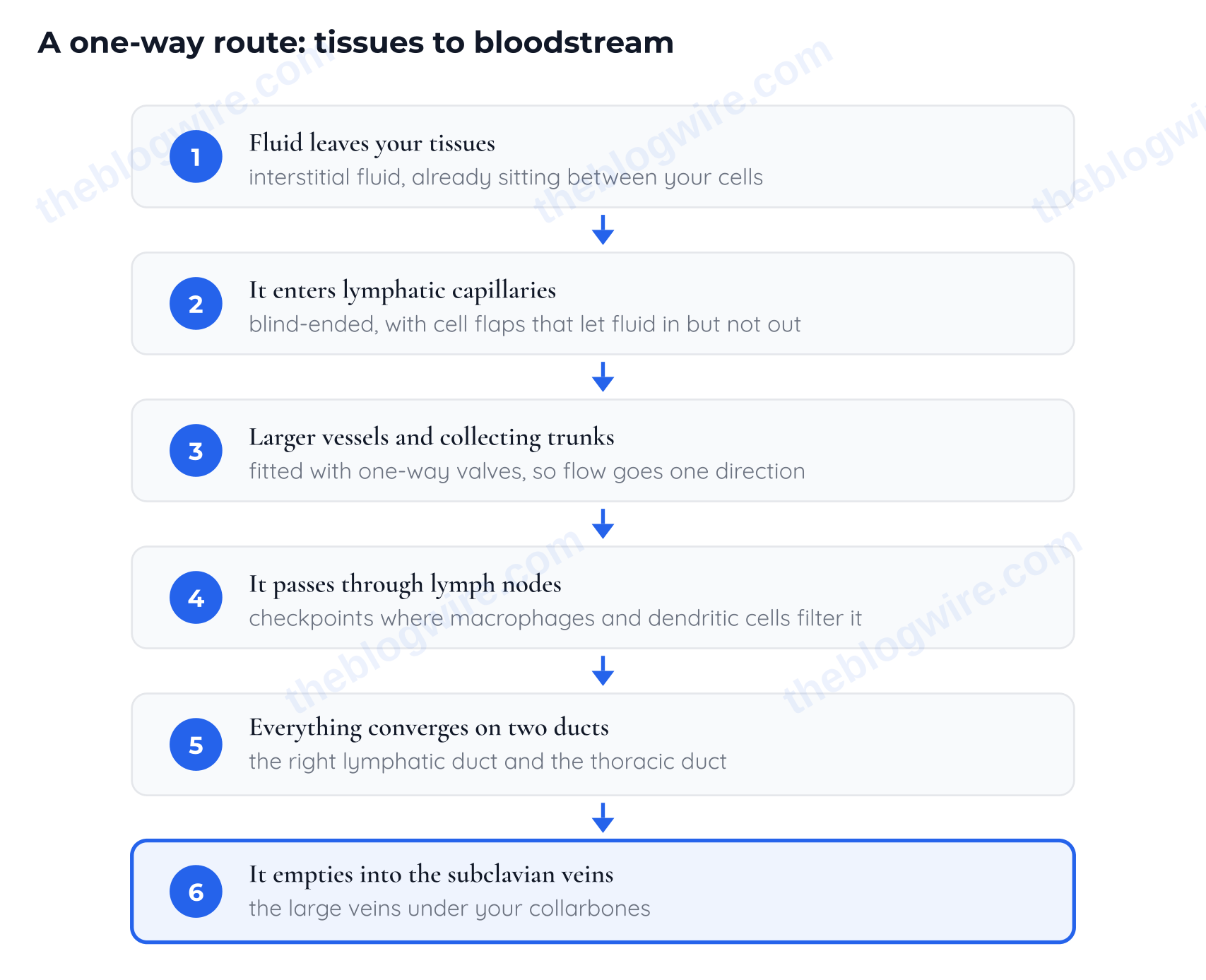
It drains fluid one way. This is a network, not a loop like your circulation. Fluid leaves your tissues, enters lymphatic capillaries, passes through lymph nodes, and empties into the large veins under your collarbones. That fluid doesn’t travel back the way it came.
Three jobs run on that one system, and they set the order the rest of this page follows: fluid balance, immune defence, fat absorption. The Cleveland Clinic overview of the lymphatic system lists the same three.
To remember this, think of lymph as the fluid, lymphatic vessels as the plumbing, and lymph nodes as checkpoints along the route. The lymphoid organs — bone marrow, thymus, spleen, tonsils — are where cells of the immune system are manufactured and stored.
There are not three distinct systems with the same name. The same vessels that drain fluid also carry immune cells and dietary fat, which is why one blockage can give rise to several problems at once. This also explains why references file this system under two headings. The lymphatic system is part of the circulatory system because it returns fluid to the blood, and it is part of the immune system because it helps to mount an immune response. The Merck Manual’s consumer overview details both functions: return of the interstitial fluid and waste products to the bloodstream, and the production of lymphocytes that help to eliminate microorganisms that cause diseases.
How does it keep fluid balance? The 20/17/3-litre math
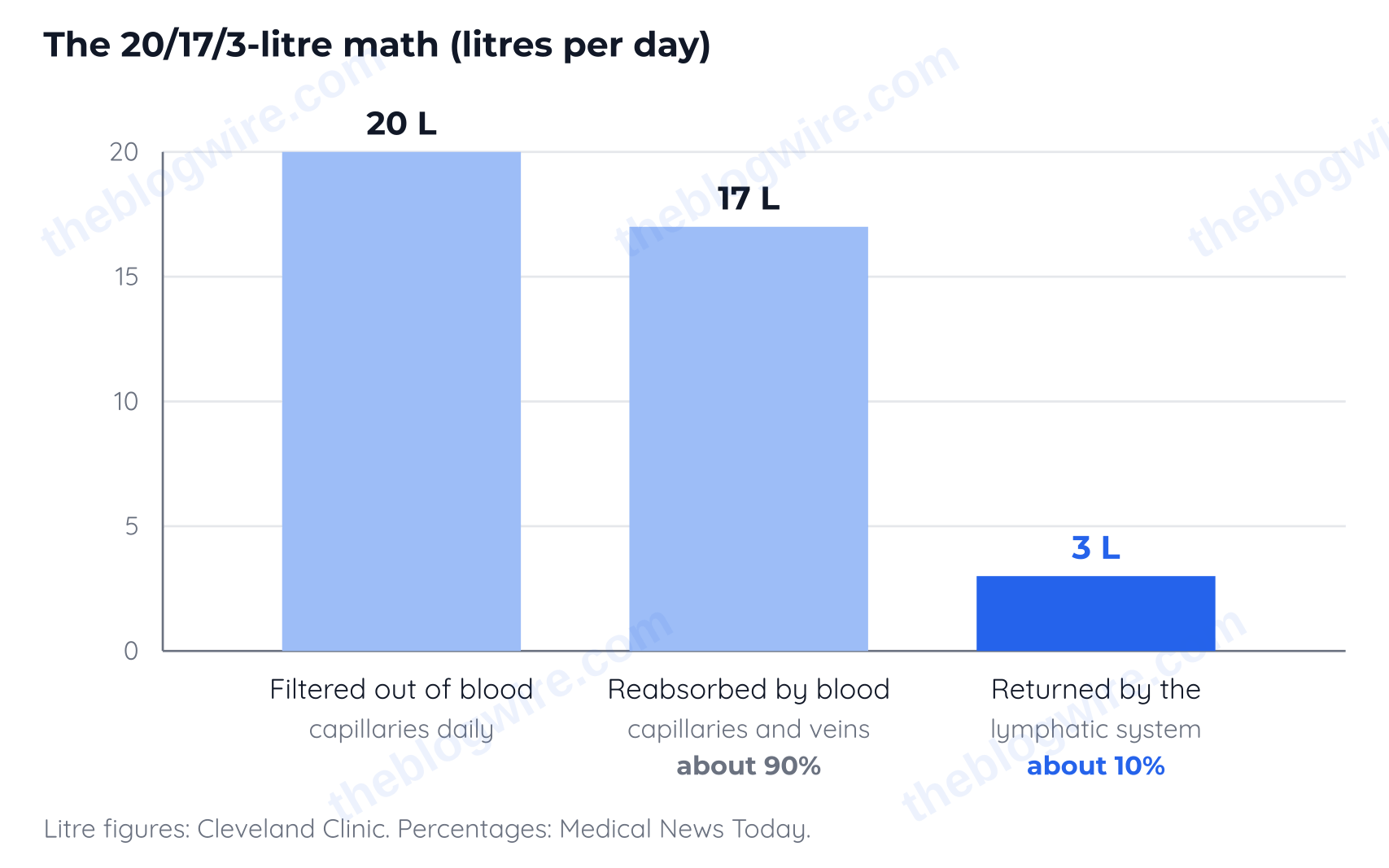
Most pages stop at “returns excess fluid.” The published arithmetic is more useful. Cleveland Clinic puts daily capillary leakage at roughly 20 litres of plasma filtering out through those thin vessel walls into your tissues. About 17 litres of that is reabsorbed by the blood capillaries and veins. The remaining 3 litres has one and only one way to return to the circulation.
You will also meet this as percentages. Medical News Today frames it as around 90% of the plasma reaching your tissues returning through the venous capillaries and veins, with the other 10% going back by the lymphatic route. Same split, counted twice — litres in one source, proportions in the other.
Water is not the only thing that comes back. Lymph also returns plasma proteins that leaked out and are now too large to squeeze into a blood capillary, plus cellular waste and debris.
The anatomy almost completely closes the circuit. Cleveland Clinic notes that the thoracic duct alone delivers about 3 litres of lymph into the circulation every day, matching the daily shortfall. That is what makes the consequence concrete: 3 litres a day with nowhere to go does not quietly vanish. It becomes visible, persistent swelling.
How does it defend you against infection?
Immune defence is the part of lymphatic system function most people name first, and it runs in two stages. Your immune cells are made in the primary lymphoid organs: bone marrow produces lymphocytes, T cells then mature in the thymus, and B cells mature in the bone marrow itself.
The response happens elsewhere. Lymph nodes, the spleen, your tonsils and adenoids, and the mucosa-associated lymphoid tissue (MALT) lining your gut and airways are the secondary lymphoid organs — the venues, not the factories.
Mechanical filtration is how that defence actually works. Lymph is pushed slowly through a node, where macrophages and dendritic cells trap bacteria, viruses and damaged cells, then present pieces of them to lymphocytes waiting inside, which starts the response. The slow pace is the point: it buys contact time.
Transport matters as much as storage. Lymphatic vessels are the road immune cells use to patrol tissue and reach the node where a response gets coordinated.
The spleen is a bit of an oddball. Instead of dealing with lymph it filters blood, and alongside its immune work it clears worn-out red blood cells.
How does it absorb fats and fat-soluble vitamins?
Inside the villi of your small intestine — those finger-like projections on the intestinal wall — sit lacteals, specialised lymphatic capillaries. Dietary fats get packaged into particles too large to cross into a blood capillary, so they enter the lacteals instead.
The result is chyle: milky, fat-laden lymph. It travels up the thoracic duct and enters your bloodstream at the subclavian vein. The fat-soluble vitamins A, D, E and K ride along with the absorbed fat.
This is the job readers forget, and it is the one that settles the argument. A network that moves your dinner’s fat from gut to blood is a transport system first. Immune defence is something it does along the route.
What are the parts, and where are the lymph nodes?
What lymph fluid is and how it differs from blood
Lymph is clear to pale yellow and contains no red blood cells. It begins as interstitial fluid — the fluid already sitting between your cells — and picks up lymphocytes, proteins and, after a fatty meal, fat. Blood carries oxygen in red cells under pressure from a pump. Unlike blood, lymph is not under pressure and it is not carried by the heart.
The vessel hierarchy and the two collecting ducts
Lymphatic capillaries are blind-ended and have overlapping cell flaps covering the ends. The flaps let fluid in but not back out. That fluid then drains into larger lymphatic vessels fitted with one-way valves, then into collecting trunks. Everything converges on two exits. The right lymphatic duct drains your right arm, the right side of your chest, and the right side of your head and neck. The thoracic duct drains everything else. Both ducts empty into the subclavian veins.
How many lymph nodes are in the body?
There are roughly 600 to 800 lymph nodes. The range is the honest answer and not a dodge. Cleveland Clinic says about 600. Medical News Today says approximately 800. Neither is wrong: medical centres give different estimates because node size and number vary between individuals and also between clusters, and every published count is an estimate. The superficial clusters you can find on yourself are in the neck (cervical), the armpits (axillary) and the groin (inguinal). The clusters in the mediastinum (chest) and abdomen sit too deep to feel.
How does lymph move without a pump?
There is no lymphatic heart — nothing pumps lymph the way the heart pumps blood. Pressure comes from the vessels themselves and from your body moving around them.
The intrinsic pump is the lymphangion. A lymphangion is a short segment of a vessel, bounded by two one-way valves. Lymphatic muscle cells, located in the wall of the vessel, contract in sequence, pushing lymph forward one chamber at a time.
The extrinsic pump is everything that presses on those vessels from the outside. This is skeletal muscle contraction, breathing movements, gastrointestinal muscle contraction and the pulsation of nearby arteries.
The valves are what make the whole thing work. Because flow can only go one direction, any squeeze — a step, a breath, a swallow — pushes the lymph toward your chest instead of back into the tissue. It also sets up the only advice on this page that has a clear mechanism behind it: movement is the lever you actually have over lymphatic system function. Sitting still really does slow lymph flow, and moving really does speed it up.
Lymphatic system function, failure by failure: which symptom maps to which job
Here’s the gap worth naming. In the reference pages, the three jobs sit in one section and the diseases sit in another. You learn the functions with no way to map a symptom back to the job that failed. This table connects those dots.
| Job that fails | What failure looks like | The named condition |
|---|---|---|
| Fluid drainage | Persistent, often one-sided limb swelling that does not resolve overnight | Lymphedema — primary, or secondary after lymph node removal, radiation or filariasis |
| Immune filtering (overloaded or infected) | Swollen, tender, warm nodes | Reactive lymphadenopathy; lymphadenitis |
| Fat absorption via the lacteals | Pale, fatty stools and signs of fat-soluble vitamin shortfall | Malabsorption; chyle leak |
| Node architecture turns malignant | Firm, painless, growing nodes with fever, night sweats or weight loss | Lymphoma — Hodgkin and non-Hodgkin |
| Spleen or tonsil involvement | Fullness under the left ribs, or recurrent throat infection | Splenomegaly; recurrent tonsillitis |
When you find a lump, two details do most of the work. If the lump is tender and mobile, that usually points to infection. Hard, fixed and painless is the pattern that warrants prompt assessment. And when a pathway is completely blocked, everything stalls in the same territory — fluid, protein and immune traffic alike — which is why lymphedema causes repeated skin infections in the affected limb, not just swelling.
When should you see a doctor about a swollen node or swelling?
Nodes that swell with a cold or a sore throat usually settle within one to two weeks as the infection resolves. You should get assessed for a swollen node that lasts beyond about two weeks, keeps growing, or feels hard, fixed and painless rather than tender and movable. Unexplained limb swelling that persists deserves medical attention, especially on one side. This includes swelling after cancer surgery, node removal or radiation. Swollen nodes together with fever, drenching night sweats, unexplained weight loss or persistent fatigue should be evaluated by a doctor, as should a red, hot, painful area spreading across a limb, which can signal lymphangitis or cellulitis. This description outlines when you should seek care and does not give a diagnosis. The only way to tell these apart is with an examination and, where needed, imaging or biopsy.
Does your brain have lymphatic drainage? The newest part of the answer
It was traditionally taught that the central nervous system has no lymphatic vessels. That’s why consumer explainers still state this system reaches “almost all” tissues and never name the exception.
That changed in 2015. Two independent research groups described meningeal lymphatic vessels that year, and Louveau and colleagues identified functional lymphatic vessels in the dura mater that drain fluid to the deep cervical lymph nodes.
Alongside them runs the glymphatic system. This perivascular clearance pathway is supported by astroglial cells and flushes soluble proteins and metabolites, amyloid-beta among them, out of the central nervous system. The system is mainly active during sleep and is largely disengaged while you are awake.
This belongs on a page about what the system does, because it adds a fourth job — brain waste clearance — to lymphatic system function and, more importantly, ties lymphatic performance to sleep, a relationship no top-ranking consumer page draws. It is an active research front rather than settled textbook material, and what it means for conditions like Alzheimer’s is still being worked out.
What actually helps — and what doesn’t?
Generic “support your lymphatic system” advice is written loosely enough to cover two very different readers. Separate them, and the answers stop agreeing.
If you have lymphedema: what the evidence supports
Manual lymphatic drainage (MLD) has established value here, but as one part of a four-part complete decongestive therapy — alongside compression, exercise and skin care — delivered by a trained therapist as part of that programme. Performed by itself, it is one-quarter of the treatment.
If you’re healthy: what’s worth doing and what to skip
UCLA Health states there is no credible evidence that MLD produces additional benefit in healthy people, and that it’s the liver and the kidneys — not your lymphatic vessels — that handle the body’s actual detoxification. “Lymphatic detox” has the physiology wrong.
What does hold up? Regular movement and exercise, because skeletal muscle contraction and deep breathing are the external pump. Staying hydrated, so lymph stays fluid. Caring for your skin, since intact skin keeps infection out of the drainage territory in the first place.
The uncomfortable truth, plainly: most lymphatic wellness content online is selling a mechanism that only matters once the system is already damaged.
The short version
Lymphatic system function comes down to three jobs:
- It returns the roughly 3 litres of fluid a day your blood vessels can’t reclaim.
- It stages your immune response in the nodes, spleen and MALT.
- It ferries dietary fat and the fat-soluble vitamins out of your gut via the lacteals and thoracic duct.
All three run on a system with no pump of its own, so movement does more for it than any massage. And if a swollen node has outlasted two weeks, or a limb has stayed swollen with no clear cause, do book an appointment rather than searching further. For more like this, explore The Blog Wire.
Common Questions
Is the lymphatic system the same thing as the immune system?
No, though there is a big intersection. The lymph nodes, spleen, tonsils and MALT are where your body stages the immune response, so the lymphatic system is part of your immune system. But it also drains fluid back to your bloodstream and absorbs dietary fat from your small intestine, which are not immune jobs. That is why references file it under both circulatory and immune headings.
Can you feel your own lymph nodes when they’re healthy?
Yes, often. The lymph nodes in the neck, armpit and groin sit close enough to the surface to be felt, especially if you are slim. A healthy node is small, soft, movable under the skin and painless. The pattern worth attention is the opposite: a node that is enlarged, hard, fixed in place and painless, or one that keeps growing past about two weeks.
Can the lymphatic system repair itself after lymph nodes are removed?
No. Removed nodes do not grow back. Drainage from that area may partly reroute through remaining pathways, which is why not everyone who has nodes removed develops swelling — however, it does not eliminate the risk. This is why anyone who has had nodes removed or radiated is told to protect the skin on that limb and to get new or worsening swelling assessed rather than waiting it out.
Does lymphatic massage help you lose weight?
No, it does not. UCLA Health states there is no credible evidence that manual lymphatic drainage produces additional benefit in healthy people, and that the liver and kidneys — not the lymphatic system — do the body’s detoxification. Any change on the scale after a session is fluid shifting, not fat lost. For healthy people, regular movement is the intervention with a real mechanism behind it, since muscle contraction and breathing are what move lymph.