Why did Cain kill Abel? The common explanation is that God deemed Abel’s sacrifice better because Abel offered a blood sacrifice, and Cain’s sacrifice was a bloodless offering. There is no such verse in the Bible that states so. That is an interpretation, not a verse. In Genesis 4:3-8, there is no explanation whatsoever for Cain’s murder; the anger and envy come after God had regard for Abel’s offering and not for Cain’s, and then the text moves straight on to the murder — without ever stating a motive.
That gap is the whole story of this question. Every familiar reason you have heard — the rejected sacrifice, envy of Abel’s righteousness, a quarrel over land, a fight over a wife — comes from a specific source. Knowing which source matters more than picking a favourite.
Why did Cain kill Abel, according to Genesis 4?
Anger and jealousy after his offering was passed over. Genesis 4:5 states Cain was “very angry, and his countenance fell.” Jealousy and anger are explained, and three verses later his brother is dead.
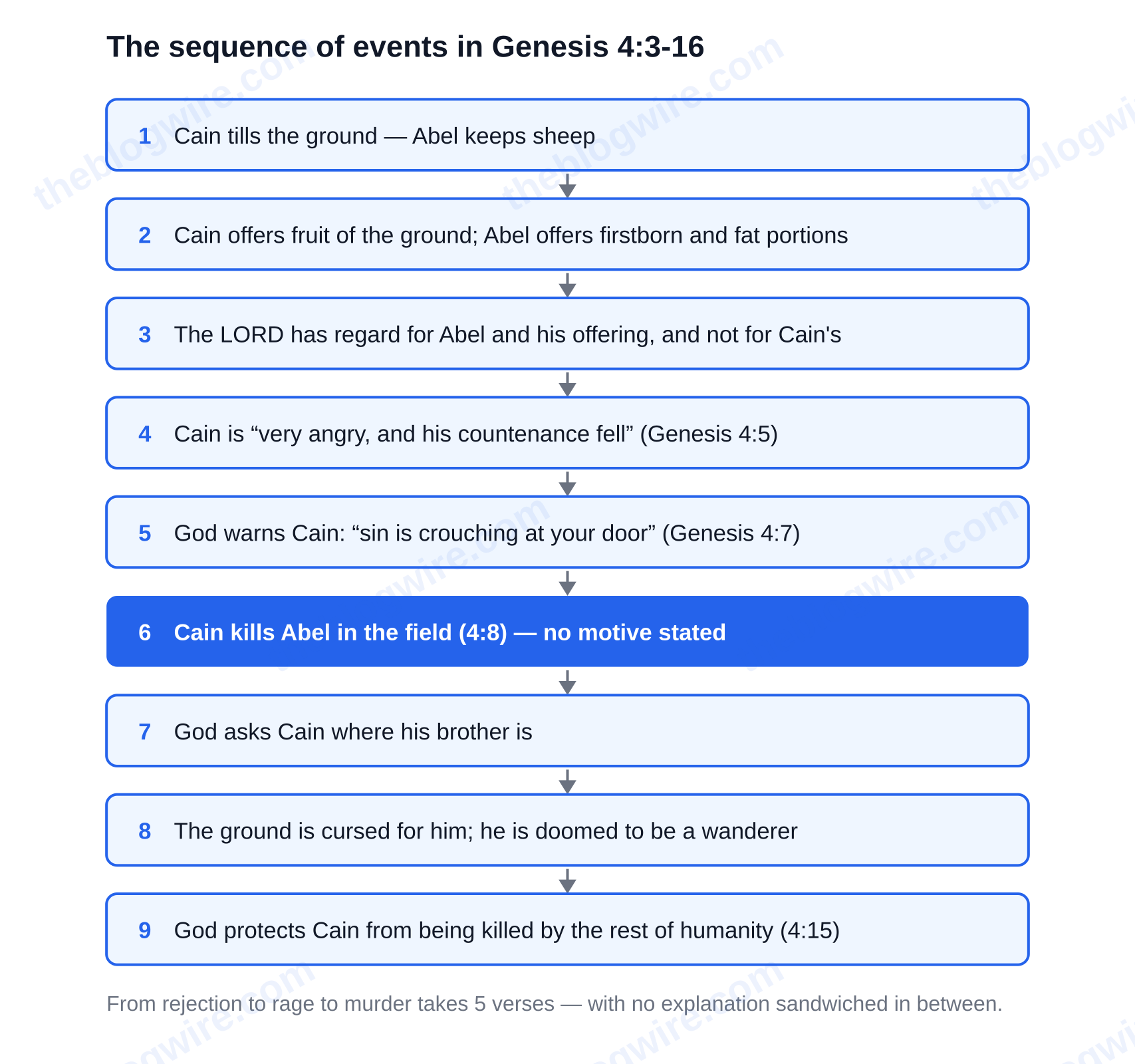
The sequence of events in Genesis 4:3-16
The narrative is brisk. Cain is portrayed tilling the land, and Abel, keeping sheep. Cain brings an offering of the fruits of the ground, and Abel brings the fatty portions of the firstborn of his sheep. The LORD has regard for Abel and his offering, and not for Cain and his. God warns Cain. Cain kills Abel in the field, and God asks him where his brother is. The ground is cursed for him, and he is doomed to be a wanderer; but God protects him from being killed by the rest of humanity.
What the text says about the brothers’ anger
It says that Cain was angry and gives no reason why things escalated. From rejection to rage to murder, it takes 5 verses, and there’s no explanation sandwiched in between. That space is what every later tradition rushes to fill.
One Hebrew word has more weight than most readers notice. The word sha’ah, which is translated as “had regard,” or “looked with favor,” is directed toward Abel and his offering, not the offering alone. God regards the person here, not the product.
Does the Bible actually say why Cain killed Abel?
It doesn’t. Genesis provides no explicit reason, and that is the one most defensible claim that can be made about this story. Dr. Rabbi David J. Zucker’s 2020 survey published by TheTorah.com comes to the same conclusion; the text gives no reason and every other reason is an interpretive assumption.
Search “why did Cain kill Abel” and almost every source gives one reason with certainty. Here’s the honest picture, each of the reasons next to the text from which they actually come.
| Proposed motive | Where it actually comes from |
|---|---|
| Anger and jealousy over the rejected offering | Genesis 4:3-8 (the only one in Genesis) |
| Hatred of Abel’s righteousness | 1 John 3:12 |
| Abel’s superior faith | Hebrews 11:4 |
| Dividing the land, the possessions, or the site of the future Temple | Genesis Rabbah 22:7 |
| Desire for Abel’s twin sister | Pirke De-Rabbi Eliezer 21 |
| An argument over whether God punishes the wicked | The Jerusalem Targums |
| Both brothers wanting their sister Aclima; the devil teaching Cain to use a stone | Islamic tradition around Quran 5:27-31 |
Only the first row comes from Genesis. The rest come from later interpretations, some of which are very good, but none of them are Genesis. A page that asserts one reason with certainty is quoting an interpretation, and treating it as if it is scripture.
Why the silence may be deliberate
Walter Brueggemann takes a harder line. For him, the absence of explanation for divine favouritism in the story is intentional. Brueggemann argues that part of the effect of the story on the reader is to make them uncomfortable by leaving them in the dark about why one brother was regarded and one was not. In fact, by explaining it away, the reader is refusing to let the text do what it is meant to do.
Why did God reject Cain’s offering but accept Abel’s?
The text doesn’t say that about either. Four interpretations compete: the firstness and quality of the gift; the gift without blood; the gift without faith; and Cain’s prior moral state before he ever brought anything.
The firstborn-and-fat-portions reading
This reading is the most literal. Abel brought “the firstborn of his flock and their fat portions.” Cain brought “some of the fruit of the ground.” Never are Cain’s offerings described as “firstfruits,” or the “choice” or “best” offerings. The contrast that is drawn in Genesis 4:3-4 is between the choicest offerings and the ordinary.
The blood-sacrifice reading — and its weakness
Many devotional pages take this approach. The offering was doomed, it is said, because an animal offering was required, and, therefore, Cain’s offering was defective. In fact, Genesis 4 is silent about blood and about atonement, and the grain offering is fully legitimate elsewhere in the Torah. Of the scholarly opinions, animal-versus-plant is but one, and not the settled answer the sermons suggest.
The faith reading from Hebrews 11:4
The author of Hebrews says Abel offered “a more excellent sacrifice” by faith. That places the difference in the giver rather than the gift — which fits sha’ah regarding Abel and his offering together. It is also a New Testament judgment, written centuries later, and not part of the Genesis narrative.
What does “sin is crouching at your door” mean in Genesis 4:7?
It is a warning to Cain that he had the choice to rule over sin and that it was not his destiny to be controlled by it. “Sin is crouching at the door; its desire is for you, but you must rule over it.”
The predator reading
The standard reading personifies sin as an animal waiting outside, ready to pounce. Two Hebrew words in this passage bring it back to Eden: teshuqah (“desire”) and mashal (“rule over”) are the same roots used in Genesis 3:16. The Hebrew suggests that God was framing Cain’s anger as something over which he had power, not as something that was predestined and beyond his control.
The sin-offering alternative
The verse is contested, and almost nothing that ranks for this question tells you that. The Hebrew is notoriously difficult, and some interpreters argue this passage supports God offering Cain a sin offering — a way back — rather than sin stalking him. In either case, the point is the same: the murder was not predestined. Cain was warned and refused correction.
What did Cain say to Abel in the field?
In this case, we just do not know. The most quoted line in the murder scene may not even be in the Hebrew.
The Masoretic Text of Genesis 4:8 notes that Cain “said to his brother Abel,” but doesn’t include what Cain said. The longer reading is found in the Septuagint, the Samaritan Pentateuch, the Vulgate and the Syriac, all of which supply “Let us go out to the field.” Additionally, a Qumran Hebrew fragment supports the inclusion of the longer reading. For this reason, some Bibles include the line while others do not, as the overview of the Cain and Abel narrative and its textual history notes.
This is important. The popular argument that Cain lured Abel out to the field, so the killing was premeditated, rests entirely on the inclusion of this line. Scholars remain divided over whether the Hebrew lost the line or the Greek supplied it. It’s better to say that directly, rather than taking a side.
What do Jewish and Islamic sources say the brothers argued about?
They say the fight was about something concrete, since midrashim and other traditions answer the question that Genesis leaves open.
Dividing the world, and the Temple site
Genesis Rabbah 22:7 proposes quarrels over splitting the land and its possessions, over which brother would own the site of the future Temple, or over rights to a wife. A tosefta from the Cairo Genizah mentions land disputes and a theological argument, but says that the real reason for the dispute was the wives.
The dispute over the sisters
Pirke De-Rabbi Eliezer 21 states Cain desired Abel’s twin sister. In the tradition Chabad presents, Cain was born with one twin sister and Abel with two, and the brothers argued about who was to marry Abel’s second sister. Cain claimed the first-born’s double portion, and Abel argued she was born with him.
The argument about divine justice
Sharper versions of this appear in the Jerusalem Targums. There Cain and Abel debate whether God actually punishes the wicked and rewards the righteous. These should be read as midrash working the narrative’s silence, and not as contradictory accounts.
The Quran tells the story differently yet again. There, in Quran 5:27-31, two sons of Adam — Qabil and Habil in Islamic tradition — bring offerings that meet the same unequal reception. The accepted brother tells the other that God accepts only from the God-fearing, and refuses to answer a threat on his life with violence of his own. After the killing the murderer regrets his act and does not know how to bury the body until a raven shows him. Tradition adds that both wanted to marry their sister Aclima, and that the devil taught Cain to use a stone. Note what this account has that Genesis does not: the victim speaks, and the moral reasoning is said out loud.
How does the New Testament explain Cain’s motive?
It tells us what Genesis withholds. Hebrews 11:4 commends Abel as righteous for a sacrifice offered in faith. In 1 John 3:12 Cain is called “of the evil one,” and the murder is made about hatred of his brother’s righteous deeds — shifting the motive off the offering and onto Abel’s standing before God.
These epistles attribute a reason to Genesis 4 that Genesis 4 doesn’t state. Most modern answers to the question “why did Cain kill Abel?” actually come from these two epistles, and it is good to be able to recognise this the next time you hear one delivered as the plain sense of the passage.
What happened to Cain after he killed Abel?
He was cursed, exiled, and then protected. The order of these shocks people.
“Am I my brother’s keeper?”
Cain’s response to God is an evasion disguised as a question, and it is harder to take when you learn Abel was literally a keeper of sheep.
The curse, the mark, and the land of Nod
A curse rests on the ground against him and he is sentenced to be a restless wanderer. Then there is the correction that most readers need: the mark of Cain in Genesis 4:15 is a protective mark, not a punitive mark. It is God’s guarantee that no one who finds him will kill him, backed by a promise of sevenfold vengeance on anyone who tries. The text neither specifies what the mark was nor where it was, and hence all the physical descriptions of the mark are later speculation — and the long habit of treating it as a stigma gets the verse backwards.
Cain goes to settle in the land of Nod, a name built on the same Hebrew root as his sentence of wandering, fathers Enoch, and there he builds a city named after him. The Bible doesn’t record how he died.
What is the lesson of Cain and Abel?
That violence here is a sequence of things rather than an explosive occurrence: resentment, a warning refused, anger privately nursed, and then a body in a field. God spoke to Cain before the murder, not after. The interest of the narrative is in the point when correction was still possible.
Notice also the kind of envy this is. Cain’s problem is not what he lacks; it is what his brother received. That is why an honest reading is also a more useful one. A text that refuses to explain the motive leaves you in Cain’s position, holding something you are told to rule over, instead of handing you a diagnosis to apply to someone else.
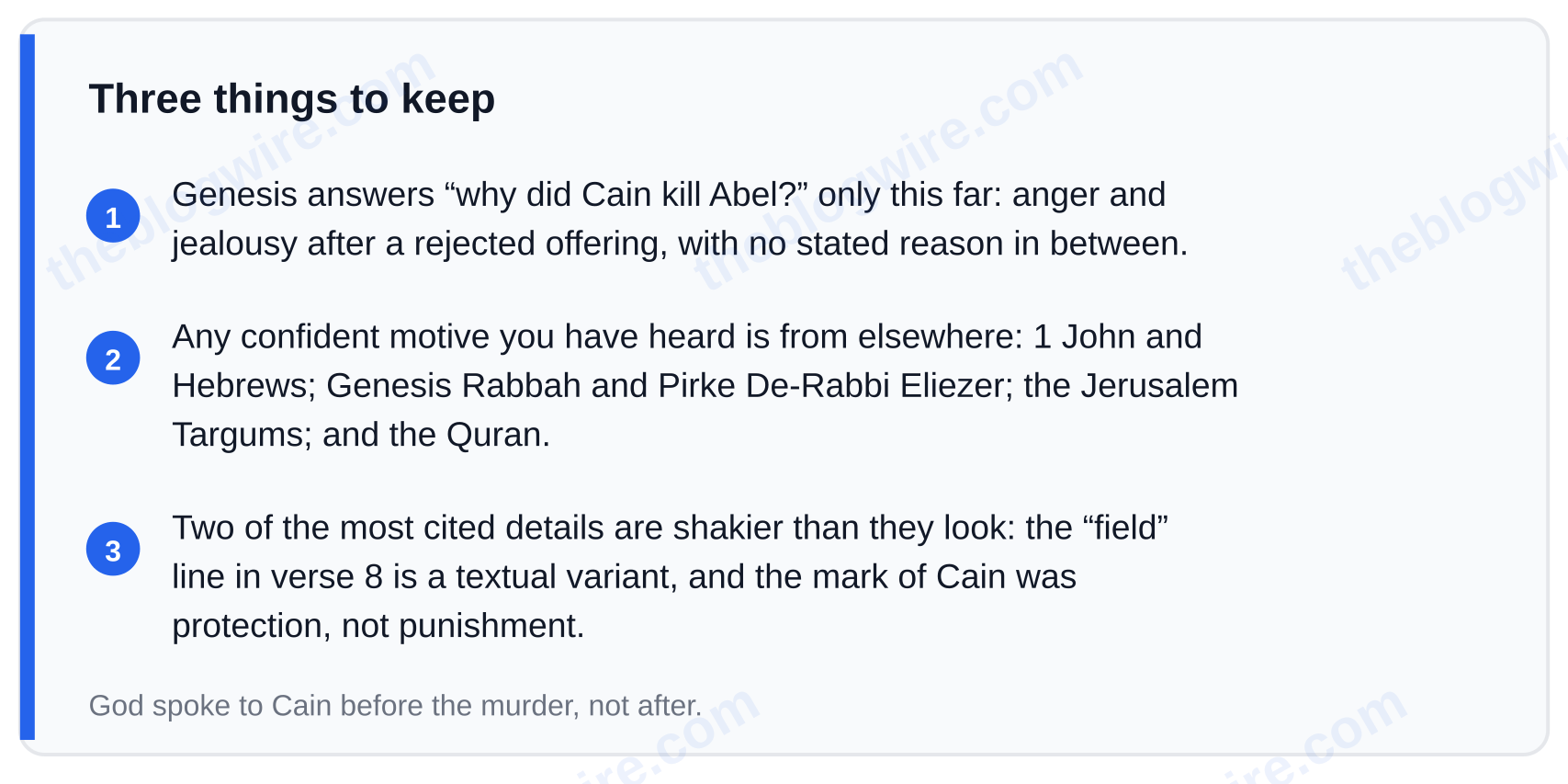
Three things to keep:
- Genesis answers “why did Cain kill Abel?” only this far: anger and jealousy after a rejected offering, with no stated reason in between.
- Any confident motive you have heard is from elsewhere: 1 John and Hebrews; Genesis Rabbah and Pirke De-Rabbi Eliezer; the Jerusalem Targums; and the Quran.
- Two of the most cited details are shakier than they look: the “field” line in verse 8 is a textual variant, and the mark of Cain was protection, not punishment.
What happens next? Read Genesis 4:1-16 straight through in one sitting, watching how little the narrator explains — then compare how your Bible renders verse 8 against another translation. Browse more explainers on The Blog Wire for related reads.
FAQ
Who was older, Cain or Abel?
Cain was older. Genesis 4:1-2 records his birth first, and then says that Eve “again” gave birth to his brother Abel, making Cain the firstborn. That birth order matters in the rabbinic retellings, where Cain claims a firstborn’s double portion in the dispute over who should marry Abel’s second twin sister.
Was Cain’s murder of Abel the first sin in the Bible?
No. The first instance of sin is found in Genesis 3, where Adam and Eve disobey God, before Cain is born. Cain’s act is the first murder, and the first sin recorded after humanity leaves Eden — which is why Genesis 4:7 echoes Genesis 3:16, reusing the same Hebrew words for “desire” and “rule over” to frame Cain’s anger as a struggle he could still win.
Why do some Bibles include “Let us go out to the field” in Genesis 4:8 and others don’t?
Because the manuscripts disagree. In the Hebrew Masoretic Text, it states that Cain spoke to Abel but does not provide his words. Other manuscripts — the Septuagint, Samaritan Pentateuch, Vulgate and Syriac — supply “Let us go out to the field,” and a Qumran Hebrew fragment supports that longer reading. Translators either follow the Hebrew as it stands or restore the clause from those witnesses. There is scholarly divide as to whether the Hebrew lost the line, or the Greek added it.