
A nephrologist is a physician (MD or DO) who specializes in diagnosing and medically treating kidney disease and failing kidney function — the specialist most people call a kidney doctor. Nephrologists manage chronic kidney disease, high blood pressure, electrolyte problems and dialysis, and co-manage transplant patients. They are internal medicine specialists, not surgeons.
A typical example: your annual blood panel comes back with an eGFR of 42 and some protein in your urine. You feel fine. Your primary care doctor sends you to nephrology anyway — because that pair of numbers, not a symptom, is what the specialty exists to act on.
What is a nephrologist, in plain terms?
A nephrologist is an internal medicine physician who sub-specializes in the kidneys. The job is to work out why kidney function is slipping and then treat it with medication, diet and — if it comes to it — dialysis. Not with an operation.
Nephrologist vs. “kidney doctor”: is there a difference?
No. “Kidney doctor” is the everyday name for the same physician. If a receptionist says “the kidney doctor” and the referral slip says “nephrology,” you are being sent to the same place. Nephrology is the field; a nephrologist is the doctor who practices it. Pediatric nephrology is a separate training track, covered further down.
What the kidneys do that makes a specialist necessary
Each kidney filters your blood through roughly a million nephrons. They pull out waste and extra fluid, hold sodium, potassium, calcium, and phosphorus in balance, help regulate blood pressure, and send the signals that drive red blood cell production and bone health. When that filtering slows, nothing hurts — which is the whole problem.
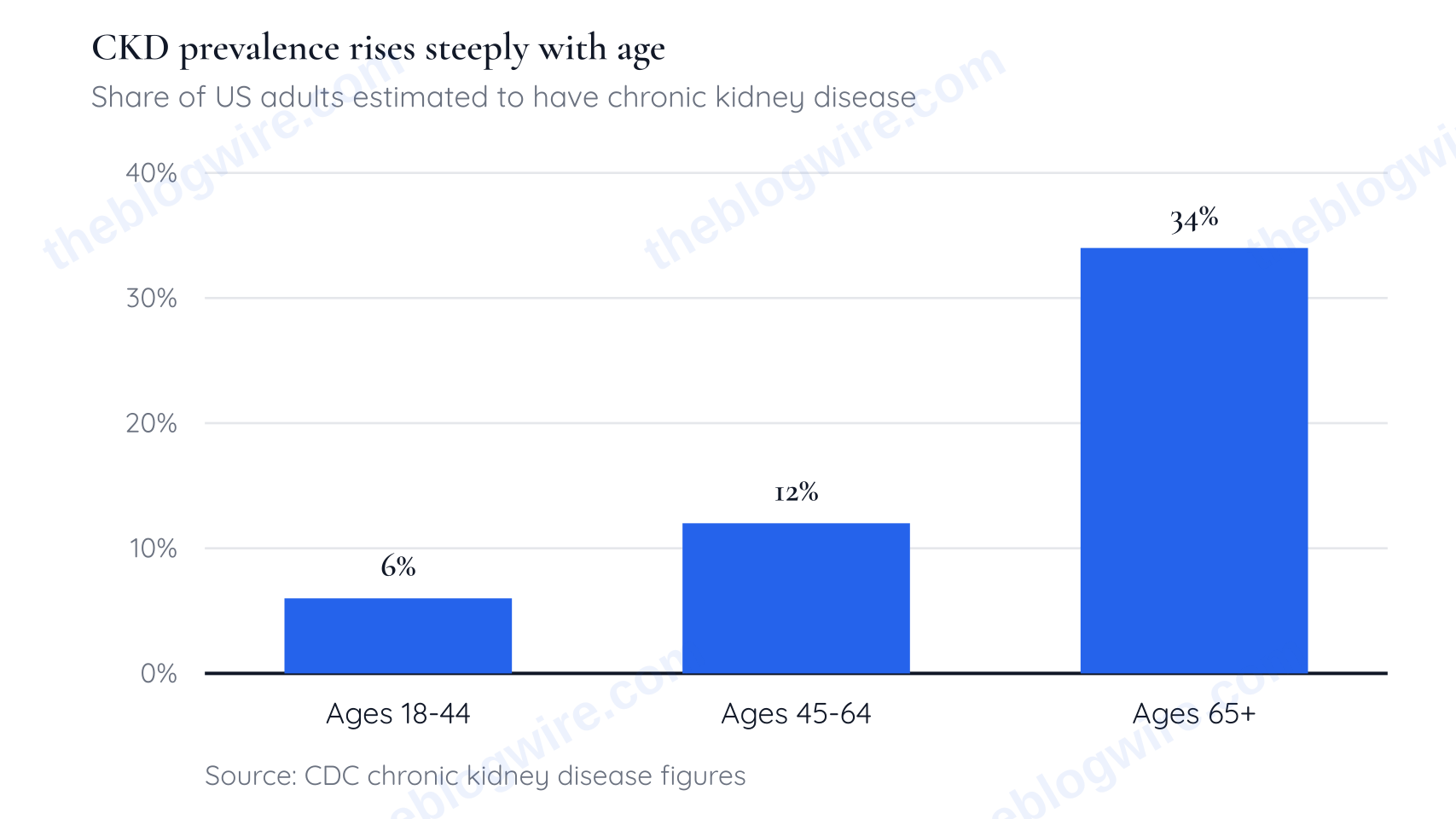
According to the CDC’s chronic kidney disease figures, more than 1 in 7 US adults — about 35.5 million people, roughly 14% — are estimated to have CKD, and as many as 9 in 10 do not know it. About 1 in 3 adults with severe CKD are unaware of it. CDC data also shows CKD climbing steeply with age: 34% of adults 65 and older, versus 12% of those 45-64 and 6% of those 18-44. That is why referrals cluster in older patients with diabetes or hypertension, and why most people meet a nephrologist because of a lab result rather than a symptom.
Where does the word “nephrologist” come from — and how new is the specialty?
The word is Greek: nephros (kidney) plus -logia (study of). Literally, one who studies the kidney. The phrase surfaces far earlier than you would guess — in Nephrologia Nova et Curiosa, a 1709 treatise by the Frankfurt physician Johann Helfrich Jüngken (1648-1726) — and then sat almost unused for about two centuries.
The specialty itself organized remarkably recently. The Renal Association formed in 1950, the International Society of Nephrology in 1960, the American Society of Nephrology in the 1960s, and the American Board of Internal Medicine did not administer its first nephrology board examination until 1972 — the same year Congress brought end-stage renal disease treatment under Medicare.
That timing is worth sitting with if you are holding a referral slip. In practice, the field grew up around dialysis coverage and around keeping people off dialysis for as long as possible — not around performing operations. It shapes every appointment you will have: the nephrologist’s tools are your medication list, your blood pressure, your diet and your lab trend, and the visit will feel much more like a long conversation than a procedure.
What does a nephrologist do day to day?
Most of the work is interpretation and adjustment. A nephrologist reads eGFR trends, serum creatinine, blood urea nitrogen, urinalysis, and the urine albumin-to-creatinine ratio together — as a direction of travel — rather than reacting to one number on one day. From there the work is slowing the decline: blood pressure control, diabetes co-management and kidney-protective medication.
One of the most underrated parts of the job is subtraction. Reduced kidney function changes how your body clears drugs, so doses get recalculated, and medications and supplements that harm the kidneys get flagged and stopped. Nephrologists also correct electrolyte and acid-base disorders and treat the anemia and bone disease that follow declining function.
Conditions nephrologists treat
- Chronic kidney disease and acute kidney injury
- Diabetic kidney disease and hypertension-related kidney damage
- Glomerulonephritis and nephrotic syndrome
- Polycystic kidney disease (PKD)
- Lupus nephritis
- Protein or blood in the urine
- Recurrent kidney stones with a metabolic cause
- Electrolyte disorders — abnormal sodium, potassium, or calcium
- End-stage kidney disease, including dialysis and transplant care
Tests and procedures they order or perform
Blood and urine chemistry, kidney imaging, and dialysis prescriptions. Nephrologists write and supervise in-center hemodialysis — typically about four hours, three times a week — as well as peritoneal dialysis, home dialysis and continuous renal replacement therapy for hospitalized patients, and they arrange dialysis access. On the transplant side they assess candidacy, run the workup, and keep following recipients after surgery alongside the transplant team.
Does a nephrologist perform surgery?
No. Nephrologists are not surgeons. They do not remove stones, operate on the prostate, or transplant the kidney themselves. That boundary is the cleanest way to tell nephrology apart from urology.
Nephrologist vs. urologist: which one do you need?
| Nephrologist | Urologist | |
|---|---|---|
| Focus of care | Kidney function — filtration, fluid and electrolyte balance, blood pressure | The urinary tract and male reproductive organs — structure and plumbing |
| Approach | Medical, non-surgical | Surgical and procedural |
| Typical conditions | CKD, acute kidney injury, glomerulonephritis, electrolyte disorders, dialysis, transplant medicine | Kidney stones, prostate disease, incontinence, bladder and kidney cancer, urinary obstruction |
| Training root | Internal medicine residency plus a nephrology fellowship | Surgical urology residency |
| Who sends you, and why | Primary care, after abnormal blood or urine results | Primary care or the ER, for pain, blockage, bleeding or prostate symptoms |
The overlap is real and worth knowing. With recurring kidney stones, a urologist removes the stone and a nephrologist investigates the metabolic reason you keep making them. With kidney cancer, the urologist operates and the nephrologist protects whatever function remains.
The short decision rule: abnormal blood or urine tests, swelling, foamy urine or a falling eGFR point to nephrology; pain, blockage, bleeding, stones or prostate symptoms point to urology. Needing both is common and does not mean anything has gone wrong.
When should you see a nephrologist — and what triggers a referral?
The usual triggers are a low or falling eGFR, protein in the urine, blood pressure that will not come under control, diabetes with kidney involvement, recurrent stones, unexplained swelling, foamy urine, blood in the urine, a family history of kidney disease, or an abnormal routine blood panel.
The lab numbers that prompt a referral
Most explainers stop at “low kidney function.” The actual thresholds are more specific. An eGFR below 30 mL/min/1.73 m² — stage 4 CKD — is a standard referral indication, and continuously rising urine albumin or a continuously falling eGFR warrants referral at any stage.
The bigger recent change is that referral is moving away from fixed stages toward calculated risk. The KDIGO 2024 CKD guideline added a validated kidney failure risk equation as a referral criterion in its own right: a 5-year kidney failure risk of 3%-5% can determine the need for nephrology referral alongside eGFR and urine ACR, with a 2-year risk of 10% or more prompting interprofessional care and 40% or more prompting dialysis-access and transplant planning. If your eGFR is not yet below 30, your risk score may still be the reason you are being sent.
For orientation on the GFR scale nephrologists use: 90 or above is normal, 60 or below indicates dysfunction, and under 15 is kidney failure requiring dialysis or a transplant. End-stage kidney failure means roughly 85-90% of normal function is gone. Government prevalence and progression data is also collected by NIDDK’s kidney disease statistics.
What a referral does not mean
It is not a dialysis sentence. Early nephrology care exists to preserve function, and most people with CKD never reach dialysis. But timing matters in a way soft advice tends to hide: in a study published in JAMA Internal Medicine, patients who did not see a nephrologist until 90 days or less before starting dialysis had a 37% higher likelihood of death in their first year on dialysis than patients referred earlier. Early kidney disease is silent, which is exactly why labs — not symptoms — are the right trigger.
What happens at your first nephrology appointment?
Expect about an hour, and expect most of it to be talking. The visit runs through the reason for referral, your health, and family history, a full medication and supplement review, your blood pressure, and a physical exam looking for swelling and fluid status.
Testing usually follows rather than happens on the spot: blood work for creatinine, eGFR, potassium, sodium, calcium, and phosphorus; urine tests for albumin and microscopic blood; and often a kidney ultrasound. A kidney biopsy is not a routine first-visit event — it is reserved for cases where the cause of the damage stays unclear after labs and imaging.
What to bring to the visit
- Your prior lab results, especially the last two or three eGFR and urine albumin values
- A complete medication and supplement list, including over-the-counter pain relievers
- Any home blood pressure readings you have been keeping
- Your family kidney history
What to do if there is no nephrologist near you
“Ask your primary care doctor for a referral” assumes a nephrologist is available to refer you to. Increasingly, one is not. Nephrology fellowship fill rates fell from 94.1% in 2010 to 65.8% in 2024, roughly 66% of positions were filled at the 2026 match, applicant numbers dropped by more than 37% over that period, and HRSA projects a 21% shortage of nephrologists by 2037 — with rural areas hit first. A 2025 CJASN analysis found the bottleneck is recruiting interested applicants rather than training capacity, though the 2025 match did bring in 362 candidates, up 13% year over year.
If your referral has a long queue, ask three specific things: whether the practice offers telenephrology, what the next available slot is at the nearest academic kidney center, and what your primary care doctor can manage in the meantime. Do not let the referral quietly lapse.
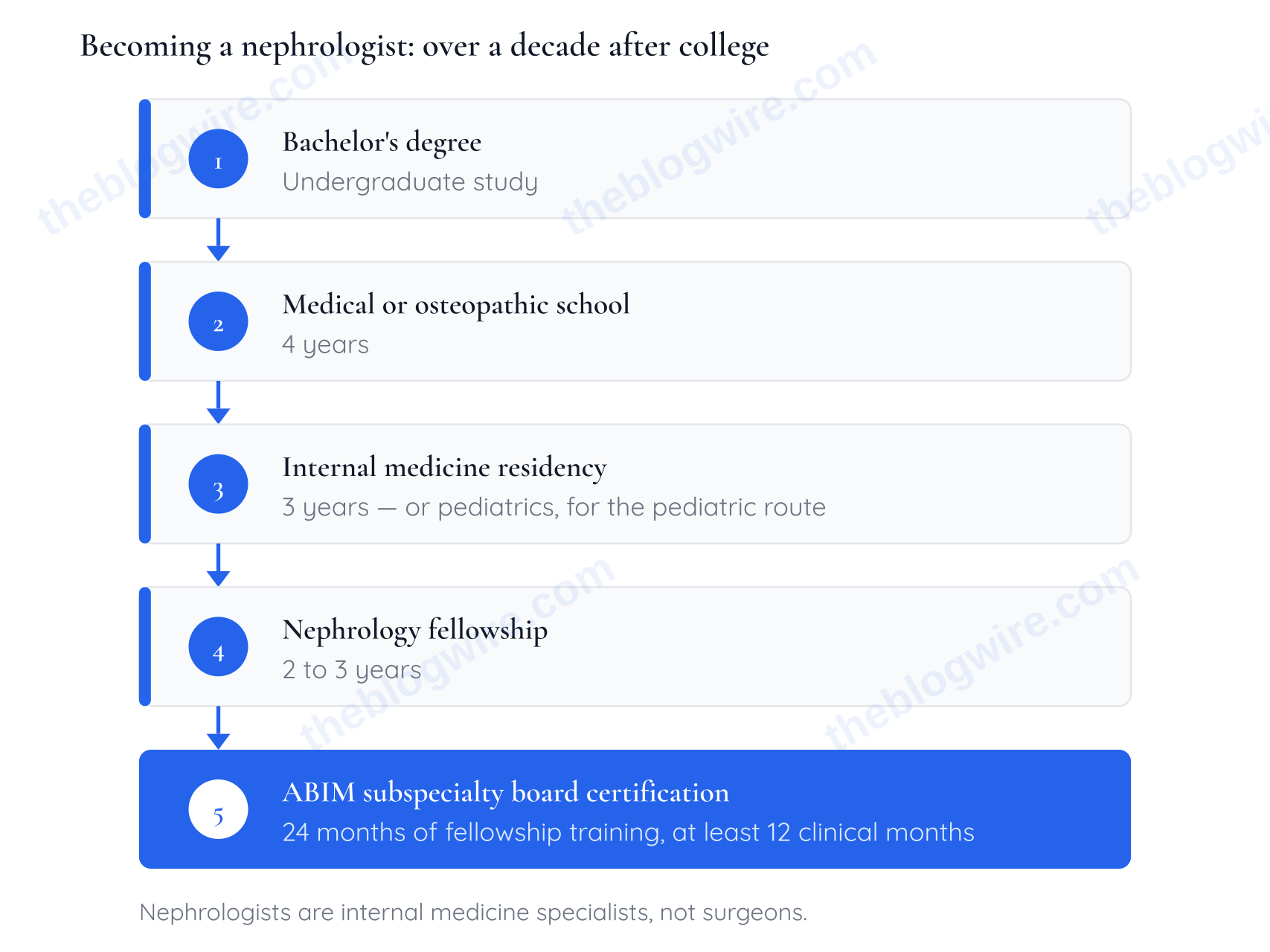
How long does it take to become a nephrologist?
- A bachelor’s degree
- Four years of medical or osteopathic school
- A three-year residency in internal medicine — or pediatrics, for the pediatric route
- A nephrology fellowship of two to three years
That is over a decade of training after college, capped by ABIM subspecialty board certification, which requires 24 months of fellowship training with a minimum of 12 clinical months.
One detail here is newer than almost anything else published on this topic, and it affects patients directly. Per ABIM’s nephrology subspecialty policies, acute and chronic hemodialysis, continuous renal replacement therapy and peritoneal dialysis — including at least eight PD clinic sessions — remain competency-required. But for fellows beginning in or after academic year 2024-25, percutaneous kidney biopsy (autologous and transplanted), placement of temporary vascular access for hemodialysis, and home hemodialysis moved to an “opportunity-to-train” standard.
Translated for a patient: a nephrologist certified under the new rules may have never been required to demonstrate biopsy competence. So if a biopsy is proposed, it is entirely reasonable to ask who will actually be performing it — often an interventional radiologist or an interventional nephrologist rather than your own doctor.
What is a pediatric nephrologist?
A separate subspecialty built on pediatrics rather than internal medicine, and a materially different disease mix. Congenital abnormalities of the kidney and urinary tract are the most common cause of CKD in young children, and genetic kidney disease is common in children while accounting for only a minority of adult cases. Pediatric nephrologists also manage childhood nephrotic syndrome, and they work with child-sized equipment.
The one line to remember
A nephrologist protects kidney function: finding out why it is declining, slowing the loss, and running dialysis or transplant care if it comes to that. The work is medical, not surgical — that is what separates nephrology from urology — and the specialty is younger than most patients assume, roughly as old as Medicare dialysis coverage.
If your primary care doctor has mentioned a referral, pull your last two or three eGFR and urine albumin results and book the appointment while those numbers are still in a range that can be defended. If the wait is long, ask about telenephrology or the nearest academic kidney center rather than letting the referral lapse.
Rule of thumb: kidney numbers go to the nephrologist, kidney plumbing goes to the urologist — and the best time to go is while you still feel fine. Browse more explainers on The Blog Wire for related reads.