
Most people assume slope and the angle of a slope are the same number. They are not. A 100% grade is 45 degrees, not vertical. The rise over run formula is the formula for slope: the vertical change between two points on a line divided by the horizontal change. Written algebraically, m = rise/run = (y₂ − y₁)/(x₂ − x₁) = Δy/Δx. Divide rise by run and the result is the slope.
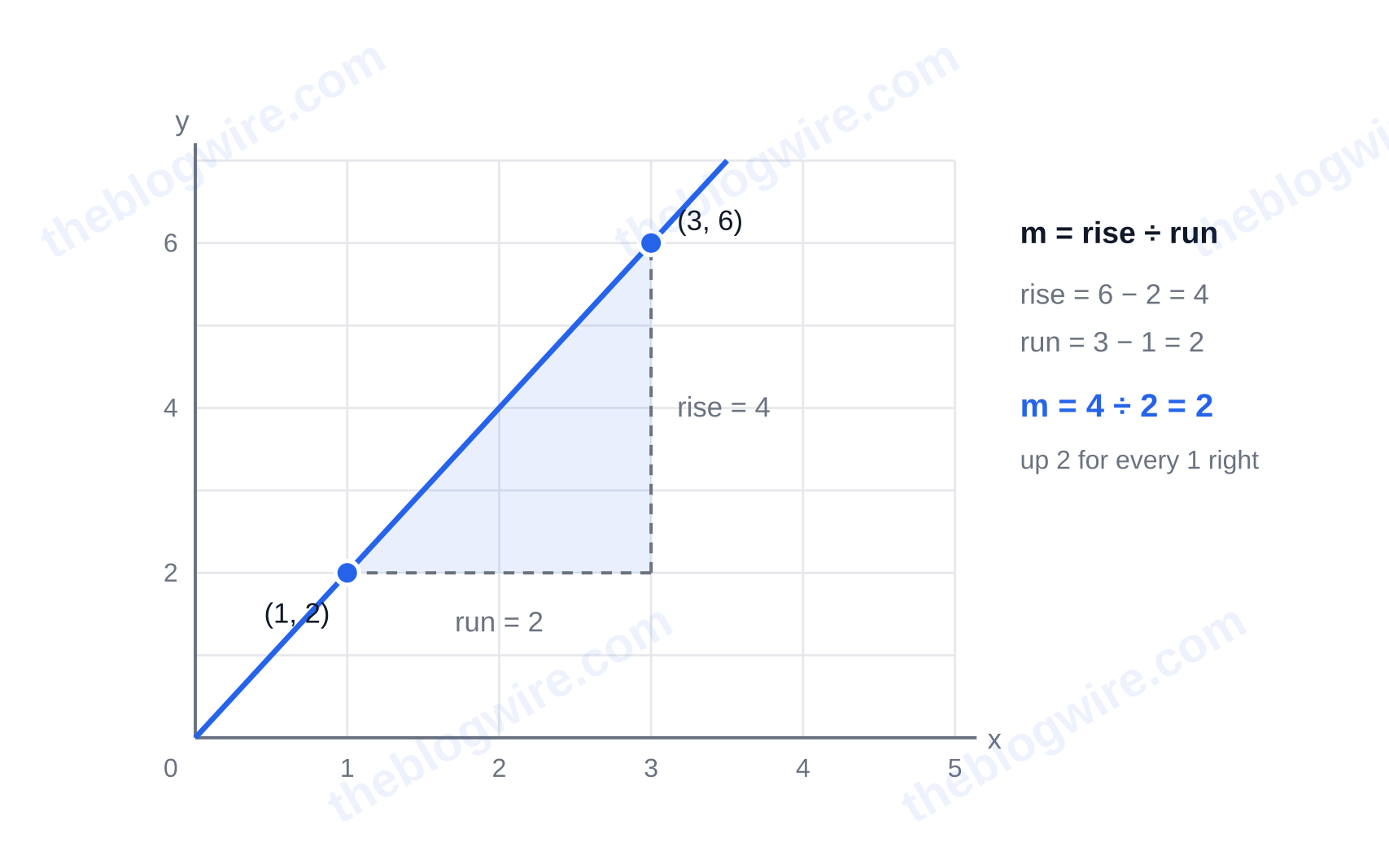
One quick example before anything else. Take the points (1, 2) and (3, 6). The rise is 6 − 2 = 4. The run is 3 − 1 = 2. The slope is 4 ÷ 2 = 2, so the line climbs two units for every one unit it travels right.
What Does the Rise Over Run Formula Actually Say?
You will see it written three ways: m = rise/run, m = (y₂ − y₁)/(x₂ − x₁), and m = Δy/Δx. These are not three methods. They are one instruction in three notations. The letter m is the slope, y₂ and y₁ are the vertical coordinates of your two points, x₂ and x₁ are the horizontal ones, and Δ (delta) just means “change in.”
What “rise” means
Rise is the vertical change — the difference in y-coordinates. On a graph it is the vertical leg of the triangle you can draw between your two points.
What “run” means
Run is the horizontal change — the difference in x-coordinates. It is the horizontal leg of that same triangle.
Why it is risen over run and not run over rise
Rise goes on top. Always. Slope measures how much a line climbs for each unit it travels sideways, so the climb is the numerator. Flip the fraction, and you get the reciprocal, which is a different number and a wrong answer. The phrase itself is the mnemonic: rise is the first word, so it goes first.
Slope is also called gradient, especially in British textbooks and in earth science. Same ratio, different word. And the reason this particular ratio earned a name is that it stays constant everywhere along a straight line — any two points on the line give the same answer. That constancy is what makes a line straight.
How Do You Find Rise Over Run From Two Points or From a Graph?
Finding slope from two coordinate pairs
Four steps. Label your points (x₁, y₁) and (x₂, y₂). Subtract the y-values to get rise. Subtract the x-values in the same order to get run. Divide and simplify. Cuemath states the convention plainly in its own rise over run formula explainer: rise is the y-difference, run is the x-difference.
- Positive slope: (1, 2) and (3, 6). Rise = 6 − 2 = 4. Run = 3 − 1 = 2. Slope = 4/2 = 2.
- Negative slope: (2, 5) and (6, 1). Rise = 1 − 5 = −4. Run = 6 − 2 = 4. Slope = −4/4 = −1. That minus sign is not an arithmetic slip — it is the line falling. Dropping it is the most common error on this kind of problem.
- Fractional slope: (−2, 3) and (4, 6). Rise = 6 − 3 = 3. Run = 4 − (−2) = 6. Slope = 3/6 = 1/2. Watch that subtraction of a negative; it is where the sign usually gets lost.
Finding slope from a graph by counting squares
Pick two points where the line crosses grid intersections cleanly. Count up or down to get the rise. Count left or right to get the run. Divide. Up and right is positive; down is negative. Draw the right triangle between your two points — the slope triangle — so rise and run are legs you can see instead of numbers you have to hold in your head.
Does it matter which point you use first?
No, provided your subtraction order stays consistent. From (1, 2) to (3, 6): +4/+2 = +2. Reverse it to (3, 6) and (1, 2): −4/−2 = +2. Same line, same slope. As OnePrep notes in its rundown of common slope mistakes, the sign only flips when you reverse the numerator and forget to reverse the denominator too.
The magnitude carries its own information. A slope of 5 is far steeper than a slope of 1/2. The sign gives you direction; the absolute value gives you steepness.
What Happens With Horizontal Lines, Vertical Lines and Negative Slopes?
Slope of a horizontal line (rise = 0)
Every point on a horizontal line shares the same y-value, so rise = 0 and slope = 0/run = 0. A flat line has zero slope. It does not have “no slope.”
Slope of a vertical line (run = 0, undefined)
Every point on a vertical line shares the same x-value, so run = 0 and the formula asks you to divide by zero. The slope is undefined. That is a genuine mathematical outcome, not a mistake in your arithmetic.
The hook that separates the two cases: zero rise gives you zero, zero run gives you don’t answer at all.
How rise over run fits into y = mx + b
A positive slope rises left to right; a negative slope falls. The sign appears on its own when the second y-value is smaller than the first. A slope of −3 means the line drops three units for every one unit you move right — outside algebra, that is a downhill grade or a falling trend.
In slope-intercept form, y = mx + b, the m is exactly this ratio and b is where the line crosses the y-axis. Rise over run is not the same thing as y = mx + b; it is the m inside it. Once you have the slope and any one point on the line, you can write the full linear equation. Two bits of vocabulary that come next in most courses: parallel lines share a slope, and perpendicular lines have slopes that are negative reciprocals.
How Do You Convert Rise Over Run Into Degrees and Percent Grade?
This is the step almost nobody completes. Pages teach the ratio, then list real-world uses, and never actually convert the number. In practice, the ratio is rarely the form you hand to anyone — the saw wants degrees and the code sheet wants a percentage.
Rise over run to degrees with arctan
θ = arctan(rise/run), which is the tan⁻¹ key on a calculator. Work a 4-in-12 roof pitch all the way through: arctan(4 ÷ 12) = arctan(0.333) = 18.43°.
Rise over run to percent grade
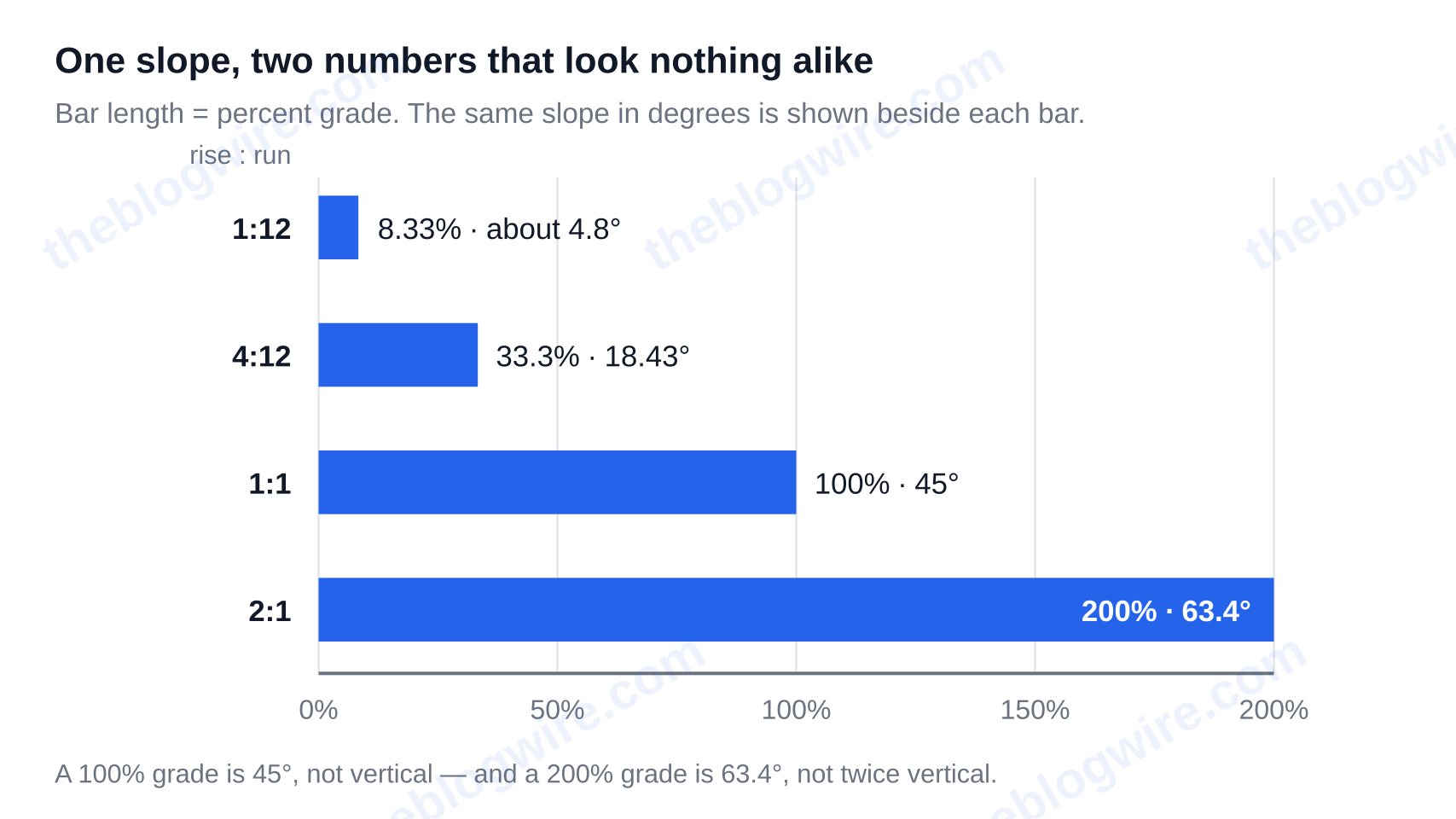
(rise ÷ run) × 100. Same pitch: (4 ÷ 12) × 100 = 33.3%. One slope, two numbers that look nothing alike. RedXapps confirms both figures for a 4/12 pitch — 18.43 degrees and a 33.3% grade.
Slope conversion table: fraction, decimal, degrees, percent
| Ratio | Fraction | Decimal | Degrees | Percent grade | Where you meet it |
|---|---|---|---|---|---|
| 1:12 | 1/12 | 0.083 | about 4.8° | 8.33% | Maximum ADA ramp running slope |
| 4:12 | 1/3 | 0.333 | 18.43° | 33.3% | 4/12 roof pitch |
| 1:1 | 1/1 | 1.0 | 45° | 100% | The point percent and degrees diverge hardest |
| 2:1 | 2/1 | 2.0 | 63.4° | 200% | Steep cut or fill slope |
Why 100% grade is 45°, not vertical
Percent grade is the tangent of the angle multiplied by 100, and tan(45°) = 1. So 45 degrees is a 100% grade, as Wikipedia’s entry on grade (slope) sets out alongside the percent, degree and 1-in-n notations. Degrees and percent sit on entirely different scales. A 200% grade is 63.4°, not twice vertical. Nothing expressed as a percent grade can ever reach straight up, because the tangent runs off to infinity.
Two unit traps that change the answer
First, the units must match before you divide. A percentage is unitless only because the units cancel, so convert first — multiply miles by 5,280 or kilometres by 1,000. SERC Carleton College’s geoscience guide to calculating slope and gradient is explicit about this. A raw slope may legitimately be reported as feet per mile or metres per kilometre, but a percent grade computed from mismatched units is simply wrong.
Second, run means horizontal distance, not the length along the sloping surface. Measure along the hypotenuse, and you are following the sine instead of the tangent — which would report that same 45° slope as a 71% grade rather than 100%. Measure the horizontal projection, or trigonometry will quietly hand you a wrong figure.
So: fraction for the drawing, degrees for the saw or the inclinometer, percent for the code sheet and the signage. Three forms of one ratio, and two measurements should be enough to produce all three.
Where Is Rise Over Run Used in Real Life?
Roof pitch (x-in-12)
Roof pitch is written as x-in-12: the rise in inches per 12 inches of horizontal run. A 4/12 pitch is a slope of 1/3, an angle of 18.43°, and a grade of 33.3%. One roof, four notations.
Ramps and the ADA 1:12 limit
The 2010 ADA Standards cap a ramp’s running slope at 1:12 — about 4.8 degrees, or an 8.33% grade. Cross slope may be no steeper than 1:48, clear width must be at least 36 inches, and a single run may not rise more than 30 inches. Do that last bit of arithmetic: 30 inches of rise at 1:12 needs 30 × 12 = 360 inches, which is 30 straight feet of ramp before a landing. As the ADA ramp slope standards make clear, that 30-foot figure is usually what decides whether a compliant ramp fits the site at all.
Stair rise and run under the IRC
The riser is the rise; the tread is the run. IRC Section R311.7 allows a maximum riser of 7-3/4 inches and requires a tread at least 10 inches deep measured nosing to nosing, with no more than 3/8 inch difference between the tallest and shortest riser in a flight. That variation limit is the one that most often fails inspection. Reported riser and tread limits do differ between code editions, and local amendments apply — confirm the edition your jurisdiction has adopted with the building department rather than trusting any single published number.
Road grade, drainage, and land slope
Highway grade is posted as a percentage. Site drainage is specified as a minimum percent fall away from the structure. On a topographic map, slope is elevation change divided by horizontal map distance, with the contour interval supplying the rise — which is exactly where feet-per-mile and the unit conversion above come into play. The common thread across every one of these trades: the ratio is identical to the algebra. Only the notation and the governing threshold change.
What Mistakes Do People Make With the Rise Over Run Formula?
- Inverting the ratio. Run over rise is the most frequent error, and it gives you the reciprocal — not something close to right.
- Mixing subtraction order. Subtracting y₁ from y₂ but then x₂ from x₁ flips the sign and reports a climbing line as a falling one. Pick a first point and stay with it through both subtractions.
- Dropping the negative sign. A downhill answer becomes uphill. Pure transcription error, not a conceptual one.
- Confusing zero with undefined. Flat lines have a slope of zero. Vertical lines have none.
- Reading the graph in mismatched scales. When the axes are not scaled alike, count units, not squares.
- Mismatched units, or run measured along the surface. Both traps from the conversion section — restated here as checks to run, not concepts to learn.
One sanity check catches most of these: does the sign of your answer match the direction the line visibly travels, and is the steepness plausible for what you are looking at? It is the same habit that makes a well-labelled diagram useful elsewhere — a stomach pain map works because the picture and the label agree, and your slope should pass the same test.
Rise over run is one ratio with four faces: a fraction for the algebra, a decimal for the calculator, an angle in degrees for the tool, and a percent grade for the code sheet. The formula never changes — m = (y₂ − y₁)/(x₂ − x₁) — only the notation you report it in. Next step: take the two numbers in front of you, divide rise by run, then push that same figure through arctan and through × 100, so you have all three versions on paper before you cut, spec, or hand it to anyone else.