We all face two options right now: wait a few days and hope it goes away, or find a dentist for a tooth that only hurts when we bite down. This post covers every cause of this type of tooth pain, the test that zeroes in on the problem in less than 10 seconds, why a clean X-ray proves nothing, and what each fix involves. So, why does my tooth hurt when I bite down? Because chewing pressure is reaching either an irritated nerve inside the tooth or an inflamed ligament around its root. A cavity is the usual assumption, but the two most frequent real causes are a fine crack that flexes under load and a bruised periodontal ligament — often from a filling or crown sitting slightly too high.
Why does my tooth hurt when I bite down but feel fine the rest of the time?
Because it is only tested under biting force. Molars deliver enormous force every time you close, and if a tooth is complaining only when force is applied, then there is a mechanical issue and not a decay issue. At other times the tooth is quiet because there is no load and there is nothing to be flexed.
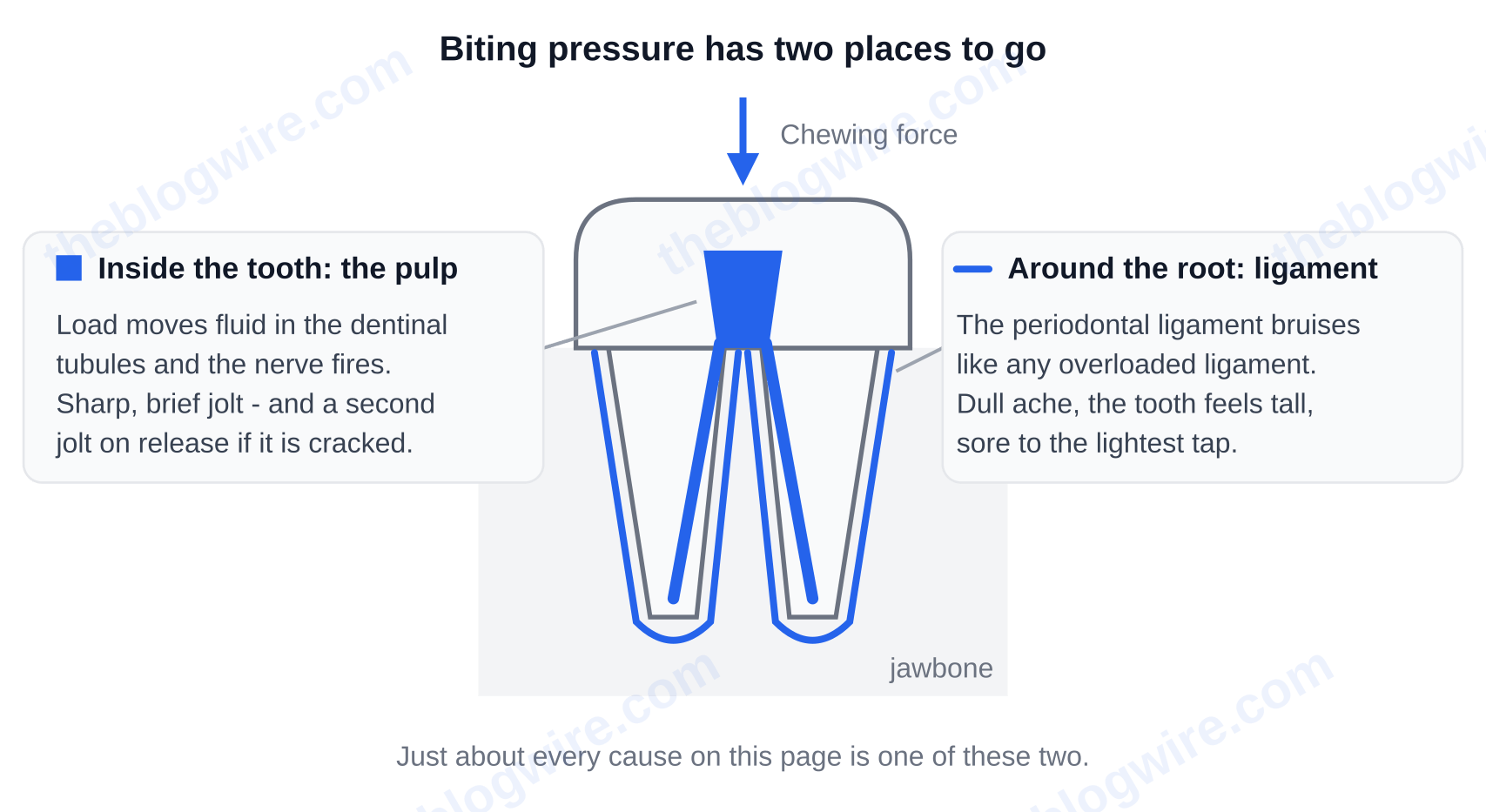
Pressure has two places to go, and that is the whole diagnosis in one sentence.
The cavity assumption — and why it is right less often than people expect
When people think about tooth pain, they assume it’s from a cavity. Decay definitely causes pain while biting once it gets deep, but it tends to act in other ways. A cavity will usually react to sweet, cold or hot on one specific spot. It’ll also ache when you’re not even chewing. And once it is close to the nerve, it stops waiting for you to eat before it hurts.
Pain that comes and goes when you bite down and then goes away the moment you stop is a different kind of pain. So is pain that throbs, wakes you up, or is there as soon as you open your eyes in the morning — that belongs to the infection group of causes further down this page.
Inside the tooth vs around the root: the two things pressure actually irritates
Pressure can irritate the dental pulp — the nerve and blood supply in the middle of the tooth — through the dentinal tubules, microscopic fluid-filled channels running through the dentine. That fluid can be moved suddenly and the nerve can be stimulated to fire.
Pressure can also irritate the periodontal ligament, the thin shock-absorbing tissue that suspends the root in bone, the same way that other ligaments can be bruised or irritated.
It can happen around the root or in the tooth. Just about everything on this page is either one of the two. You can usually figure it out before anyone looks in your mouth.
The ten-second self-test almost no one tells you about: does it hurt on release?
Bite something firm, hold, and then let go — and pay attention to the letting go.
A sharp, fleeting jolt as you release the bite? That is a good indication of a cracked tooth. NCBI StatPearls describes the classic presentation of cracked tooth syndrome as sudden sharp pain on biting plus a fleeting sharp pain on release, with little or no pain at rest. In practice, that release jolt is the most important thing you can check yourself, and almost every page on this topic omits that key detail.
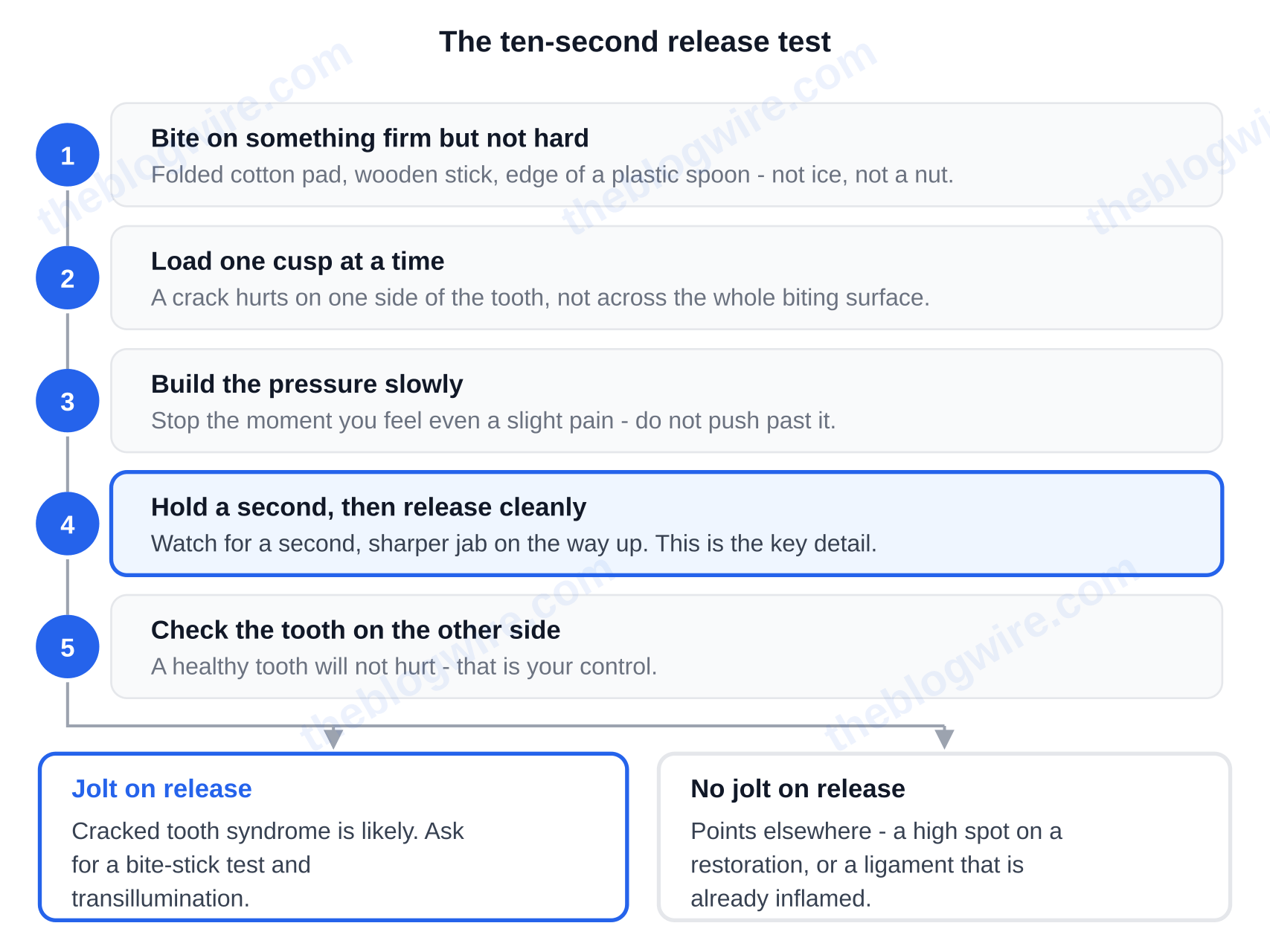
How to run the release test on yourself
- Find something firm but not hard to bite down on — a folded cotton pad, a wooden stick, the soft edge of a plastic spoon. Not ice, and not a nut!
- Start with just one cusp at a time, not across the whole tooth. A crack will hurt on just one side of the tooth.
- Build the pressure slowly and stop when you feel even a slight pain.
- Hold for a second, then release cleanly and check if a second, sharper jab arrives on the way up.
- Check the tooth on the other side as a control. Healthy teeth will not hurt.
The mechanism is specific. The two fractured segments move independently of one another, and the bite-then-release cycle shifts fluid inside the dentinal tubules onto the nerve, which is the basis for the fluid movement theory. That is why the pain is sharp and brief, and is tied to movement, not to temperature.
Pain on biting with no release jolt points somewhere else: a high spot on a restoration, or a ligament which is already inflamed.
Decision table: match your pain pattern to its likely cause
| What you notice | Most likely cause | What it means for the fix |
|---|---|---|
| Sharp on bite and again on release, no pain at rest, X-ray reported as clean | Cracked tooth syndrome | Bite testing and transillumination, then usually a crown |
| Started within days of a new filling or crown, and the tooth feels tall when you close | High bite (occlusal high spot) | Occlusal adjustment — often a two-minute polish |
| Dull ache, tooth feels taller than its neighbours, sore to the lightest tap, throbbing at rest | Ligament inflammation or an abscess | Urgent assessment; root canal or drainage if infected |
| Several upper back teeth at once, worse bending forward or lying down, with congestion | Sinus-referred pain, not dental | Treat the congestion first, then reassess |
| Also reacts to sweet or cold on one specific spot | Decay, or a failing old filling | Filling or replacement restoration |
No page currently ranking for this question assembles these five pain patterns in one location. The components of these patterns are described, but they are described in different locations, and that means that for the consumer of this information, a list of potential causes is all they get to work with.
What to note down before you call the dentist
Write down five things on your phone. Which tooth? Which cusp or corner? Bite, release, or both? Hot, cold, sweet, or none of them? And does tapping the tooth with a fingernail hurt? Hand this to the dentist when you get there. Writing down these things usually helps the dentist to narrow down the likely causes for your symptoms, because the pattern is the diagnosis.
Is it a cracked tooth — and why can a crack hurt this much yet look like nothing?
When a tooth “cracks” in this sense, it’s not a break that you can see. It’s a fracture too fine to see that, with the force of biting, flexes open and then closes (or “snaps” shut) on release. Once again, nothing is actually missing. Nothing is visibly wrong. The tooth simply acts like it’s made of two separate pieces pretending to be one.
What a crack actually does under chewing load
When you close, the segments push apart by a fraction of a millimetre, the fluid in the tubules moves, and the nerve reports it. When the force is released, the segments spring back to their original position, and this is the second jolt. This happens a few thousand times a day. So it’s no wonder the tooth becomes irritated and the pulp becomes progressively more irritated.
Which teeth crack most often, and why molars lead the list
According to StatPearls, cracked tooth syndrome predominantly affects adults between the ages of 30 to 50, affects men and women equally, and most commonly includes the mandibular molars, followed by the maxillary premolars and molars. Lower molars are more commonly affected because the opposing upper cusp acts as a wedge and drives the force into the middle of the tooth rather than spreading the force along the surface.
Common and unglamorous precursors are: a large, old filling that leaves thin cusp walls, clenching and bruxism, biting something unexpectedly hard, or simply years of ordinary load on a heavily restored tooth.
Where bruxism and a heavy bite come in
Biting forces are not evenly distributed across the chewing surface of teeth, especially in the presence of bruxism or a heavy bite. With bruxism, the grinding force concentrates on one cusp and that cusp takes a load that is not evenly distributed across the arch. One point takes the load every time, and that point becomes sore and inflamed.
The results of a neglected crack are documented and do not occur subtly: the crack propagates, the pulp dies, an abscess forms, and the tooth can eventually be lost. Acting while the crack is still shallow is the difference between a crown and an extraction.
Why does my tooth hurt when I bite down after a new filling or crown?
Dentists try their best to achieve an even bite and ensure that the restoration is even with the surrounding teeth, but sometimes a restoration can be sitting fractions of a millimetre too tall. A restoration that contacts first takes a greater load than a normal contact — every meal, every swallow, every unconscious clench. This focuses the load on one single point and bruises the periodontal ligament underneath. The tooth then aches on biting and usually feels taller than its neighbours.
How a high spot bruises the ligament
Normal chewing spreads load across many contacts. A high spot collapses that sharing. The tooth becomes a single overworked point of contact, and the ligament responds the way any overloaded ligament does — with inflammation and tenderness that chewing keeps renewing.
Does a high filling wear down on its own? No — and here is why
Typically, when patients report high fillings, the standard reassurance is that sensitivity after dental work is normal and it will go away with time. This is true for most cases of genuine post-treatment sensitivity. However, for high fillings, the material is set, and it will not lower itself. It will not adjust to the anatomy. It does not settle. Therefore, waiting simply means more days of chewing on an inflamed ligament, and chewing with a high filling will only make the condition worse.
When to stop waiting and call: the day-count rule
- It has been 2 to 3 days since the numbness wore off, and the bite still feels off? Book an adjustment.
- If it has been one to two weeks, and the tooth is still feeling tall? Stop waiting entirely.
- Normal healing looks different: mild sensitivity to cold or pressure that fades week over week, not a tooth that hits first every time you close.
The fix is usually anticlimactic. The dentist puts articulating paper between your teeth, asks you to tap and grind, reads the marks, and polishes the high spot down. Minutes, and most of the time this is painless, frequently with no anaesthetic.
What else makes a tooth hurt on biting — the full because list
There are several reasons a tooth may hurt on biting other than high bites and cracks. Healthline’s rundown of why a tooth hurts when you bite down or touch it outlines several of these reasons, including cavity, malocclusion, injury, periodontitis, gum recession with exposed root, sinus congestion, a loose filling or crown, pulp necrosis and abscess.
Decay and failing restorations
Deep decay softens dentine, so biting drives pressure and debris toward the pulp. It will also cause a tooth to be hypersensitive to both cold and to sweetness on one spot. A loose or failing old filling or crown behaves similarly but adds micro-movement under load, often with fresh decay developing underneath where you cannot see it.
Gum disease, bone loss and a loose tooth
Periodontitis damages the tissues holding the tooth in place. As bone is lost the tooth becomes slightly mobile, and the soreness and pain from this will be felt in the ligament and the surrounding gum rather than inside the tooth. It feels like a deep bruise rather than a sharp jab, and the gum is usually tender too.
Recession, exposed root and the simple mechanical causes
Exposed roots are not protected by enamel and are also not designed to be exposed. So pressure and temperature will be able to easily pass through. Recent trauma can inflame the ligament with no fracture to find. Pulp necrosis leaves a dead nerve that still gives pressure sensitivity, sometimes with the tooth darkening. And food impacted in the tight space between two teeth is the most overlooked cause of all, where the pressure pain is coming from wedged food, not from either tooth. Flossing first can easily solve that before you assume the worst — the same “check the simple mechanical explanation before the alarming one” logic that applies to mapping any pain you are trying to locate by its pattern.
Could it be an abscess — and when does this become an emergency?
Does a crack read like this? The throbbing continues at rest. The gum swells. The tooth, which feels like it’s being pushed upward in its socket by infection at the root tip, becomes taller than its neighbours and is tender to the lightest tap. Heat, cold and pressure all provoke it.
Red flags that mean same-day or emergency-room care
According to the Cleveland Clinic, guidance on an abscessed tooth is to contact a dentist within 24 hours of noticing symptoms. The documented emergency threshold is higher and clearer, and these symptoms require immediate attention: a fever of 38°C / 100.4°F or higher, swelling of the face, obstructed swallowing or breathing. Those mean the emergency room, not a waiting list, because infection can spread from the tooth into the jawbone and the soft tissues of the face and neck.
Why the pain does not stop when the pulp dies
People assume a dead nerve means the end of the pain. It often does not. The infection extends beyond the tip of the root into the surrounding jaw bone, and that periapical inflammation is what makes the tooth feel extruded and exquisitely tender to tapping. Pain killers and antibiotics can be used to buy time, but neither removes the source — the pulp nor the periapical infection still has to be treated.
Is it even my tooth? Sinus pain and the upper-molar mimic
The roots of your upper molars sit immediately beneath the maxillary sinuses, and the trigeminal nerve supplies both. Because of this, your brain can genuinely misread sinus pressure as toothache.
Sinus pain vs tooth pain: the bending-forward test
Pain that involves several upper back teeth at once, that is pressure-like and dull and gets worse when you bend forward or lie down, is sinus-referred pain. Pain that is sharp, pinned to one tooth, and triggered specifically by biting or by temperature is dental pain. Other clues that point to a sinus origin of pain are a recent cold or allergy flare, congestion, and post-nasal drip. Congestion is also an important clue; pain that rises and falls with the congestion is sinus pain.
If the pattern says sinus, treat the congestion first and reassess the tooth once it clears.
Jaw muscles and the TMJ as a second mimic
Clenching produces jaw-joint and muscle pain that gets worse with chewing but is diffuse. The test is localisation: if you cannot pin it to one cusp, and the ache covers the whole side of your face and gets worse throughout the day, suspect muscle rather than tooth.
Why can a tooth hurt when biting down even if the X-ray looks normal?
This is because of orientation. A radiograph’s ability to show a crack diminishes when the crack runs mesio-distally, parallel to the film — and that is precisely the orientation most bite-pain cracks take. This is the reason the condition is called cracked tooth syndrome rather than simply a cracked tooth: it is diagnosed by its symptom pattern, because the fracture is frequently invisible on imaging.
Why fine cracks hide on film
An X-ray needs a gap wide enough and angled enough to interrupt the beam. A hairline fracture lying flat to the film does neither, hence it will show up as a normal X-ray. An X-ray can however rule out some things. It does not rule out the presence of a crack, and it does not mean that everything is OK with the tooth.
The bite stick, transillumination and CBCT
Three tests find what the film misses. A tooth is loaded one cusp at a time with a bite stick, or a Tooth Slooth, to determine which cusp is reproducing the pain. Fiber-optic transillumination shines light through the tooth, where it deflects at the fracture and leaves a visible light-to-dark transition line. The pulp is tested for vitality to establish whether it is still alive. A CBCT is the next step when conventional radiographs stay inconclusive — current reference guidance still treats the depth and extent of a fracture as genuinely hard to determine, with CBCT reserved for exactly those cases.
What to say if you were told the X-ray looked fine
Saying ‘I am sorry’ won’t really do any good. Be specific rather than apologetic. The main points you need to get across here are: it hurts on release as well as on bite, it is this cusp, and I’d like a bite stick test and transillumination. Also, there are a number of things a dentist can’t catch on an X-ray early on. These include a high bite, early ligament inflammation and irritation beneath an old filling. They are found by examination, not by imaging.
What will the dentist actually do, and what will the fix cost me in time?
The exam order is fairly standard: history and pain pattern first, then percussion and bite testing, articulating paper, transillumination, vitality testing, periodontal probing, and imaging last. The order is important — the pattern will narrow it before anyone reaches for a film.
Treatment by cause, from a two-minute polish to a crown
| Cause | Treatment | Time and documented outcome |
|---|---|---|
| High restoration | Occlusal adjustment with articulating paper | Minutes; usually no anaesthetic |
| Decay or failing filling | Filling or replacement restoration | One appointment |
| Cracked cusp, holding measure | Bonded composite or an orthodontic band to splint the tooth | StatPearls reports 92.6% pulp survival at two months with band placement |
| Cracked tooth, definitive | Full-coverage crown | StatPearls reports 25 of 28 tested teeth became asymptomatic after crowning |
| Pulp involvement | Root canal therapy, usually followed by a crown | Endodontically treated cracked teeth carry poorer long-term survival |
| Gum and bone disease | Periodontal treatment | Staged over several visits |
| Crack below bone level or into the root | Extraction and replacement | The outcome early treatment is meant to avoid |
What to do at home until your appointment
Avoid chewing on that side. Try to stick with soft foods. Avoid hot or cold. Keep the area clean, and floss the gap in case food impaction is the whole story. Take over-the-counter pain relief as labelled.
Two things not to do: don’t test the sore tooth to see whether it still hurts — each time a tooth is tested, the nerve becomes more irritated — and don’t wait it out hoping it settles. The pain from a high bite, a crack in a tooth, or developing decay will not resolve on its own, and continued chewing makes it worse.
The three things to take away
Pain only when you bite down is a mechanical signal, not a mystery. Here are three things to note, and nothing new:
- Run the release test and note four answers. Does it hurt on release as well as bite? Does the tooth feel tall? Is it one tooth, or several? Has anything been done recently to that tooth? Those four answers point at a crack, a high bite, decay or a sinus.
- None of the dental causes fix themselves. A high filling does not wear down, and a crack does not close. Similarly, decay does not reverse — and chewing on any of them makes the eventual fix bigger.
- Book the appointment, and bring the pattern in writing. Include the bite versus release test, which tooth is in question, and which cusp. If you have facial swelling, a fever of 38°C / 100.4°F or higher, or any trouble swallowing or breathing, go to the emergency room tonight instead.